TL;DR:
- Robusta coffee, originating from Coffea canephora, is often misunderstood as cheap or inferior but has unique flavor and growth advantages. It features higher caffeine, a bold earthy profile, and is essential in espresso blends and instant coffee. Improving processing methods has revealed its potential for complex, high-quality brews, challenging its reputation in specialty coffee.
Robusta coffee gets a bad reputation it mostly doesn’t deserve. Ask most coffee drinkers what is robusta coffee, and you’ll get answers like “the cheap stuff” or “what they put in instant.” But that framing misses the full picture. Robusta is a distinct species with its own flavor profile, growing conditions, and real advantages that Arabica simply can’t match. Understanding it won’t just make you a sharper coffee drinker. It’ll open up a whole category of bold, high-caffeine brews you might have been skipping.
Table of Contents
- Key takeaways
- What is robusta coffee, exactly?
- Where and how robusta is grown
- Robusta coffee flavor: what to expect
- Robusta vs. Arabica: the chemistry
- How robusta is used and brewed
- My take on robusta’s growing reputation
- Explore robusta coffee at Zscoffee
- FAQ
Key takeaways
| Point | Details |
|---|---|
| Robusta is a separate species | It comes from Coffea canephora, not the same plant as Arabica, with different chemistry and characteristics. |
| Higher caffeine, less fat and sugar | Robusta contains nearly double the caffeine of Arabica, making it a stronger, more energizing brew. |
| Bold and earthy flavor | Expect dark chocolate, nutty, and woody notes rather than the bright acidity found in Arabica. |
| Used in espresso blends and instant coffee | Robusta adds body, crema, and caffeine punch to espresso blends and is the backbone of most instant coffee. |
| Processing quality changes everything | Poor post-harvest handling causes bitterness. Good processing produces smooth, complex robusta worth drinking straight. |
What is robusta coffee, exactly?
Robusta coffee comes from Coffea canephora, one of the two commercially dominant coffee species in the world. The other, Coffea arabica, gets the most attention in specialty circles. But robusta accounts for roughly 40% of global coffee production and is foundational to how billions of people drink coffee every day.
The plant itself is built differently than Arabica. It grows as a larger shrub or tree and produces oval, moderately sized cherries. The beans inside are smaller and rounder than Arabica beans, with a straighter center crease and noticeably higher natural oils. Those oils matter. They’re part of why robusta produces such a thick, persistent crema in espresso.
The species originates from sub-Saharan Africa, particularly present-day Uganda and the Democratic Republic of Congo, where it grew wild before commercial cultivation began in the late 19th century. It spread quickly to Southeast Asia and Brazil, regions that now dominate global production. Understanding these origins and processing differences is key to appreciating why robusta tastes and behaves the way it does.
Key botanical traits that set robusta apart:
- Self-sterile flowers requiring cross-pollination (unlike Arabica)
- Diploid chromosome structure (22 chromosomes vs. Arabica’s 44)
- Higher chlorogenic acid content, contributing to its characteristic bitterness
- Greater resilience to pests and harsh growing conditions compared to Arabica
Where and how robusta is grown
Robusta thrives where Arabica struggles. It grows best at lower altitudes, between sea level and about 800 meters, in hot and humid climates. This gives it a massive geographic advantage. Countries that can’t grow Arabica at commercial scale can still produce excellent robusta.
Vietnam and Brazil currently lead global production by a wide margin, with other significant producers including Indonesia, Uganda, Ivory Coast, and India.
| Country | Est. 2025/26 Production (60kg bags) | Primary Use |
|---|---|---|
| Vietnam | 30.8 million | Instant coffee, espresso blends |
| Brazil | 24.7 million | Blends, domestic consumption |
| Indonesia | ~10 million | Specialty robusta, blends |
| Uganda | ~5 million | Export blends |
| Ivory Coast | ~3 million | Industrial blends |
One thing that makes robusta farming increasingly significant is its environmental profile. Drip irrigation in robusta farming can reduce carbon footprint by nearly 60%, cut water use by 56%, and boost yields by over 50%. That’s a meaningful shift for a crop grown at massive scale across tropical regions.
Robusta production is growing globally because of its drought and heat resistance, which makes it better suited to the increasingly unpredictable climate conditions farmers face. When Arabica crops fail due to heat stress or leaf rust, robusta farms often keep producing.
Pro Tip: If you care about sustainable sourcing, look for robusta from farms using drip irrigation or shade-grown practices. These beans tend to have better flavor development alongside a smaller environmental footprint.
Robusta coffee flavor: what to expect
Let’s clear this up directly. Robusta does not taste bad by default. It tastes different. The flavor profile runs bold and earthy, with notes that lean toward the savory and bitter end of the spectrum rather than the fruity or floral notes Arabica fans love.
Common flavor descriptors for robusta include:
- Dark chocolate and cocoa
- Roasted nuts and hazelnut
- Woody and earthy undertones
- Tobacco and leather at darker roasts
- A thick, full body with low acidity
Compared to Arabica’s bright acidity and complex fruit notes, robusta is blunter and more intense. That intensity works in your favor in certain contexts. The bold flavor and dark chocolate notes in robusta pair beautifully with sweetened condensed milk, which is exactly why Vietnamese iced coffee has used it for generations.
Here’s the part most coffee guides skip. The bitterness and “rubbery” flavor that gives robusta a bad name is largely a processing problem, not an inherent bean trait. When robusta is carefully washed, fermented, or wet-hulled, the result is far smoother and more nuanced. Recent work in varietal blending and processing has produced robusta with genuinely complex flavor profiles that specialty roasters are now showcasing.

Pro Tip: When buying robusta, look for details about the processing method on the bag. Washed or honey-processed robusta tends to be noticeably cleaner and more nuanced than naturally dried lots.
Robusta vs. Arabica: the chemistry
The differences between these two species go well beyond taste. Their chemical makeup is distinct, and that chemistry directly drives the sensory experience in your cup. This is where the robusta vs arabica coffee comparison gets genuinely interesting.
| Characteristic | Robusta | Arabica |
|---|---|---|
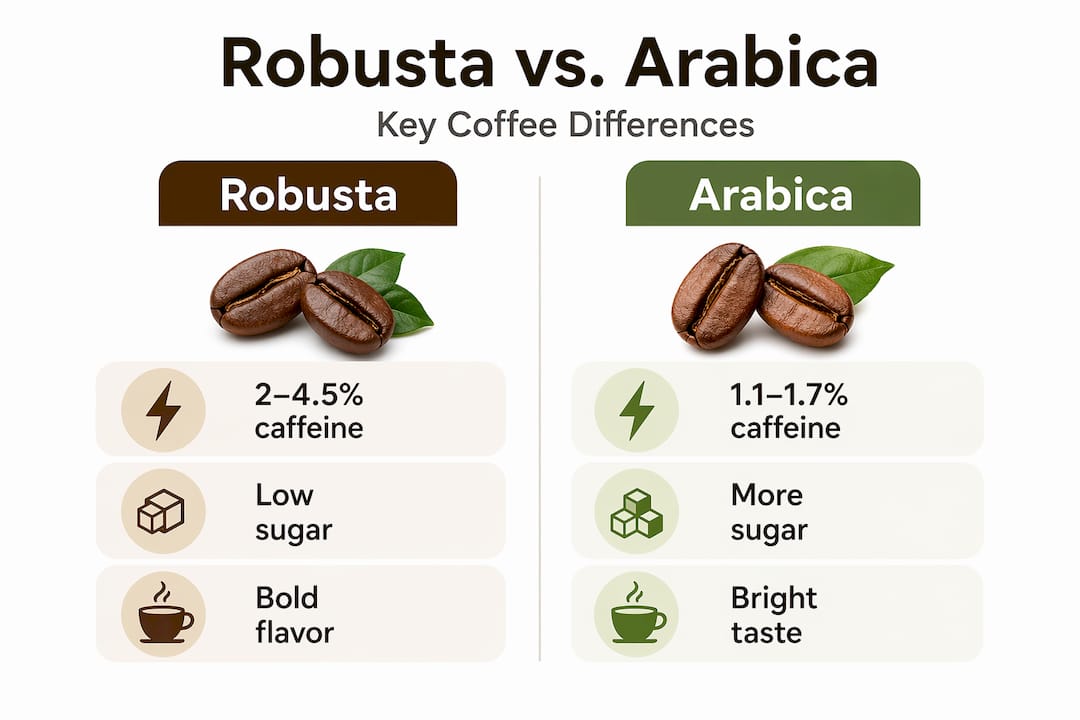
| Caffeine content | 2.0 to 4.5% | 1.1 to 1.7% |
| Fat and sugar content | ~60% less than Arabica | Higher |
| Chlorogenic acids | Higher | Lower |
| Body in cup | Full, thick | Medium to light |
| Crema quality | Rich and persistent | Thinner |
| Price point | Lower | Higher |
The caffeine content difference is the most practical. Robusta beans contain 2 to 4.5% caffeine compared to 1.1 to 1.7% in Arabica. That gap means a single shot of robusta espresso delivers more energy than an equivalent Arabica shot. For people who drink coffee primarily for the caffeine effect, robusta is a genuinely more efficient choice.
The lower fat and sugar content in robusta also shapes the cup. Less sugar means the natural sweetness you find in a well-roasted Arabica simply isn’t there. That’s not a flaw. It’s a different profile, one that lends itself to milk-based drinks and bold espresso applications rather than light, complex pour-overs.
How robusta is used and brewed
Most people drink robusta every day without realizing it. It’s the primary ingredient in the vast majority of instant coffee products worldwide. It’s also a core component in Italian-style espresso blends, where it adds body, crema density, and caffeine strength that straight Arabica can’t provide.
Here are the most common and effective ways robusta gets used:
- Instant coffee: Robusta’s higher solubility and stronger flavor make it the dominant choice for soluble coffee products. It dissolves cleanly and holds its intensity even after the drying process.
- Espresso blends: Many traditional Italian roasters use 10 to 30% robusta in their blends specifically to improve crema and add structure. If you’ve had a classic Roman espresso, you’ve tasted robusta.
- Vietnamese coffee: Cà phê sữa đá (iced coffee with sweetened condensed milk) relies on robusta’s bold body and earthy depth to stand up to the sweetness. The combination of flavors would be lost with a lighter Arabica.
- Cold brew: Robusta’s high caffeine and full body translate well to cold brew, producing a concentrated, smooth extract with serious staying power. The cold brewing process also reduces perceived bitterness, which plays to robusta’s strengths.
- Single-origin specialty robusta: A growing movement among specialty roasters is showcasing high-quality, well-processed robusta as a standalone product. These are worth trying if you want to understand what the bean can actually taste like at its best.
Brewing tip: robusta extracts faster than Arabica due to its structure. If you’re pulling an espresso shot with high-robusta content, dial back your grind slightly finer and watch your extraction time. Overextraction amplifies bitterness in an already bold bean.
My take on robusta’s growing reputation
I’ve spent years watching robusta get dismissed in specialty coffee circles, and I think that attitude is slowly, finally, changing. The shift isn’t happening because robusta suddenly tastes different. It’s happening because the processing has gotten better, and people are starting to connect those dots.
Here’s what I’ve come to believe: the bean itself was never the problem. The problem was that for decades, robusta was farmed and processed with one goal. Volume. When you treat a coffee crop as a commodity ingredient for instant coffee, you’re not going to invest in careful post-harvest handling. The result is the flat, bitter robusta that earned its bad reputation.
What I find genuinely exciting now is how that’s changing at the farm level. When I see well-documented washed robusta from Uganda or specialty-grade Vietnamese beans processed with real intention, the cup is completely different. There’s depth, there’s character, and the caffeine hit is real.
My honest advice: don’t write off robusta based on what you’ve tasted in cheap instant coffee. Try a quality single-origin or a well-crafted espresso blend that lists its robusta content. You might be surprised what this underestimated bean is capable of.
— zachary
Explore robusta coffee at Zscoffee
If reading this has made you want to actually taste what robusta can do at its best, Zscoffee has you covered. Cold brew is one of the best formats to experience robusta’s bold character without the bitterness. The cold extraction process draws out the deep, chocolatey notes while keeping sharpness in check.

Browse Zscoffee’s cold brew coffee options for a ready-to-drink experience that showcases robusta’s natural strength and body. If you want something for on-the-go, pair it with the travel mug with handle to keep your cold brew cold and your morning moving. Zscoffee ships internationally and offers straightforward purchase options, so getting quality coffee wherever you are is genuinely straightforward. Check the return and refund policy if you have any questions before ordering.
FAQ
What is robusta coffee made from?
Robusta coffee comes from the Coffea canephora plant, a species native to sub-Saharan Africa. It’s one of two main commercial coffee species, alongside Arabica.
How does robusta coffee taste compared to Arabica?
Robusta has a bold, earthy flavor with notes of dark chocolate and nuts, and a thick body with low acidity. Arabica tends to be brighter, fruitier, and more aromatic by comparison.
What is the caffeine content in robusta coffee?
Robusta contains 2 to 4.5% caffeine, which is nearly double the 1.1 to 1.7% found in Arabica beans, making it a significantly stronger caffeine source per bean.
Is robusta coffee good for espresso?
Yes. Robusta’s high natural oils create a richer, more persistent crema than Arabica, which is why traditional Italian espresso blends regularly include 10 to 30% robusta.
Why is robusta coffee sometimes bitter?
Bitterness in robusta is often a result of poor post-harvest processing rather than the bean itself. High-quality washed or honey-processed robusta produces a noticeably smoother and more complex cup.