Many coffee enthusiasts struggle with inconsistent brews, often blaming their beans or technique when the real culprit is their accessories. The right grinder, scale, and kettle can transform your daily cup from mediocre to exceptional. This guide provides science-backed insights to help you confidently choose brewing accessories that deliver consistent, flavorful results every time you brew.
Table of Contents
- Understanding Your Coffee Brewing Needs And Essential Accessories
- Selecting The Right Coffee Grinder For Consistent Flavor
- Choosing A Precision Coffee Scale For Measurement And Timing
- Selecting The Ideal Kettle For Controlled Pouring
- Enhance Your Coffee Experience With Z’s Coffee Accessories
- Frequently Asked Questions About Selecting Coffee Accessories
Key takeaways
| Point | Details |
|---|---|
| Uniform grind size | Consistent particle distribution is essential for balanced flavor extraction and avoiding bitter or sour notes. |
| Precision scales matter | 0.1g resolution and fast responsiveness ensure repeatable dosing and better brewing control. |
| Method-matched accessories | Choosing tools aligned with your brewing style, whether espresso or pour-over, maximizes results. |
| Controlled pouring | Gooseneck kettles enable precise water flow for even saturation and improved flavor clarity. |
Understanding your coffee brewing needs and essential accessories
Before investing in accessories, identify your preferred brewing method. Espresso demands different tools than pour-over or cold brew, and the choice of accessories should align with the brewing method. A manual grinder suits pour-over enthusiasts, while a scale becomes crucial for consistent espresso shots. Understanding how these tools impact flavor, consistency, and workflow helps you build a setup that supports your goals rather than complicates them.
Core accessories include a grinder, scale, and kettle suited to your brewing style. Each piece plays a distinct role in controlling variables that affect extraction. Grinders determine particle size distribution, scales ensure accurate coffee-to-water ratios, and kettles provide the flow control needed for even saturation. Together, these tools remove guesswork and create a foundation for repeatable, high-quality brews.
For newcomers, beginners should prioritize accessories that remove uncertainty and support a smoother workflow. Focus on consistent grinding, controlled pouring, and accurate measurement. These fundamentals matter more than expensive gadgets or complex setups. A reliable grinder and responsive scale will improve your coffee more than any premium bean if your current tools introduce inconsistency.
Consider these essential factors when building your accessory collection:
- Match accessories to your primary brewing method for optimal compatibility
- Prioritize tools that improve measurement precision and reduce variability
- Invest in quality over quantity, focusing on fewer versatile pieces
- Choose accessories that fit your available counter space and storage
Pro Tip: Start with a quality grinder and scale before expanding to specialized accessories. These two tools provide the biggest improvement in brew consistency and are essential regardless of your preferred method. Once you master these basics, explore our coffee brewing guide for advanced techniques.
Selecting the right coffee grinder for consistent flavor
Your grinder is the single most important accessory in your brewing arsenal. Particle size distribution significantly impacts coffee extraction, with uniformity leading to better flavor clarity and balance. When particles vary wildly in size, smaller pieces over-extract and turn bitter while larger chunks under-extract and taste sour. The result is a muddled, unpleasant cup that no brewing technique can fix.
Flat and conical burr grinders represent the two main designs, each with distinct characteristics. Flat burrs produce more uniform particles and work well for espresso, where consistency matters most. Conical burrs generate slightly more fines but excel at preserving bean flavor and operate more quietly. Neither design is objectively superior, your choice depends on whether you prioritize absolute uniformity or a more forgiving grind profile. Explore the nuances in this conical and flat burr grinders comparison.
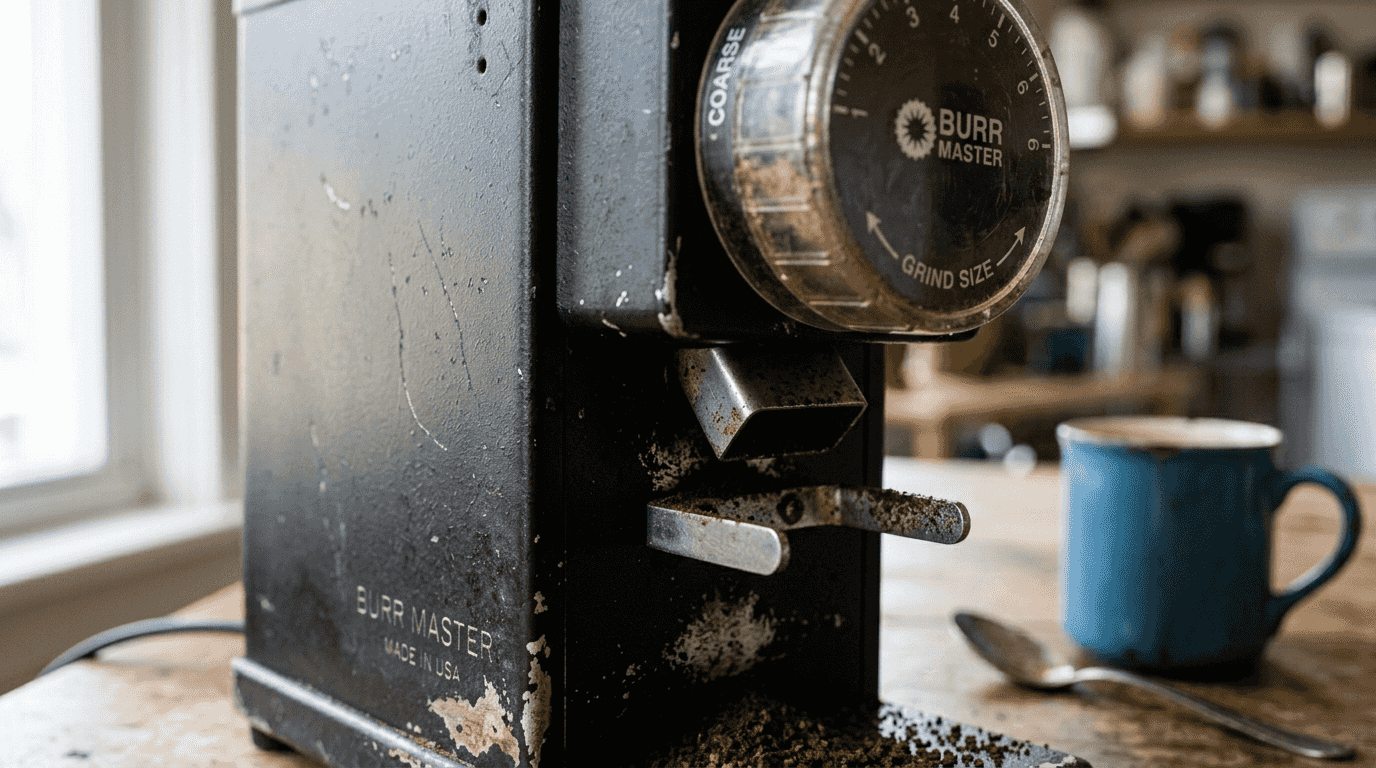
Burr alignment is crucial for consistent grinding and optimal extraction, with misaligned burrs leading to uneven particle sizes and undesirable flavors. Even premium grinders can suffer from alignment issues due to manufacturing tolerances or wear over time. Checking alignment periodically and making adjustments ensures your grinder performs as intended. This maintenance step separates good coffee from great coffee.
Key features to evaluate when selecting a grinder:
- Burr material and size, with larger burrs typically offering better consistency
- Grind adjustment mechanism, preferably stepless for espresso or fine-tuned pour-over
- Motor power and speed, balancing grinding efficiency with heat generation
- Static reduction features to minimize mess and particle retention
Pro Tip: After purchasing a grinder, run 50 grams of inexpensive beans through it to season the burrs and clear manufacturing residue. This simple step improves grind consistency from day one and prevents off-flavors in your first batches.
“A grinder with poor burr alignment will never produce consistent results, no matter how expensive the model. Regular maintenance and alignment checks are as important as the initial purchase decision.”
Maintenance extends grinder lifespan and preserves performance. Clean burrs monthly to remove coffee oils and residue that affect flavor. Check alignment every six months or whenever you notice inconsistent extraction. Replace burrs according to manufacturer guidelines, typically after grinding 500 to 1000 pounds of coffee. These practices keep your grinder performing like new and protect your investment. Perfect your technique with our espresso brewing guide.
Choosing a precision coffee scale for measurement and timing
Accuracy transforms brewing from guesswork into a repeatable science. The accuracy of a coffee scale is crucial for consistent brewing, with 0.1g resolution being ideal for espresso and pour-over. A one-gram variance in a 15-gram espresso dose changes your ratio by nearly 7%, enough to shift flavors from balanced to harsh. Precision scales eliminate this variability and let you dial in recipes with confidence.
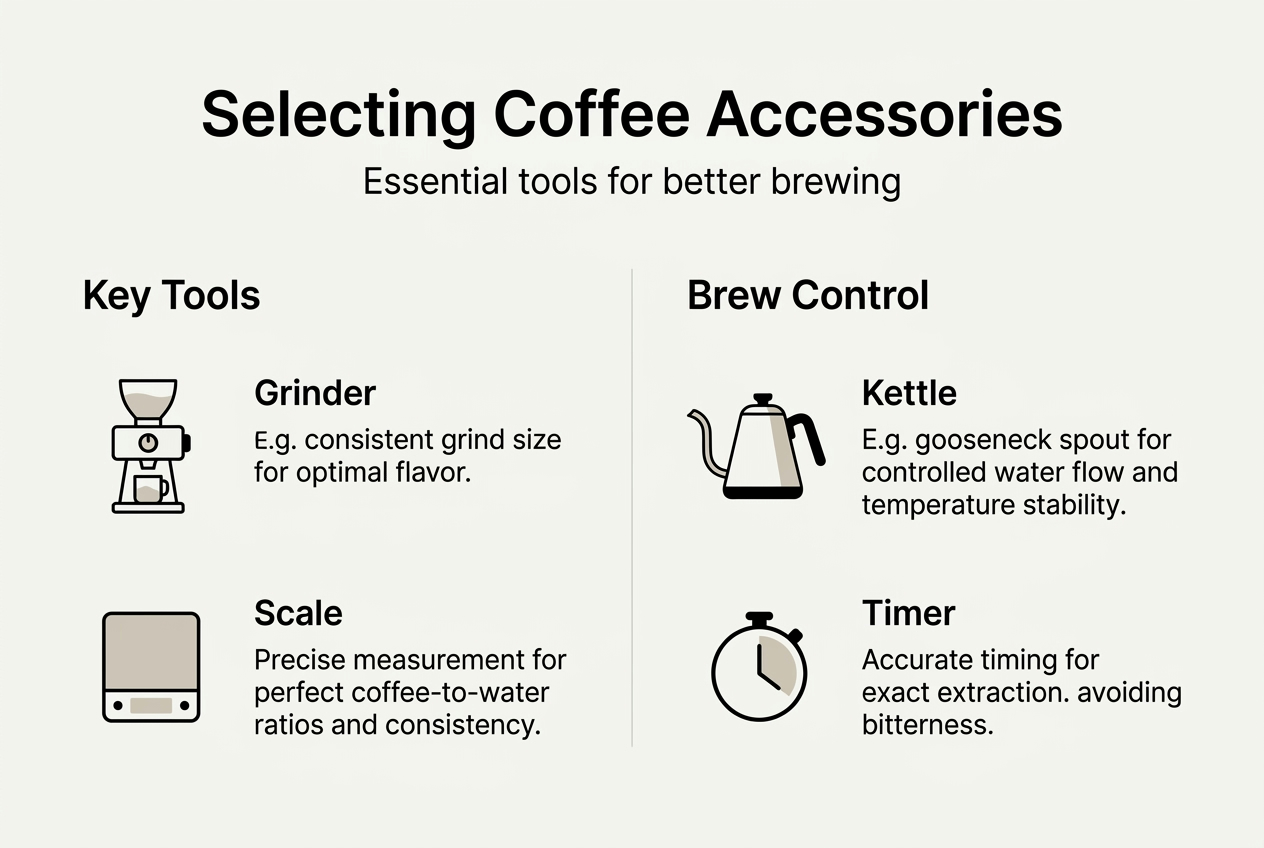
Scale responsiveness and stability are as important as accuracy, as a scale that lags or jumps around can make it difficult to achieve consistent results. Imagine trying to stop pouring at exactly 250 grams when the display updates every two seconds or fluctuates wildly. You end up either under-dosing or over-shooting your target, introducing the same inconsistency you bought the scale to eliminate. Fast refresh rates and stable platforms solve this problem.
Footprint size matters more than many realize. A compact scale fits neatly on an espresso machine drip tray, while a larger platform accommodates pour-over setups with room for a dripper and carafe. Measure your brewing area before purchasing to avoid compatibility issues. A scale that doesn’t fit your workflow will gather dust regardless of its technical specifications. For more precision techniques, check our perfect coffee brewing techniques guide.
Button layout and display clarity improve usability during busy mornings. Scales with intuitive controls and bright, angled displays reduce frustration and speed up your routine. Touchscreens look modern but can be finicky when wet. Physical buttons provide reliable tactile feedback and work in any condition. Consider how you’ll actually use the scale, not just its feature list.
| Feature | Espresso Priority | Pour-Over Priority |
|---|---|---|
| Resolution | 0.1g essential | 0.1g to 1g acceptable |
| Responsiveness | Critical for dosing | Important for bloom timing |
| Platform Size | Compact for drip tray | Large enough for dripper |
| Water Resistance | Helpful for cleaning | Essential for wet pours |
| Timer Function | Optional | Highly useful |
Key considerations when evaluating scales:
- Maximum capacity should exceed your largest brew size by 20%
- Auto-off timers should be adjustable or disableable to prevent mid-brew shutdowns
- Battery life and USB charging options affect long-term convenience
- Calibration features maintain accuracy over time
Pro Tip: Test scale responsiveness in-store by rapidly adding and removing weight. The display should update within half a second without overshooting or oscillating. This simple check reveals real-world performance better than any specification sheet. Explore high accuracy digital kitchen scales for additional options.
Selecting the ideal kettle for controlled pouring
Pouring technique directly affects extraction evenness, making kettle selection critical for manual brewing methods. Controlled pouring with a gooseneck kettle enhances brewing precision by allowing you to direct water exactly where needed. Standard kettles dump water in unpredictable streams that create channels and uneven saturation. Gooseneck kettles allow precise water flow control, crucial for even saturation and improved flavor clarity.
Ergonomic design improves comfort and precision during pouring, especially for multi-minute pour-over sessions. A well-balanced kettle with a comfortable handle reduces fatigue and gives you finer control over flow rate. The spout angle and opening diameter determine how easily you can maintain a thin, steady stream versus a heavy pour. Try holding different models to find one that feels natural in your grip.
Variable heat source compatibility expands kettle usefulness across different kitchen setups. Electric kettles with temperature control offer convenience and precision but limit portability. Stovetop models work on gas, electric, and induction cooktops, providing flexibility if you move or upgrade appliances. Some electric bases accept multiple kettle sizes, letting you swap between a small kettle for single cups and a larger one for batch brewing.
Consistent pouring leads to even extraction and balanced flavor. When you control water placement and flow rate, you can execute advanced techniques like pulse pouring or center-focused blooms. These methods unlock flavor nuances impossible with inconsistent pouring. Your kettle becomes an extension of your brewing intent rather than a limiting factor. Refine your skills with our manual brewing guide.
Essential kettle features to evaluate:
- Spout design with thin opening for controlled, laminar flow
- Capacity matching your typical brew size, usually 0.6 to 1.2 liters
- Temperature control accuracy within 2 degrees for optimal extraction
- Heat retention to maintain temperature during extended pours
Pro Tip: Practice pouring plain water into a cup on your scale before brewing. Aim for a steady 3 to 5 grams per second flow rate. This drill builds muscle memory and reveals whether your kettle provides the control you need. Learn more coffee making techniques to enhance your skills.
Enhance your coffee experience with Z’s Coffee accessories
Now that you understand what makes quality brewing accessories essential, it’s time to put that knowledge into action. Z’s Coffee offers a curated selection of premium coffee beans and accessories designed for enthusiasts who demand consistency and flavor. Whether you’re upgrading your grinder, adding a precision scale, or exploring new brewing methods, you’ll find everything needed to elevate your daily ritual.

Explore our coffee collection to pair your new accessories with exceptional beans that showcase their capabilities. For coffee on the go, check out our travel mugs designed to maintain temperature and flavor. Looking for convenient brewing options? Our cold brew coffee delivers smooth, consistent results without specialized equipment. Transform your home brewing with tools and products that make every cup exceptional.
Frequently asked questions about selecting coffee accessories
What type of grinder is best for beginners?
Beginners should start with a quality burr grinder, either conical or flat, rather than a blade grinder. Burr grinders provide the consistency needed for good extraction, while blade grinders produce uneven particles that lead to poor flavor. A manual burr grinder offers an affordable entry point, though electric models provide convenience for daily use.
How important is scale accuracy for different brewing methods?
Espresso demands 0.1g accuracy due to small dose sizes where minor variations significantly impact flavor. Pour-over and French press tolerate 1g accuracy since larger doses dilute the percentage error. However, precise measurement always improves consistency regardless of method, making a quality scale worthwhile for any serious coffee lover.
Can I use the same kettle for espresso and pour-over?
Yes, a gooseneck kettle works for both methods, though espresso doesn’t require the same pouring precision as pour-over. The controlled flow helps with techniques like pre-infusion but matters less than grind quality and pressure. Pour-over benefits most from gooseneck design, making it the priority if you primarily brew manually.
How often should coffee grinder burrs be checked for alignment?
Check burr alignment every six months or whenever you notice inconsistent extraction, such as channeling in espresso or uneven brew times. Professional baristas inspect alignment quarterly, but home users can extend this interval with lighter use. Realignment takes 15 minutes and dramatically improves grind consistency when needed.
Do I need separate accessories for different coffee types?
Not necessarily, though some specialization helps. A quality grinder and scale work across all methods, while kettles matter most for manual brewing. Consider method-specific accessories like portafilter funnels for espresso or specific drippers for pour-over only after mastering the basics. Visit our select coffee accessories guide for detailed recommendations.
Recommended
- Master perfect coffee at home: brewing guide for 2026 – Z’s Coffee
- Brew perfect espresso at home: expert guide 2026 – Z’s Coffee
- What is single serve coffee? Your 2026 complete guide – Z’s Coffee
- Cold Brew Coffee – Z’s Coffee
- Coffee Making – Autoryzowany dystrybutor i serwis Jura Wrocław
- Checklista wyboru kawy