TL;DR:
- Coffee shop collaborations are strategic partnerships that create unique products and experiences, strengthening community bonds. These alliances deepen a shop’s role as a social hub, boost loyalty, and expand reach through shared credibility and diverse demographics. Success depends on authentic partner selection, clear goal-setting, and precise impact measurement, ensuring long-term community building and business growth.
Coffee shop collaborations are defined as structured partnerships between coffee businesses and external brands, artists, roasters, or local organizations to co-create products, events, or experiences that neither party could produce alone. The practice has moved well beyond novelty. Specialty roasters like Onyx Coffee Lab and La Cabra now treat cross-brand partnerships as core growth strategy, while equipment makers like La Marzocco have long used collaborative activations to embed themselves in coffee culture. Ray Oldenburg’s theory of “third places” explains why this works: coffee shops already function as informal social hubs between home and work, and collaborations amplify that role by giving people new reasons to gather, return, and connect.
Why coffee shop collaborations build stronger communities
Coffee shops occupy a unique social position. Ray Oldenburg’s third place theory identifies them as informal gathering spaces where friendship, conversation, and community form outside the obligations of home or work. Collaborations extend that function by layering in new cultural touchpoints that draw people together around shared interests beyond caffeine.
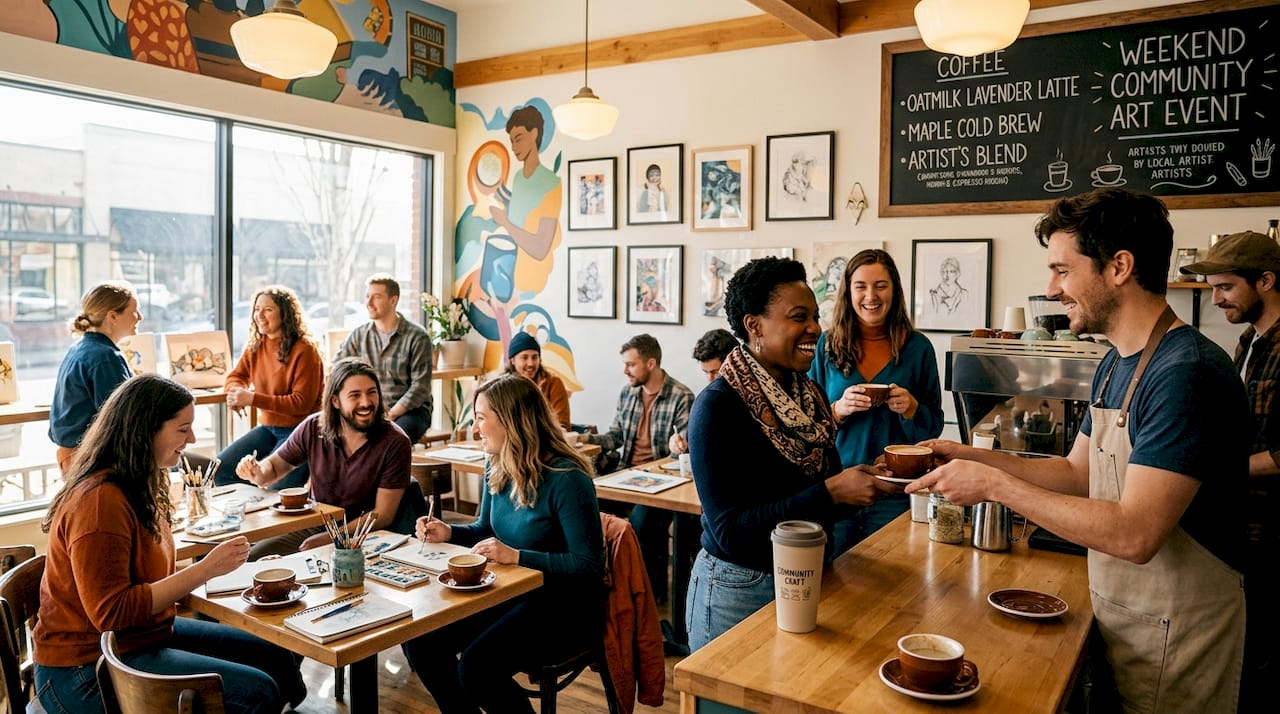
When a coffee shop partners with a local artist for a rotating gallery, or hosts a musician for a monthly acoustic set, it creates recurring reasons for customers to return. The visit is no longer just transactional. It becomes social. That shift from “I need coffee” to “I want to be here” is the foundation of genuine loyalty, and it is very difficult to manufacture through marketing alone.
“Collaborations don’t just bring new faces through the door. They give your regulars a reason to bring their friends.”
Research with 328 urban coffee users confirms that multisensory shop design significantly increases dwell time, revisit intention, and emotional attachment to a space. Collaborations that introduce visual art, curated music, or tactile merchandise directly activate those sensory layers. The result is a space that feels alive rather than static, and customers notice the difference.
Community-focused partnerships also renew the social fabric of a neighborhood. A coffee shop that co-hosts events with a local bookstore, yoga studio, or independent clothing brand becomes a connector. It signals that the business is invested in the neighborhood, not just operating within it. That perception builds trust at a level that no loyalty punch card can replicate.
Pro Tip: When selecting a community partner, prioritize organizations whose regulars do not already overlap heavily with yours. The goal is to introduce your space to genuinely new social circles, not just reinforce the existing one.
What are the strategic business benefits of coffee shop collaborations?
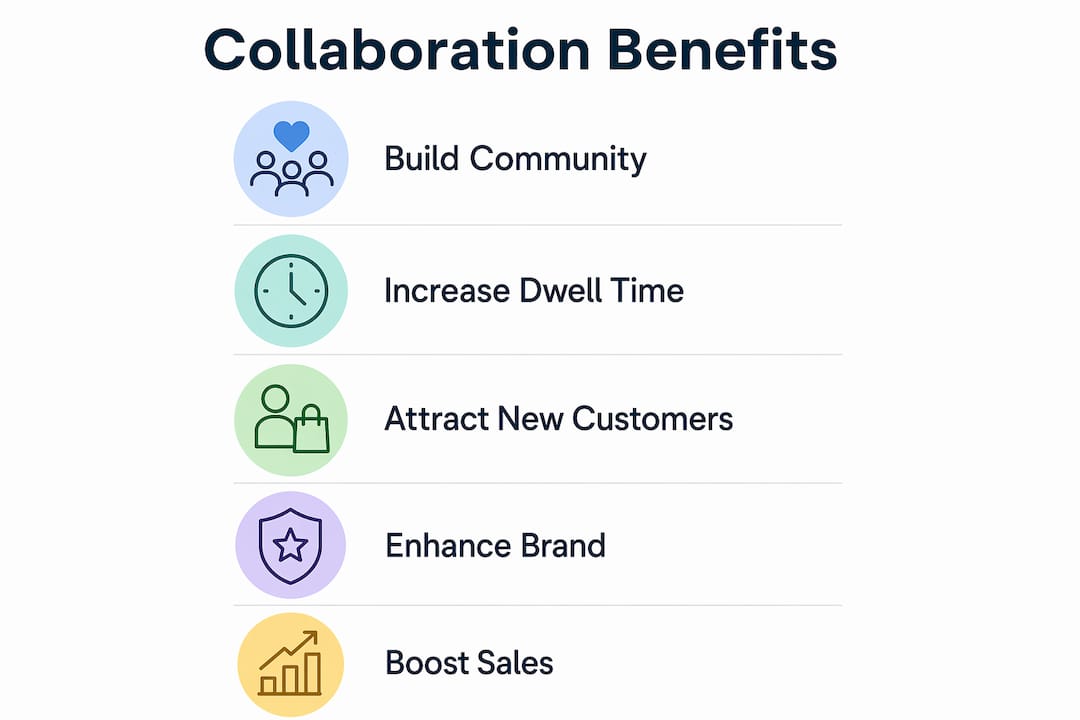
The business case for partnerships is grounded in economics as much as culture. Collaboration in specialty coffee is increasingly a strategic tool to leverage partner credibility, expertise, and audiences to expand reach amid rising operational costs. For independent shops operating on tight margins, that framing matters.
Here are the core strategic benefits that well-structured partnerships deliver:
- Shared costs. Co-hosted events, co-branded merchandise, and joint marketing campaigns split expenses between partners. A pop-up activation that costs one shop $2,000 to produce alone might cost $800 when a fashion or lifestyle brand co-funds it in exchange for exposure.
- Credibility transfer. Associating with a respected brand signals quality to new customers who have no prior experience with your shop. Roaster-to-roaster collaborations like those between Onyx Coffee Lab and La Cabra build shared prestige and open access to each other’s loyal audiences.
- New customer segments. A partnership with a local gym, art gallery, or record shop exposes your brand to demographics you would not reach through traditional coffee marketing. Each partner brings their own community to the table.
- Cultural relevance. Collaborations embed coffee culture into lifestyle sectors such as fashion, music, and art, maintaining relevance across generations. Expert Alex Zeal describes this as treating collaboration as a cultural gateway rather than a marketing tactic.
- Emotional differentiation. In a saturated market, product quality alone rarely wins long-term loyalty. Partnerships that co-create relationship-driven spaces give customers something to feel attached to beyond the espresso itself.
The distinction between marketing and cultural embedding is worth dwelling on. A promoted post reaches people once. A collaboration with a respected local brand creates an association that lives in customers’ minds every time they interact with that partner brand. That is compounding brand value, and it costs far less than paid advertising at scale.
What types of collaboration ideas are effective for coffee shops in 2026?
The range of formats available to coffee shop owners is broader than most realize. The most effective collaboration ideas share one trait: they create an experience the customer cannot get anywhere else.
| Collaboration type | Core benefit | Example application |
|---|---|---|
| Roaster-to-roaster blend | Shared credibility and new audience access | Two local roasters co-release a limited seasonal blend |
| Cross-industry pop-up | Exposure to non-coffee demographics | Coffee shop hosts a fashion brand’s capsule collection launch |
| Artist residency or gallery | Increased dwell time and repeat visits | Monthly rotating local artist display with opening night event |
| Co-branded merchandise | Physical brand extension and loyalty signal | Travel mugs or tote bags designed with a partner lifestyle brand |
| Experiential programming | Community anchor status and social media reach | Weekly cupping class co-hosted with a specialty importer |
Co-branded merchandise deserves particular attention. A well-designed travel mug or tote bag carrying both your logo and a respected partner’s mark travels far beyond your four walls. Every time a customer uses it, both brands receive passive exposure. The key is choosing a partner whose aesthetic and values align closely enough that the co-branded item feels intentional rather than opportunistic.
Storytelling is the thread that ties all of these formats together. Customers respond to knowing why two brands came together. A collaboration between a coffee shop and a local ceramics studio is interesting. A collaboration where the ceramics artist hand-throws every cup used in the shop’s tasting flights, and the shop features the artist’s process on its walls, is a story worth sharing. Social media integration amplifies that story, but the story has to exist first. You can find inspiration for creative flavor pairings that translate naturally into collaborative product launches with food or beverage partners.
Pro Tip: Before approaching any potential partner, write one sentence explaining why your two brands belong together. If you cannot write that sentence clearly, the collaboration will feel forced to customers too.
Choosing authentic partners aligned with your brand values is not just good ethics. Research finds that atmosphere, knowledge transfer, and social media positively influence customer loyalty, while constant product changes and misaligned partnerships can actively harm it. Consistency of identity matters more than novelty of concept.
How to approach partnerships and measure collaboration success
Knowing why to collaborate and what to do is only half the work. The other half is execution and measurement. Here is a practical sequence for initiating and managing a coffee shop partnership:
- Identify partners by audience fit, not just brand appeal. Research who your potential partner serves. Their customer base should be adjacent to yours but not identical. Overlapping audiences reduce the new-reach benefit.
- Align goals before any creative planning. One partner may want foot traffic; the other may want social media exposure. Document both goals explicitly so success criteria are agreed upon from the start.
- Co-create the experience together. The best collaborations feel like genuine hybrids, not one brand hosting another. Involve the partner in design decisions, menu choices, and event programming.
- Draft a simple written agreement. Cover cost splits, marketing responsibilities, exclusivity terms if relevant, and the timeline. This protects both parties and prevents the most common partnership breakdowns.
- Build a co-marketing plan with shared assets. Agree on what each party will post, when, and with what messaging. Coordinated launches outperform uncoordinated ones significantly.
- Use branch-specific QR tracking to measure impact. QR tracking systems help accurately measure collaboration impact by distinguishing customer acquisition from redemption patterns. Without this, you cannot tell whether new visitors came from your partner’s audience or your own existing base.
- Evaluate and adjust after each activation. Track foot traffic changes, new customer sign-ups, social media reach, and product sales tied to the collaboration period. Use that data to decide whether to repeat, modify, or discontinue the partnership.
Measurement is where most coffee shop collaborations fall short. Operators invest time and money, see a busy event night, and call it a success without knowing whether those customers returned. Successful collaborations function as loyalty systems rather than isolated events, and that requires precise tracking for true performance evaluation. Integrating collaboration sign-ups with your existing loyalty program closes that loop. You can also explore coffee shop concepts built around partnership models to understand how other operators have structured this from the ground up.
Key takeaways
Coffee shop collaborations work because they convert transactional visits into cultural experiences, giving customers emotional reasons to return that product quality alone cannot provide.
| Point | Details |
|---|---|
| Third place amplification | Collaborations deepen a shop’s role as a community hub, increasing loyalty beyond the product itself. |
| Strategic cost sharing | Partnerships split event and marketing costs, making activations viable for independent operators on tight margins. |
| Cultural embedding | Cross-industry partnerships with fashion, art, and music keep coffee relevant across new demographics. |
| Authentic partner selection | Misaligned partnerships harm loyalty; choose partners whose values and audience complement yours specifically. |
| Measurement closes the loop | Branch-specific QR tracking and loyalty integration reveal true collaboration impact, not just event attendance. |
What I’ve learned from watching collaborations succeed and fail
I have watched coffee shops treat collaborations as a shortcut to buzz and others treat them as a long-term relationship strategy. The difference in outcomes is not subtle.
The shops that win with partnerships are the ones that resist the urge to collaborate constantly. There is a real risk in over-programming. When your space hosts a new pop-up every two weeks, regulars stop knowing what your shop stands for. The collaboration becomes the identity, and that is a fragile foundation. The most loyal customers are attached to you, not to whoever you happened to partner with last month.
What I find genuinely underappreciated is the knowledge-transfer dimension. When a specialty importer co-hosts a cupping event at your shop, your staff learns alongside your customers. That shared learning moment builds a kind of community that no marketing campaign replicates. It is also the kind of experience that community-building research points to as a driver of repeat visits and emotional attachment.
My honest advice: treat your first collaboration as a pilot, not a campaign. Choose one partner, set clear goals, measure rigorously, and decide from evidence whether to scale. The shops that build real community through partnerships do it slowly and deliberately. They are not chasing novelty. They are building something their neighborhood actually needs.
— zachary
Elevate your shop’s collaboration game with Zscoffee
Zscoffee offers products that translate directly into collaboration opportunities for coffee shop owners. The cold brew coffee range is a natural fit for co-branded event offerings or seasonal partnership launches with food and lifestyle brands. For shops exploring merchandise collaborations, the travel mug with a handle provides a physical product that carries your brand and your partner’s into customers’ daily routines. Whether you are planning a pop-up activation, a co-hosted tasting event, or a branded merchandise drop, Zscoffee’s product catalog gives you quality starting points. Browse the full range at Zscoffee and reach out to explore how their offerings can support your next partnership.
FAQ
What is a coffee shop collaboration?
A coffee shop collaboration is a structured partnership between a coffee business and an external brand, artist, roaster, or local organization to co-create products, events, or experiences. The goal is to expand audience reach, build community, and create value that neither party could deliver independently.
How do collaborations help coffee shops build community?
Collaborations give customers recurring cultural reasons to visit beyond the product itself, activating a shop’s role as a third place. Research confirms that enriched sensory and social experiences significantly increase dwell time and revisit intention.
What are the most effective coffee shop collaboration ideas?
The most effective formats include roaster-to-roaster limited blends, cross-industry pop-up events, artist residencies, co-branded merchandise, and experiential programming like cupping classes. The best ideas create an experience customers cannot find elsewhere.
How do you measure whether a coffee shop collaboration worked?
Branch-specific QR tracking systems distinguish new customer acquisition from existing customer redemption, preventing misattribution of results. Integrating collaboration sign-ups with a loyalty program reveals whether new visitors actually returned after the initial event.
How often should a coffee shop run collaborations?
Quality and intentionality matter more than frequency. Over-programming with constant new partnerships can dilute brand identity and confuse regulars. One or two well-executed collaborations per quarter typically outperform a continuous stream of loosely connected activations.