TL;DR:
- Choosing the right coffee business model depends on your capital, operational skills, and market strategy, with diversified channels reducing risk. Modern technology, including integrated POS systems and data analytics, is essential for managing multiple revenue streams profitably. Successful businesses treat their models as portfolios, balancing high-margin direct-to-consumer and scalable wholesale or roasting operations.
Choosing among the many coffee business models available today is one of the most consequential decisions you’ll make as an entrepreneur. The specialty coffee market is projected to grow from $29.7 billion in 2025 to $47.8 billion by 2032, driven by premiumization, direct-to-consumer e-commerce, and sustainability trends. That growth is real, but so is the complexity. Each model carries a different margin profile, capital requirement, and operational burden. This article breaks down 7 coffee business models with the specifics you need to make a clear-eyed decision.
Table of Contents
- Key takeaways
- 1. Understanding what makes coffee business models work
- 2. The standalone coffee roasting business model
- 3. The café-focused model with in-house roasting
- 4. Digital and technology-enabled coffee shop models
- 5. Coffee franchise opportunities and scalable chain models
- 6. White label, private label, and capsule production models
- 7. Comparing coffee business models side by side
- My honest take on picking the right coffee business model
- Explore quality coffee products at Zscoffee
- FAQ
Key takeaways
| Point | Details |
|---|---|
| Model choice drives margins | Retail channels like cafes and capsules yield 55–75% gross margin; wholesale B2B yields 30–55%. |
| Revenue mix beats single channels | A balanced channel split, roughly 70% B2B and 30% retail, protects profitability and reduces risk. |
| Technology is a strategic asset | Integrated POS and data systems are now foundational infrastructure, not optional upgrades. |
| In-house roasting changes the economics | Cafes that roast in-house gain supply chain control, signature products, and additional revenue streams. |
| Align model with your strengths | Capital, operational skill, and market access should drive which model you choose, not trend alone. |
1. Understanding what makes coffee business models work
Before you pick a model, you need a framework for evaluating them. Not every coffee business model that works for someone else will work for you, and the gap between a good idea and a profitable operation is almost always operational.
Here are the core criteria that separate sustainable coffee businesses from ones that grind to a halt within three years:
- Margin vs. volume trade-off. Channel margins vary widely: HORECA (hotels, restaurants, cafes) runs 40–55%, while capsules can reach 75%. A high-volume, low-margin wholesale channel needs scale to pay off. A low-volume, high-margin retail channel needs loyal customers.
- Revenue diversification. No single channel should exceed 45% of total revenue. Concentration risk is real. One large B2B client walking away can destabilize an entire business.
- Customer acquisition cost. Wholesale B2B is harder to win but stickier. Direct-to-consumer is easier to start but more expensive to grow at scale.
- Operational complexity. Adding channels adds overhead. A roastery selling through four channels needs inventory management, logistics, and sales systems that a single-channel café does not.
- Technology readiness. Modern POS systems with real-time analytics are now table stakes for any multi-channel coffee business. If your data infrastructure is weak, your decisions will be too.
- Roasting control. Owning your roast means owning your margin. Businesses that buy pre-roasted beans are permanently dependent on a supplier’s pricing.
Pro Tip: Before committing to a model, map your revenue channels on a spreadsheet and stress-test each one. What happens if your top wholesale client drops you? What happens if foot traffic falls 30% in winter? The model that survives those scenarios is the one worth building.
2. The standalone coffee roasting business model
This is the engine-room model. You roast. You sell through multiple channels. You may never interact directly with the end consumer. It is one of the most scalable types of coffee businesses when done right, and one of the most punishing when done wrong.
The economics hinge on where you sell your roasted coffee, not just how well you roast it. Roaster profitability depends heavily on the channel mix, not just roast quality.
| Channel | Gross Margin | Revenue Role |
|---|---|---|
| HORECA (B2B) | 40–55% | Volume anchor |
| Retail grocery (B2B) | 30–45% | Scale driver |
| Own cafes | 55–70% | Margin booster |
| D2C online | 60–75% | Brand builder |
| Capsules | 60–75% | Premium growth |
| White label | 30–50% | Capacity filler |
The optimal revenue mix for a roastery is approximately 70% B2B and 30% retail. That split gives you volume stability from B2B while retail channels pull up your blended margin. Net margins for well-run roasteries land between 12% and 25%.
Two operational factors matter more than most entrepreneurs expect. First, roasting shrinkage. Green bean weight loss during roasting ranges from 12% to 24% depending on roast level. Every pound of dark roast you sell costs meaningfully more to produce than a light roast, and pricing that doesn’t account for shrinkage will quietly destroy your margins. Second, capacity utilization. Running your roaster at 40% capacity doubles your per-kilogram fixed cost compared to running at 80%. Scaling roastery output before scaling sales is how new roasters burn cash.
Pro Tip: Build roast profile libraries and run batch cupping protocols from day one. The discipline required to maintain quality at 500kg/week is completely different from quality control at 50kg/week. Systems built early scale. Habits do not.
3. The café-focused model with in-house roasting
The traditional café model, where you buy pre-roasted beans from a third party and brew drinks across a counter, is the most common entry point into coffee. It’s also the most operationally constrained. Labor is sticky, peak sales concentrate in roughly 2 morning hours, and your margin is capped by your wholesale bean cost.
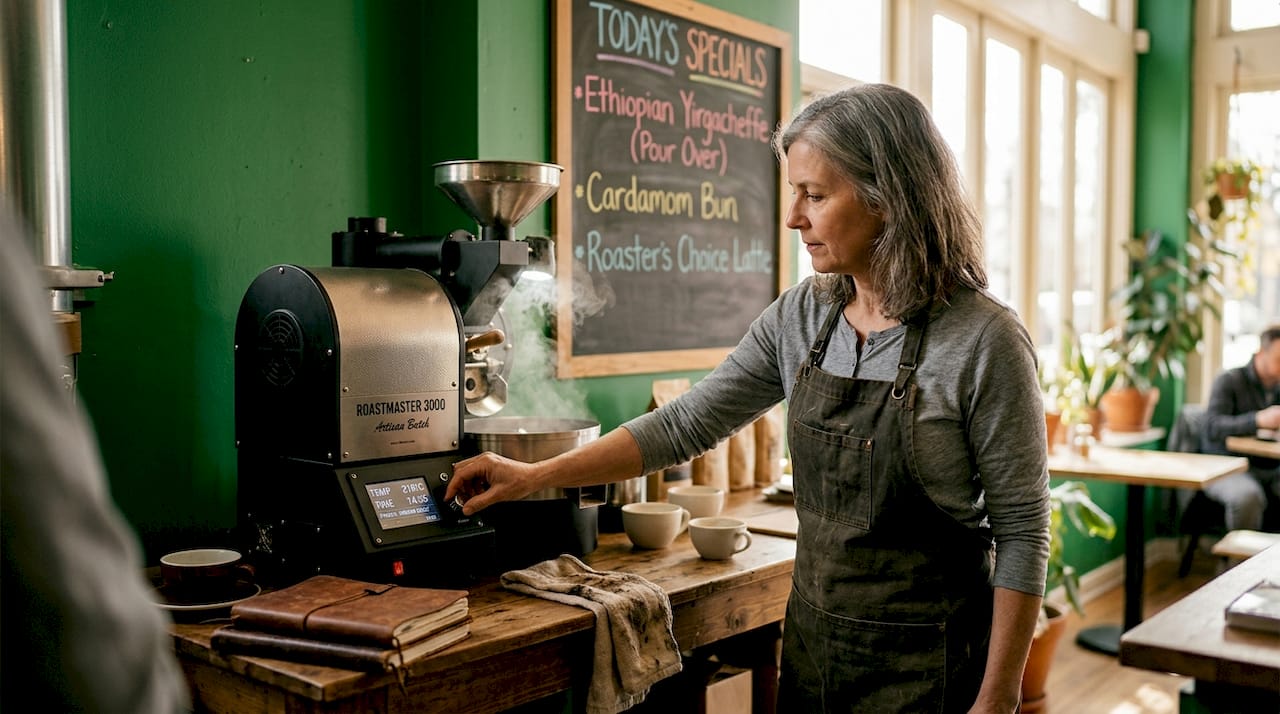
Adding in-house roasting changes that equation significantly. In-house roasting gives cafes direct control over supply chain, inventory timing, and blend development, while opening new revenue channels that a pure café cannot access.
The practical barrier is lower than most people assume. A Bellwether Shop Roaster, for instance, can process 20kg in under 4.5 hours without requiring ventilation infrastructure. That puts production-level roasting within reach of a single-location café. Once you’re roasting, you can:
- Sell retail bags directly from the café counter
- Develop signature blends that competitors cannot copy
- Offer private-label roasting for local restaurants
- Launch a small D2C online channel without a major logistics investment
- Use your roasting story as a marketing asset that costs nothing but time
The branding effect alone is underrated. Customers who watch coffee being roasted on-site develop a different relationship with the product than customers who see a generic bag on the counter. That translates directly into repeat visits and higher average ticket size.
Pro Tip: When building an artisan coffee business plan that includes in-house roasting, budget for the learning curve. Your first three months of roast profiles will be inconsistent. Plan for it, price for it, and don’t put your early roasts in your flagship blends.
4. Digital and technology-enabled coffee shop models
Technology is not an add-on for modern coffee businesses. It’s the architecture that determines whether you can profitably run multiple revenue channels at the same time. The shift toward takeaway, third-party delivery, online ordering, and coffee subscription models has fundamentally changed what coffee shop infrastructure needs to look like.
Here’s what that means practically:
- Integrated POS systems provide real-time visibility into sales by channel, inventory depletion rates, and customer purchase history. Without that data, you’re making pricing and staffing decisions blindly.
- Online ordering and delivery integrations can add 15–30% to revenue for cafes in urban markets, but they carry platform fees of 15–30% of order value. The net margin impact requires careful modeling before you commit.
- Coffee subscription models create predictable monthly recurring revenue, something almost no other channel provides. They also build the most loyal customer segment in your database.
- AI-powered demand forecasting is moving from enterprise software into accessible POS platforms. Early adopters are using it to reduce over-ordering and waste by forecasting day-level demand against weather, local events, and historical patterns.
- Loyalty program integration tied directly to POS data allows targeted offers based on actual purchase behavior, not guesses.
The operational complexity of running four channels simultaneously is real. But businesses that treat their data systems as strategic assets rather than administrative overhead consistently outperform those that don’t. The coffee businesses that will win in 2026 are the ones that know their numbers at the channel level, not just in aggregate.
5. Coffee franchise opportunities and scalable chain models
Franchising is how proven coffee shop concepts grow faster than organic capital allows. As a franchisee, you’re buying a playbook: brand recognition, supplier relationships, training systems, and marketing infrastructure that would cost years to build independently.
The trade-off is margin. Franchise fees and royalties typically run 5–10% of revenue, and you’re locked into supplier agreements that may not offer the best pricing. You also sacrifice the brand authenticity that independent operators use to compete.
As a franchisor, the model flips entirely. You build margin through royalty streams rather than direct retail. Your capital exposure decreases as franchisees fund location buildouts. The risk is quality control at scale. One bad franchisee location damages the brand you’ve spent years building.
For entrepreneurs with strong operational skills but limited capital, franchising a mid-tier coffee brand is often a faster path to profitability than starting from scratch. For entrepreneurs with a strong local brand and genuine product differentiation, staying independent and growing selectively is usually the smarter call.
6. White label, private label, and capsule production models
These are the specialty coffee world’s least glamorous and most financially interesting models. White label roasting, where you roast to another company’s brand specifications, fills your roaster capacity during off-peak production windows. It’s low-margin work, typically 30–50%, but it converts idle fixed costs into real revenue.
Private label is a step up. You create a blend for a client under their brand, giving you more creative input and slightly better pricing leverage. Grocery chains, hotel groups, and office coffee services are common buyers.
Capsule manufacturing sits at the top of the margin stack, with gross margins reaching 60–75%, because the packaging format commands a premium and consumption is habitual. The capital investment in capsule-compatible packaging equipment is significant, but the unit economics justify it at volume.
A hybrid approach that many successful coffee shop concepts now use: run a flagship café for brand credibility, roast in-house for margin control, sell branded capsules online for recurring revenue, and use white label work to keep the roaster running at full capacity. Each channel supports the others structurally.
7. Comparing coffee business models side by side
| Model | Gross Margin | Scalability | Capital Need | Complexity |
|---|---|---|---|---|
| Standalone roastery | 30–75% blended | High | Medium-High | High |
| Café only (no roasting) | 55–70% | Low-Medium | Medium | Medium |
| Café with in-house roasting | 55–75% | Medium | Medium-High | High |
| Franchise (franchisee) | 40–60% after fees | Medium | Medium | Low-Medium |
| White label roasting | 30–50% | High | Low-Medium | Medium |
| Capsule production | 60–75% | High | High | High |
| Subscription/DTC brand | 60–75% | Medium-High | Low | Medium |
The right model depends on three things: the capital you can deploy, the operational skills you actually have, and the market you’re entering. A subscription-focused DTC coffee brand requires strong digital marketing skills and patience. A standalone roastery requires sales discipline and quality management. A café with in-house roasting requires both, plus the ability to manage a small production operation while running a retail floor.
For entrepreneurs starting a coffee brand with limited capital, a subscription or DTC model offers the lowest barrier to entry with strong margin potential. For operators with production experience and access to B2B clients, a roastery model with a diversified channel mix offers the strongest long-term economics.
My honest take on picking the right coffee business model
I’ve spent a lot of time looking at how different coffee businesses succeed and fail, and the pattern is consistent. The businesses that struggle are almost always the ones that chose a model based on what excited them rather than what fit their actual skills and market position.
In my experience, the single biggest mistake I see entrepreneurs make is going 100% into one channel. A roaster who sells exclusively to HORECA clients is one bad contract away from a cash crisis. A café that ignores online sales is leaving predictable revenue on the table. The micro-lot sourcing and specialty positioning that make a brand compelling in retail mean nothing if you haven’t built the operational systems to deliver consistent quality at scale.
What I’ve found actually works is treating your business model as a portfolio, not a single bet. Start with one or two channels where your competitive advantage is clearest. Build the systems. Then add channels deliberately, with the data to support the decision.
Technology is where I see the biggest underinvestment. A cloud POS with real-time analytics is not a luxury for a $2 million roastery. It’s a minimum. The businesses I’ve watched grow the fastest are the ones that made data-driven decisions early, before those decisions became expensive corrections.
The coffee industry rewards operators who combine genuine product quality with disciplined business execution. Passion gets you started. Systems keep you profitable.
— zachary
Explore quality coffee products at Zscoffee
If you’re building a coffee business or simply want to understand the products you’ll be selling, sourcing, or sourcing around, the quality of your beans matters as much as the model you choose.
Zscoffee carries a curated range of coffee and tea products that span origins, roast profiles, and brewing formats, which makes it a practical starting point whether you’re testing blends for a new brand or stocking up for your own café. You’ll also find brewing accessories and a travel mug worth keeping on your counter. For deeper reading, the Zscoffee blog covers everything from home roasting techniques to sourcing strategy, so you can keep building your knowledge alongside your business.
FAQ
What are the most profitable coffee business models?
Capsule production and D2C subscription models offer the highest gross margins, typically 60–75%, while standalone roasteries with a balanced channel mix generate net margins of 12–25% at scale.
How much does it cost to start a coffee roasting business?
Startup costs vary widely based on equipment and channel strategy, but a small commercial roastery with multi-channel sales typically requires $50,000 to $200,000 in initial capital before reaching profitability.
What is a coffee subscription model?
A coffee subscription model delivers pre-selected or curated coffee to customers on a recurring schedule, generating predictable monthly revenue and building a loyal, high-retention customer segment.
Should I buy a coffee franchise or start independently?
Franchising offers faster startup, brand recognition, and operational support, but costs 5–10% of revenue in ongoing fees. Independent brands preserve margin and product control but require longer brand-building timelines.
What channel mix should a new roastery target?
A proven starting framework targets roughly 70% B2B channels like HORECA and wholesale grocery, with 30% in higher-margin retail channels like D2C and own cafes, keeping no single channel above 45% of total revenue.