TL;DR:
- Following basic coffee shop etiquette, such as buying something, keeping noise low, and cleaning up, helps maintain a respectful shared space. Customers should be prepared before ordering, pick appropriate seats, and practice courteous scripting to prevent conflicts. Respectful behaviors from both patrons and staff are key to a pleasant café experience for everyone.
Follow these coffee shop etiquette tips and you’ll stay on good terms with staff, avoid friction with other customers, and keep shared spaces pleasant for everyone. The core rules are simple: buy something, tip when appropriate, keep your noise down, and clean up when you leave.
| Rule | What it means in practice |
|---|---|
| Buy something | Purchase at least one item; reorder if you stay if sitting for a long time |
| Tip appropriately | Leave a tip for made-to-order drinks, especially during busy shifts |
| Don’t overstay | Be ready to give up your table during peak hours |
| Keep noise low | Use headphones, step outside for long calls, speak at indoor volume |
| Clean up | Return dishes, dispose of trash, wipe up spills |
| Follow house rules | Respect posted policies on pets, laptops, and seating limits |
| Respect space | Don’t spread belongings across multiple seats or block walkways |
| Order efficiently | Know your order before you reach the counter |
The sections below break each rule down by situation, whether you’re grabbing a quick latte or settling in for a three-hour work session.
Table of Contents
- 1. How to order considerately and move through the line
- 2. Choosing a seat without taking more than you need
- 3. Working from a café: the rules remote workers often skip
- 4. Keeping noise at a level everyone can live with
- 5. Shared stations and cleaning up after yourself
- 6. What to do when the shop gets busy
- 7. Why these rules matter: the barista’s side of the counter
- Key Takeaways
- The part most etiquette guides skip
- Brew café-quality coffee at home with Zscoffee
- Useful sources
1. How to order considerately and move through the line
Arriving prepared is the single biggest favor you can do for the barista and the person behind you. Etiquette expert Lisa Mirza Grotts frames it as “the three P’s”: be prepared, present, and polite. That means knowing your drink size, milk choice, and payment method before you reach the counter, not while you’re standing at it.
- Put your phone away before you step up. Eye contact and a greeting go a long way.
- Say please and thank you. It sounds obvious, but baristas notice when you don’t.
- If the line is long, simplify your order or use mobile ordering when the shop offers it.
- After ordering, move to the pickup area immediately. Don’t linger at the register.
- If you have questions about the menu, step aside and let the next person order while you decide.
Pro Tip: If your order is complex, a quick “sorry, this one’s a bit involved” to the barista signals self-awareness and usually earns goodwill rather than eye-rolls.
Understanding how a café designs its menu and flow helps explain why quick decisions at the counter matter so much for the whole operation.
2. Choosing a seat without taking more than you need
Pick a seat that matches how long you plan to stay. A two-top near the window is fine for a 20-minute espresso. Claiming a six-person community table for a solo laptop session during the morning rush is not.
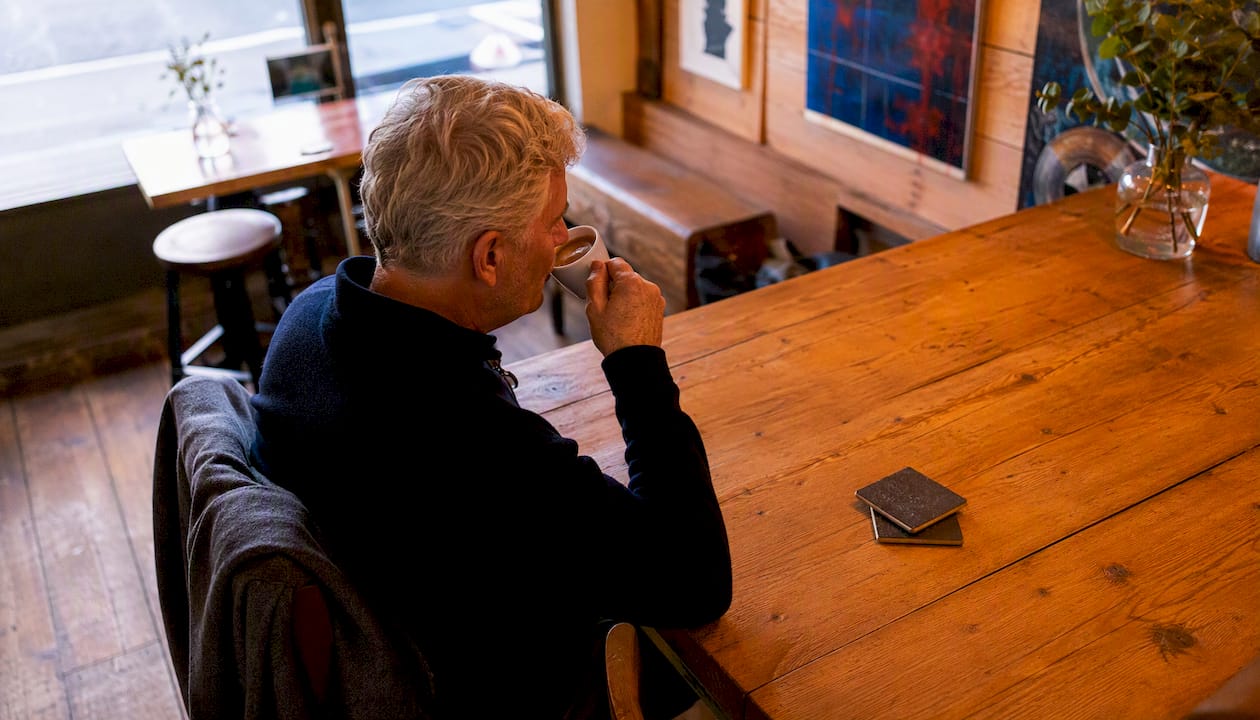
Keep your belongings on your lap or under your chair. A coat draped across the seat next to you signals “occupied” to someone scanning for a spot. Keep pathways clear, especially near the door and the condiment station, where stroller and ADA access matters.
If the café is busy and a staff member asks you to consolidate or move, the right answer is a short “of course” and a quick shift. Arguing about it in front of other customers helps no one. The ambiance a café works to create depends on everyone doing their small part.
One more thing: don’t stare at other people’s screens. It’s a shared space, not a co-working facility where everyone opted into visibility.
3. Working from a café: the rules remote workers often skip
Remote work at a coffee shop is a fair trade when you hold up your end. The widely cited guideline among etiquette commentators is one purchase per hour of seating. That’s not a hard policy at most shops, but it’s a reasonable standard that keeps the relationship honest.
- Buy something every hour. A drip coffee counts. The point is that you’re a paying customer, not a free co-working space user.
- Share outlets. If someone else needs power and there’s only one socket, offer to split time or keep your charge topped off before you arrive.
- Keep cables tidy. A charging cable stretched across a walkway is a trip hazard. Tuck it close to your chair.
- Take calls outside. A five-minute check-in is fine at low volume. A 45-minute client call is not. Step out.
- Use a meeting room or reserve a table for groups. Showing up with three colleagues and spreading across four seats without a reservation during peak hours is a friction point for staff.
- Comply when asked to move. If a staff member needs your table during a rush, pack up politely and ask where they’d prefer you to sit.
Pro Tip: Keep your cup visible on the table. It signals to staff that you’re an active customer, not someone who ordered once at 8 AM and is still there at noon.
Eater’s guide to working from coffee shops makes a similar point: the social contract of café work depends on both sides getting something out of it.

4. Keeping noise at a level everyone can live with
Volume is the most common complaint in shared café spaces, and it’s almost always unintentional. People don’t realize how loud they’ve gotten until someone flinches.
Keep calls brief and at low volume. Use headphones for music, podcasts, or video. If you’re watching something with audio, headphones are non-negotiable. Audible notifications, loud keyboard typing, and chair-scraping all register more than you’d expect in a quiet room.
For groups, choose a corner table when possible and keep voices at a genuine indoor level. The test: can the person two tables away hear your conversation clearly? If yes, dial it back.
If another customer politely asks you to lower your voice, respond with a simple “sorry about that” and adjust. Escalating to staff is for situations where the behavior continues after a direct, courteous request.
5. Shared stations and cleaning up after yourself
The condiment station is a high-traffic bottleneck. Miss Manners advises sizing up the pace before you step in, and if someone is actively using the station, a quick “I’ll be just a minute” preserves polite ownership without creating a standoff. Get in, fix your drink, and get out.
- Don’t crowd someone who’s already at the station. Wait your turn.
- Put lids back on sugar dispensers and wipe up any spills you cause.
- Return reusable cups to the counter when the café asks for them. Leaving them on the table creates extra work for staff.
- Dispose of single-use items in the right bins. Most cafés now separate compostables from trash.
- If you knock something over, clean it up or flag a staff member immediately.
Pro Tip: Returning your dishes to the counter, even when there’s a bussing station, is noticed. It’s a small gesture that takes ten seconds and makes a real difference to the team.
Qahwa World’s 2026 café etiquette guidance frames sustainability as a baseline expectation now, not a bonus behavior. Returning reusable cups and balancing app-order speed with human acknowledgment are part of what it means to be a considerate customer in 2026.
6. What to do when the shop gets busy
Rush hour changes the calculus. What’s fine at 2 PM on a Tuesday is inconsiderate at 8:30 AM on a Monday. During peak periods, prioritize short stays, avoid large groups without reservations, and be ready to move after roughly an hour.
If a staff member asks you to free a table, comply without making it a negotiation. Ask where they’d like you to move your things, then do it. That’s the whole interaction.
If you and another customer both spot the last open seat at the same moment, a calm “go ahead, I’ll grab the next one” or “want to share?” resolves it in five seconds. Most people are reasonable when you lead with reasonable.
When a barista makes an error with your order, state it quietly and directly: “I ordered oat milk, not whole.” Let them fix it. A loud complaint in front of a full café embarrasses everyone and solves nothing faster.
7. Why these rules matter: the barista’s side of the counter
Good café hospitality runs on small, consistent courtesies from both sides of the counter. When customers treat the space as a shared living room, as Lisa Mirza Grotts puts it, the whole experience improves for everyone in it.
One detail that often gets overlooked: in formal café settings, the cup handle is traditionally positioned about 40 degrees to the right to allow comfortable lifting and reduce spill risk. It’s a small thing, but it reflects the care that goes into a well-run café.
| Guideline | Practical standard |
|---|---|
| Reorder frequency | At least once per hour when working from a café |
| Cup handle placement | Approximately 40 degrees to the right for easy lifting |
| Noise level | Indoor conversational volume; headphones for all audio |
Baristas remember the regulars who greet them by name, say thank you, and don’t make the line harder than it needs to be. That’s not a small thing when you’re pulling shots for six hours straight.
Pro Tip: Learn your regular barista’s name and use it. It costs nothing and changes the entire dynamic of the interaction.
Key Takeaways
Good coffee shop behavior comes down to one principle: treat the space and the people in it the way you’d want to be treated in your own home.
| Point | Details |
|---|---|
| Always buy something | Purchase at least one item per visit; reorder roughly every hour if you’re staying to work. |
| Tip and be polite | Tip on made-to-order drinks and use please/thank you every time you order. |
| Respect space and time | Don’t spread belongings across seats; give up large tables during peak hours. |
| Control your noise | Use headphones for audio, step outside for long calls, and keep group conversations at indoor volume. |
| Clean up and comply | Return dishes, dispose of trash correctly, and follow staff requests without pushback. |
| Zscoffee for home brewing | When busy cafés aren’t worth the friction, Zscoffee’s specialty beans and brewing gear let you replicate the experience at home. |
The part most etiquette guides skip
Most coffeehouse etiquette guides focus on what not to do. That’s useful, but it misses the more interesting question: why do people ignore these norms in the first place?
The honest answer is that cafés have become ambiguous spaces. They’re part retail, part community hub, part co-working spot, and the rules haven’t kept pace with how people actually use them. A customer who camps for four hours without reordering isn’t necessarily rude. They may genuinely not know the expectation exists.
That’s why the most effective etiquette isn’t a list of prohibitions. It’s a shared understanding that the space works because everyone gives a little. You buy something. You keep your noise down. You move when it’s busy. None of it is a sacrifice. It’s just the social contract of a shared room.
The polite scripts matter more than people realize. “Sorry, just a minute” at the condiment station. “Of course” when asked to move. “I ordered oat milk” instead of a loud complaint. These phrases defuse situations before they become situations. They’re worth practicing.
Brew café-quality coffee at home with Zscoffee
Some days the café is exactly what you need. Other days, the line is long, every table is taken, and the person next to you is on a speakerphone call. For those days, Zscoffee’s cold brew coffee and specialty bean selection give you the same quality without the commute.
Zscoffee ships specialty single-origin beans, flavored blends, and brewing accessories directly to your door, with regional and currency options for customers across the U.S. and internationally. If you want to bring the café ritual home, a reusable travel mug from Zscoffee also covers the sustainability side of the 2026 etiquette shift. Browse the full range at zscoffee.shop and find what fits your routine.
Useful sources
| Source | What it covers |
|---|---|
| Lisa Mirza Grotts via Fox News | Etiquette expert’s five rules customers commonly break |
| Lisa Mirza Grotts personal site | Reorder-per-hour guideline and ordering behavior |
| Miss Manners via Anchorage Daily News | Polite scripts for shared stations and small-space conflicts |
| Qahwa World: Coffee Etiquette in 2026 | Sustainability expectations and digital-order balance |
| Flinders Lane Co: Coffee Manners Guide | Ordering flow, cup placement, and cleanup behavior |
| Eater: Seven Rules for Working From a Coffee Shop | Remote work norms, outlet sharing, and call etiquette |
| Third Space Coffee: Hospitality Guide | Staff-side perspective on customer courtesy |