Choosing the right coffee accessories can transform your brewing routine, yet the sheer variety of grinders, tampers, scales, and brewers on the market often overwhelms even seasoned enthusiasts. Whether you’re a home brewer aiming for café-quality espresso or a professional barista refining your craft, the tools you select directly impact flavor clarity, extraction consistency, and overall satisfaction. This guide walks you through expert criteria for evaluating coffee accessories, compares top grinders and essential tools, and helps you match products to your brewing style and skill level in 2026.
Table of Contents
- How To Evaluate Coffee Accessories: Key Criteria
- Top Coffee Grinders: Manual Vs Electric For 2026
- Essential Brewing Accessories Beyond Grinders
- Comparing Accessory Sets For Home Enthusiasts And Professional Baristas
- Upgrade Your Coffee Experience With Z’s Coffee Accessories
Key takeaways
| Point | Details |
|---|---|
| Uniform grind size | Consistent particle size prevents muddy, sour, or bitter coffee by ensuring even extraction. |
| Temperature control | Stable water temperature avoids over-extraction and preserves delicate flavor notes in your brew. |
| Distribution and tamping | Proper technique eliminates channeling, which causes uneven extraction and off-flavors. |
| Match tools to method | Select accessories that align with your brewing style, whether pour-over, espresso, or French press. |
| Build progressively | Start with core essentials like a burr grinder and scale, then expand as your skills grow. |
How to evaluate coffee accessories: key criteria
Selecting quality coffee accessories begins with understanding the factors that directly influence extraction and flavor. Uniform grind size stands at the top of the list because inconsistent particles lead to simultaneous over-extraction and under-extraction, producing muddy or sour coffee. Burr grinders excel here by crushing beans between two abrasive surfaces, yielding a narrow particle distribution that blade grinders simply cannot match. When you prioritize uniformity, you set the foundation for repeatable, balanced cups every time.
Temperature stability matters just as much. Water that’s too hot extracts bitter compounds, while cooler water leaves desirable flavors locked in the grounds. Accessories like temperature-controlled kettles and preheated brewing vessels help you maintain the ideal range, typically between 195°F and 205°F for most methods. Dark roasts, which over-extract easily, benefit from slightly lower temperatures to preserve sweetness and avoid harsh bitterness.
Distribution and tamping technique prevent channeling, a common issue where water finds paths of least resistance through the coffee puck. Channeling causes uneven extraction, delivering sour and bitter notes simultaneously. A quality distribution tool levels the grounds before tamping, and a well-balanced tamper applies consistent pressure across the entire surface. These steps ensure water flows evenly, extracting flavors uniformly and producing a clean, vibrant cup.
When evaluating accessories, consider how they match your brewing method and skill level. Espresso demands precision tools like calibrated tampers and fine-tuned grinders, while pour-over setups benefit from gooseneck kettles and digital scales for accurate ratios. Adjust only one variable at a time as you experiment, whether that’s grind size, water temperature, or brew time. This disciplined approach lets you isolate each factor’s impact and refine your technique systematically.
Pro Tip: Keep a brewing journal to track grind settings, water temperature, and tasting notes. Over time, patterns emerge that guide you toward your ideal flavor profile and help you select coffee accessories with confidence.
Top coffee grinders: manual vs electric for 2026
Grinders define the quality of your brew more than any other accessory. Burr grinders dominate the market because they produce uniform particles that prevent muddy, sour, or bitter cups, while blade grinders chop beans unevenly, creating a chaotic mix of fines and boulders. Flat burr designs yield a monomodal particle distribution, meaning most grounds cluster around a single size, which translates to exceptional clarity and balance in the cup. This consistency allows you to dial in recipes precisely and replicate results day after day.
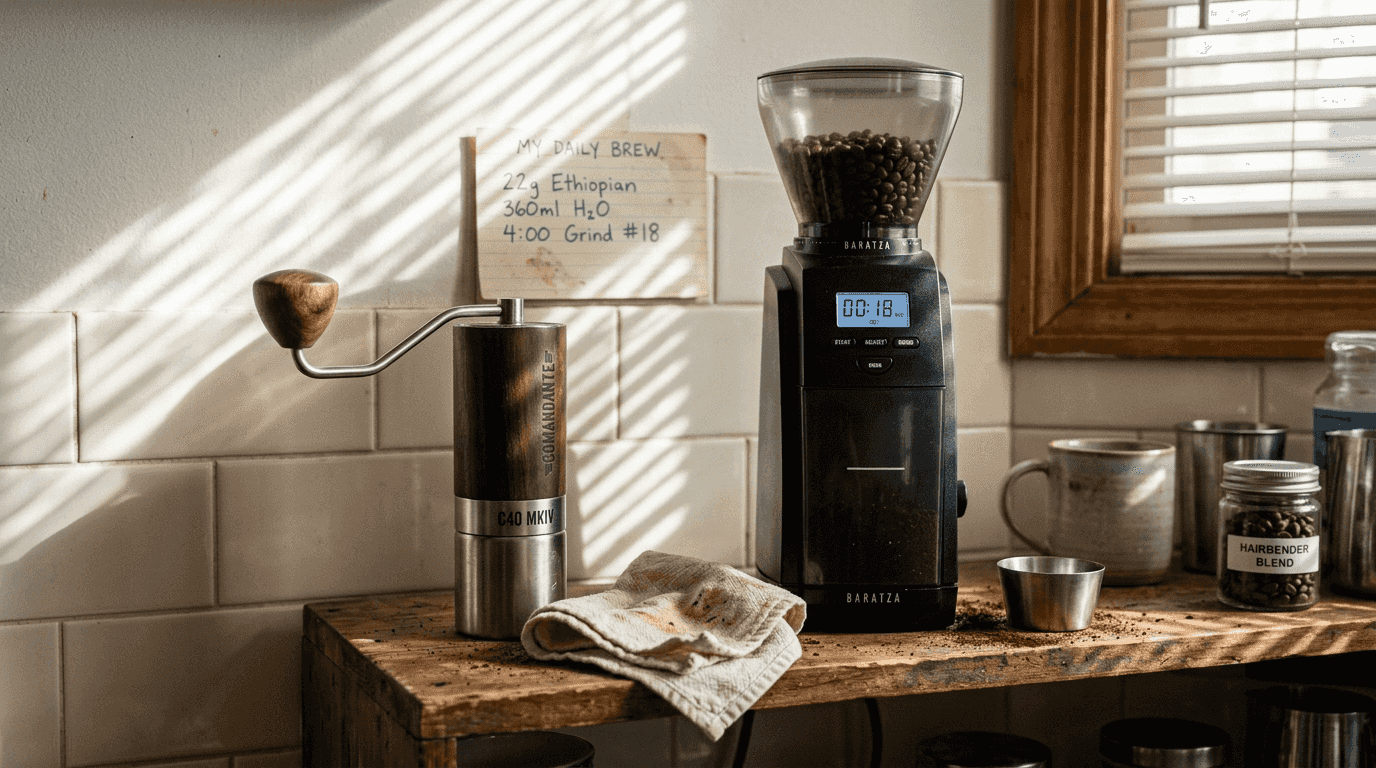
Manual grinders like the 1Zpresso K-Ultra have surged in popularity among enthusiasts who value portability and hands-on control. These hand-cranked models rival electric grinders in uniformity, often featuring high-quality steel burrs that produce professional-grade grinds. They’re ideal for travel, camping, or small kitchens where counter space is limited. The trade-off is effort and time, as grinding 18 grams for espresso can take 45 to 60 seconds of steady cranking. However, the tactile feedback and quiet operation appeal to those who enjoy the ritual of manual brewing.
Electric grinders offer speed and convenience, grinding the same dose in under 10 seconds with the push of a button. Entry-level models like the Baratza Encore suit home brewers seeking reliability without a steep learning curve, while high-end options like the Niche Zero or Fellow Ode cater to enthusiasts chasing single-dose workflows and minimal retention. Super-automatic machines integrate grinders directly into espresso makers, delivering one-touch convenience but sacrificing granular control over grind size and dose. These machines suit busy households prioritizing ease over customization.
RPM impacts particle size and extraction, especially in electric grinders. Higher speeds generate more heat and static, which can clump grounds and alter flavor. Lower RPM grinders reduce these issues but take longer to process beans. Flat burrs generally spin faster than conical burrs, producing slightly different particle shapes that influence mouthfeel and clarity. Understanding these nuances helps you choose a grinder that aligns with your coffee beans for flavor preferences and brewing goals.
| Feature | Manual Grinders | Electric Grinders |
|---|---|---|
| Grind consistency | Excellent with quality burrs | Excellent with quality burrs |
| Speed | 45-60 seconds per dose | 5-10 seconds per dose |
| Price range | $50-$300 | $100-$600+ |
| Portability | Highly portable | Stationary |
| Noise level | Silent | Moderate to loud |
| Best for | Travel, small spaces, hands-on control | Daily home use, speed, convenience |
Pro Tip: Calibrate your grinder by pulling test shots or brewing small batches at different settings. Note the extraction time and taste, then adjust finer or coarser until you hit the sweet spot for your espresso brewing guide or preferred method.
Essential brewing accessories beyond grinders
Precision scales ensure consistent brew ratios, the backbone of repeatable coffee quality. Measuring beans by weight rather than volume accounts for density variations between roasts and grind sizes, delivering accuracy within 0.1 grams. A scale with a built-in timer streamlines pour-over workflows, letting you track both dose and extraction time on a single device. This dual functionality simplifies your setup and keeps your focus on technique rather than juggling multiple tools.
Temperature-controlled kettles prevent over-extraction, especially critical for dark roasts that release bitter compounds quickly. Gooseneck spouts provide precise pouring control, essential for bloom phases and circular pours in methods like V60 or Chemex. Models with variable temperature settings let you dial in the exact heat level for each coffee, whether you’re brewing a bright, fruity light roast at 205°F or a smooth, chocolatey dark roast at 195°F. This flexibility helps you avoid the harshness that comes from over-extracting dark roasts with excessively hot water.
Quality tampers provide even pressure across the espresso puck, crucial for preventing channeling and achieving balanced extraction. Look for tampers that fit your portafilter basket precisely, leaving minimal gaps around the edges. Flat bases suit most workflows, while convex or ripple bases can enhance flow in certain setups. Consistent tamping pressure, typically around 30 pounds of force, creates a uniform puck density that encourages water to flow evenly through all the grounds.
Filters and brewers impact clarity, ease of use, and flavor nuances. Paper filters trap oils and fines, producing a clean, tea-like cup, while metal filters allow more body and texture to pass through. Ceramic and glass brewers retain heat well, maintaining stable temperatures throughout extraction, whereas plastic and stainless steel options offer durability and portability. Your choice depends on whether you prioritize flavor purity, convenience, or ruggedness for travel and outdoor brewing.
- Digital scales with 0.1-gram precision and integrated timers streamline pour-over and espresso workflows.
- Gooseneck kettles with variable temperature control prevent over-extraction and enhance pouring accuracy.
- Calibrated tampers ensure even puck density, reducing channeling and off-flavors in espresso.
- Paper filters deliver clean cups, while metal filters preserve oils and body for richer mouthfeel.
- Preheating brewers and vessels maintains temperature stability, crucial for consistent extraction.
Pro Tip: Preheat your brewer and mug with hot water before brewing. This simple step maintains temperature stability throughout extraction, preventing heat loss that can lead to under-extraction and sour, weak coffee. Check out our coffee brewing guide for more techniques.
Comparing accessory sets for home enthusiasts and professional baristas
Home accessory sets prioritize ease of use, space efficiency, and simplified controls. These bundles typically include an entry-level burr grinder, a basic scale, a simple tamper, and a manual brewer like an AeroPress or French press. They’re designed for beginners who want to elevate their coffee without overwhelming complexity or a steep learning curve. Prices range from $100 to $300, making them accessible for casual drinkers ready to move beyond pre-ground coffee and drip machines.
Professional sets emphasize precision, durability, and customizable features. Baristas working in cafés or serious home enthusiasts invest in high-end grinders with stepless adjustment, commercial-grade tampers with ergonomic handles, and advanced scales that track flow rates during extraction. These kits often include distribution tools, puck screens, and bottomless portafilters for diagnosing channeling and perfecting technique. Prices climb from $500 to over $1,500, reflecting the quality and longevity required for daily, high-volume use.
| Feature | Home Enthusiast Sets | Professional Barista Sets |
|---|---|---|
| Grinder type | Entry-level burr grinder | High-end burr grinder with stepless adjustment |
| Scale precision | 1-gram increments | 0.1-gram increments with flow rate tracking |
| Tamper quality | Basic flat tamper | Calibrated or ergonomic tamper |
| Additional tools | Simple brewer, basic kettle | Distribution tool, puck screen, bottomless portafilter |
| Price range | $100-$300 | $500-$1,500+ |
| Target user | Beginners, casual home brewers | Professional baristas, serious enthusiasts |
| Durability | Moderate, suitable for occasional use | High, built for daily, high-volume use |
Choosing between these sets depends on your skill level, budget, and brewing preferences. If you’re just starting, a home set provides everything you need to explore quality coffee without financial strain. As your palate develops and you crave more control, upgrading to professional-grade tools becomes a natural progression. Many enthusiasts build their setups incrementally, starting with a solid grinder and scale, then adding specialized tools as they refine their coffee accessories selection guide and technique.
Uniform grind and distribution remain essential regardless of your setup. Investing in quality tools that address these fundamentals pays dividends in flavor clarity and consistency, whether you’re pulling shots at home or serving customers in a bustling café.
- Home sets offer affordability and simplicity, perfect for beginners exploring specialty coffee.
- Professional sets deliver precision and durability, essential for baristas and advanced home brewers.
- Incremental upgrades let you build a setup that grows with your skills and budget.
- Prioritize grinder quality first, as it has the greatest impact on flavor and extraction.
Pro Tip: Start with essential accessories like a burr grinder and scale, then expand your toolkit as you identify specific needs. This approach prevents overspending on tools you may not use and lets you invest strategically in items that genuinely improve your brewing.
Upgrade your coffee experience with Z’s Coffee accessories
Now that you understand the criteria and tools that elevate your brewing, it’s time to explore products that deliver on quality and convenience. Z’s Coffee offers a curated coffee collection featuring premium blends and single-origin beans sourced from top-growing regions worldwide. Whether you’re dialing in espresso or experimenting with pour-over, these beans provide the foundation for exceptional flavor.

Beyond beans, you’ll find brewing accessories designed for both beginners and professional baristas. From precision scales to temperature-controlled kettles, each product supports consistent results and enhances your daily ritual. If you prefer cold brew, explore our cold brew coffee products for smooth, low-acid options that shine over ice. Complete your setup with stylish travel mugs that keep your coffee hot during commutes or outdoor adventures. Shop now and discover tools that turn every cup into a moment of excellence.
FAQ
What are the must-have coffee accessories for beginners?
Start with a burr grinder, a digital scale, a quality tamper, and a reliable brewer like an AeroPress or pour-over dripper. These tools ensure consistent grind size, accurate ratios, even extraction, and repeatable results. As you develop your skills, you can add temperature-controlled kettles and distribution tools to refine your technique further. Focus on coffee accessories for beginners that address the fundamentals first.
How do manual and electric grinders compare in grind quality?
Manual grinders can match electric grinders in uniformity when equipped with high-quality burrs, making them excellent for travel and small spaces. Electric grinders offer speed and convenience, grinding doses in seconds, but may sacrifice some hands-on control over particle size. Both types produce professional-grade results when you choose reputable models. Your decision depends on whether you prioritize portability and quiet operation or speed and ease of use. Learn more in our guide on manual vs electric grinders.
What accessory is most important for preventing bitter or sour coffee?
Proper distribution of grounds and consistent tamping help avoid channeling, which causes uneven extraction and produces both sour and bitter notes simultaneously. A quality distribution tool levels the coffee bed before tamping, and a calibrated tamper applies uniform pressure across the puck. Together, these accessories ensure water flows evenly through all the grounds, extracting flavors consistently. Investing in these tools significantly improves cup quality and reduces off-flavors. Explore tips to prevent bitter coffee in our detailed guide.
Is investing in professional-grade accessories worth it for home brewers?
Professional-grade tools provide enhanced durability, precision, and control, making them worthwhile for serious enthusiasts who brew daily and want to refine their craft. If you’re a casual drinker or just starting, entry-level accessories offer excellent value and performance without the higher price tag. As your skills and passion grow, upgrading to professional coffee accessories becomes a natural next step. Consider your brewing frequency, goals, and budget when deciding whether to invest in premium tools.