TL;DR:
- Single serve packaging offers pre-measured, sealed portions that ensure freshness, convenience, and portion control.
- However, environmental impact depends more on the materials used and waste infrastructure than recycling alone.
Single serve packaging is defined as a format where each product portion is individually sealed for one-time use, eliminating the need to measure, scoop, or portion before brewing. For coffee and gourmet beverage consumers, this means every cup starts with a controlled, fresh dose. Formats like Keurig K-Cups, sachets, and spout pouches have made this the default choice for millions of households. Understanding single serve packaging means understanding how convenience, freshness, and environmental responsibility intersect in every package you open.
What is single serve packaging and how does it work?
Single serve packaging, also called unit dose packaging in manufacturing and pharmaceutical contexts, refers to any format where each dose is physically separated and sealed until use. The core principle is simple: one package, one serving, no guesswork. This contrasts sharply with bulk packaging, where every use requires measuring and exposes the remaining product to air, moisture, and contamination.

The practical result for coffee drinkers is consistency. Every K-Cup, sachet, or spout pouch delivers the same dose with the same barrier protection as the one before it. Seal integrity and barrier performance in these packs directly maintain freshness and prevent spoilage during storage and transport. That is why specialty coffee brands increasingly rely on sealed, pre-measured formats to protect flavor from roast to cup.
What are the common types of single serve packaging?
Single serve packaging spans several distinct formats, each suited to different products and use cases. The table below covers the main types you will encounter in coffee and gourmet beverage markets.
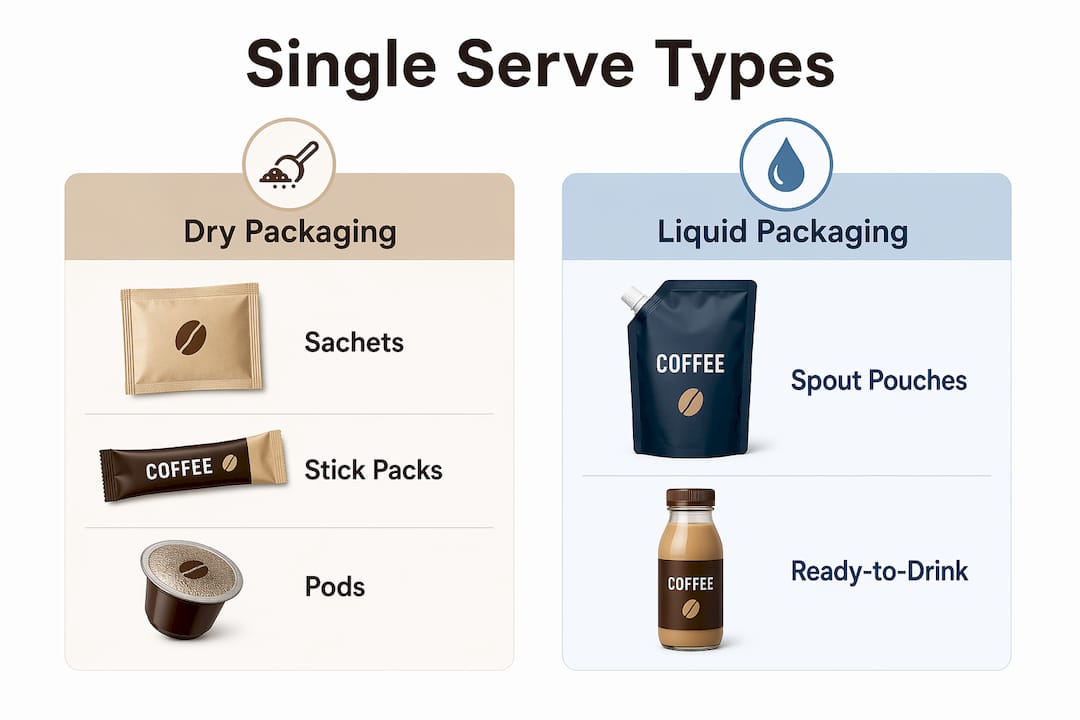
| Format | Primary materials | Best for | Key feature |
|---|---|---|---|
| Sachets / packets | Foil laminate, plastic film | Ground coffee, instant coffee, powders | Minimal material, strong moisture barrier |
| Coffee pods (K-Cups) | Plastic cup, aluminum foil lid, paper filter | Drip-style coffee machines | Machine-compatible, pre-filtered |
| Spout pouches | Flexible plastic film, foil layers | Cold brew, liquid coffee, functional drinks | Resealable, ships flat |
| Stick packs | Laminated film | Instant coffee, creamers, supplements | Slim profile, easy to carry |
| Capsules (Nespresso-style) | Aluminum or compostable bioplastic | Espresso | High-pressure seal, precise extraction |
Sachets and stick packs
Sachets use minimal materials while providing strong oxygen and moisture barriers, making them cost-effective for mass distribution of coffee powders and single-dose supplements. Stick packs are a narrower variant of the same concept, designed to pour cleanly into a cup. Both formats are widely used in instant coffee and flavored beverage mixes.
Coffee pods and capsules
K-Cups are the most recognized single serve format in North America, composed of a plastic cup, an aluminum foil lid, and an internal paper filter. Nespresso capsules use aluminum or, increasingly, compostable bioplastic shells. The sealed construction protects ground coffee from oxygen exposure, which is the primary driver of stale flavor. You can read more about how packaging protects coffee flavor and why the seal matters as much as the roast.
Spout pouches for liquid beverages
Spout pouches have expanded beyond baby food into cold brew, functional drinks, and liquid coffee concentrates. Flexible spout pouches use 60 to 80% less plastic than rigid plastic bottles of the same volume and reduce transport footprint because they ship flat. That combination of reduced material and lower logistics emissions makes them a growing choice for premium beverage brands.
Pro Tip: When buying single serve coffee products, check whether the packaging specifies nitrogen flushing or vacuum sealing. These processes remove oxygen before sealing and extend shelf life significantly compared to standard sealed packs.
What are the main benefits and challenges of single serve packaging?
Core benefits
Single serve packaging delivers four measurable advantages for coffee and beverage consumers:
- Freshness per serving. Each portion is sealed at peak freshness and opened only at the moment of use. Bulk bags, once opened, begin oxidizing immediately.
- Precise portion control. Pre-measured formats reduce product exposure after opening and provide clearer labeling and traceability compared to multi-dose containers.
- Convenience and portability. Sachets and stick packs fit in a pocket or travel bag. K-Cups require no grinder, no scale, and no cleanup beyond discarding the pod.
- Reduced food waste. Individually sealed portions prevent the spoilage that occurs when bulk products sit open for weeks. This is especially relevant for specialty coffees with short optimal-use windows after roasting.
Real trade-offs to consider
The advantages come with genuine costs. Here are the main challenges, ranked by consumer impact:
- Packaging waste volume. Each serving generates its own packaging material. A household consuming two K-Cups per day produces roughly 730 pods per year, most of which end up in landfill without specialized recycling.
- Higher cost per serving. Single serve formats consistently cost more per gram of coffee than whole bean or ground coffee sold in bulk. The premium pays for convenience and packaging, not necessarily better coffee.
- Material complexity. Multi-layer laminates and composite pods are harder to recycle than single-material packaging. This limits end-of-life options even when consumers want to dispose responsibly.
- Limited customization. Pre-dosed formats fix the brew ratio. Specialty coffee drinkers who dial in grind size and dose for each bag will find pods restrictive.
Pro Tip: If you use K-Cups regularly, look for brands that participate in dedicated pod take-back programs. Some manufacturers provide prepaid return envelopes that route pods to specialized recycling facilities rather than landfill.
How does single serve packaging impact environmental sustainability?
The environmental story of single serve packaging is more nuanced than the recycling bin debate suggests. Life cycle assessments show that more than 95% of a package’s emissions come from the production phase, while end-of-life contributes only about 2% on average. This means the material choices made during manufacturing matter far more than whether a consumer recycles the pod correctly.
That finding reframes the conversation. Obsessing over whether a K-Cup goes in the recycling bin misses the larger picture. Choosing packaging made from lower-impact materials, or formats that use less material overall, produces greater environmental benefit than optimizing disposal behavior alone.
Compostable vs. recyclable vs. landfill-bound pods
| Pod type | End-of-life pathway | Key condition |
|---|---|---|
| Standard K-Cup (plastic + aluminum) | Recyclable with separation | Requires component separation; most curbside programs reject whole pods |
| Compostable pod (bioplastic) | Commercial composting | Requires industrial composting facility; home compost is typically ineffective |
| Aluminum Nespresso capsule | Recyclable via brand program | Requires participation in Nespresso’s dedicated recycling scheme |
| Reusable pod (stainless steel) | No single-use waste | Requires compatible machine and willingness to grind and fill manually |
Standard K-Cups are not compostable in home compost bins due to material complexity. Compostable versions exist but require commercial composting facilities that accept them, and many municipal systems do not. This gap between the label and the reality is where most consumer confusion originates.
“Sustainability claims like ‘compostable’ or ‘recyclable’ only matter if local waste management systems can actually process the materials.” This is the most important sentence any coffee drinker can internalize before buying a pod product.
Spout pouches offer a different sustainability profile. Their reduced plastic volume and flat-shipping efficiency mean lower emissions during production and transport, even if the multi-layer film is difficult to recycle at the curb. Life cycle assessments for flexible packaging show carbon emission reductions of 30 to 70% compared with rigid alternatives, which is a significant production-phase advantage.
What market trends are shaping single serve packaging in 2026?
The single serve packaging market in coffee and gourmet beverages is moving in three clear directions simultaneously.
- Shift to commercial compostable materials. Major pod manufacturers are investing in bioplastic and plant-fiber capsule shells that meet industrial composting standards. The challenge remains infrastructure: compostable pods only deliver on their promise where certified facilities exist.
- Growth of flexible spout pouches. Cold brew brands, functional coffee drinks, and liquid espresso concentrates are adopting spout pouches at scale. The format’s lower material footprint and transport efficiency align with both cost reduction and sustainability goals.
- Dose-accurate formats for specialty coffee. Convenience and precise dosage control are the core drivers of single serve adoption, and specialty roasters are responding with nitrogen-flushed sachets and pre-portioned ground coffee packets that preserve origin character without requiring a grinder.
- Brand transparency on disposal. Consumers in 2026 expect clear, specific disposal instructions on packaging rather than generic recycling symbols. Brands that provide facility locators or take-back programs are gaining trust with environmentally aware buyers.
- Reusable pod accessories. Stainless steel and BPA-free reusable pods compatible with Keurig and Nespresso machines have grown into a mainstream accessory category, letting consumers use their preferred ground coffee while eliminating single-use waste.
How to choose and use single serve packaging responsibly
Making good decisions about single serve packaging starts with three questions before you buy: What material is the packaging made from? Does your local waste system accept it? Is there a take-back or recycling program from the brand?
- Check local composting and recycling capabilities first. Search your municipality’s waste management website for accepted materials before assuming a “compostable” label means curbside-compatible. Most compostable pods require industrial facilities.
- Prioritize formats with lower material intensity. Sachets and stick packs use less material per serving than rigid pods. If your brewing method supports them, they represent a lower-impact choice.
- Use reusable pods where machine compatibility allows. A stainless steel refillable pod for a Keurig machine eliminates pod waste entirely while giving you full control over coffee selection and grind.
- Store single serve products correctly. Keep sachets and pods away from heat, light, and humidity. Proper storage extends shelf life and reduces the chance of discarding product before use, which wastes both the coffee and the packaging.
- Buy from brands with transparent disposal programs. Nespresso’s aluminum recycling scheme and certain specialty roasters’ compostable pod programs are examples of manufacturer-level responsibility that goes beyond the label.
Pro Tip: For the best flavor from any single serve format, check the roast date on the packaging rather than the best-by date. Coffee peaks between 7 and 21 days post-roast. A pod roasted six months ago and sealed well is still inferior to a fresh-roasted sachet opened at the right time.
Key takeaways
Single serve packaging delivers genuine freshness and convenience benefits, but its environmental value depends entirely on material choices and local waste infrastructure, not just the label on the box.
| Point | Details |
|---|---|
| Core definition | Each portion is individually sealed, eliminating measuring and reducing spoilage. |
| Production phase dominates | Over 95% of packaging emissions come from manufacturing, not disposal. |
| Compostability requires infrastructure | Compostable pods only work where certified industrial composting facilities exist. |
| Spout pouches reduce material use | Flexible pouches use 60 to 80% less plastic than rigid bottles of equal volume. |
| Responsible buying starts with local research | Check your municipality’s accepted materials before trusting any sustainability label. |
Why I think the recycling debate misses the real point
Most conversations about single serve packaging get stuck on the recycling bin question. I understand why. It feels like the most concrete action available. But after spending years sourcing, tasting, and writing about coffee, I have come to believe that fixating on end-of-life disposal is the wrong frame entirely.
The production phase accounts for the overwhelming majority of a package’s environmental footprint. That means the most impactful decision happens at the point of purchase, not the trash can. Choosing a nitrogen-flushed sachet from a roaster who uses minimal laminate film beats choosing a “compostable” pod from a brand whose supply chain is carbon-intensive, even if the pod technically breaks down in the right facility.
The other thing I would push back on is the idea that single serve packaging is inherently wasteful. A bulk bag of coffee opened and left on a counter for three weeks, losing flavor and eventually discarded half-full, wastes both product and the packaging it came in. A sealed sachet opened at the right moment wastes neither. Coffee freshness is not a marketing claim. It is a measurable quality variable, and single serve formats protect it better than almost any alternative for the average consumer.
My honest recommendation: use single serve packaging for the coffees you drink daily, invest in a reusable pod or a grinder for the specialty bags you want to explore, and spend your environmental energy on choosing brands with transparent sourcing and lower-impact materials rather than agonizing over which bin the pod goes in.
— zachary
Explore single serve coffee at Zscoffee
Zscoffee carries a curated range of single serve coffee and tea products built around the same principles this article covers: freshness, precise dosing, and flavor integrity from roast to cup. Whether you prefer the grab-and-go simplicity of sachets or the machine-ready convenience of pods, the single serve coffee and tea collection at Zscoffee gives you options sourced from quality-focused roasters. Every product in the range is selected with packaging that protects the coffee, not just the shelf life. Browse the full selection and find the format that fits your brewing routine.
FAQ
What is single serve packaging?
Single serve packaging is a format where each product portion is individually sealed for one-time use, providing a pre-measured dose without the need for scooping or measuring. Common formats include sachets, coffee pods, capsules, and spout pouches.
Are K-Cup coffee pods recyclable or compostable?
Standard K-Cups require component separation for recycling and are not suitable for home composting due to their mixed plastic and aluminum construction. Compostable K-Cup alternatives exist but require access to a certified industrial composting facility.
Why does single serve packaging cost more per serving?
The higher cost per serving reflects the additional materials, sealing technology, and individual packaging required for each dose. Consumers pay for the convenience, freshness protection, and portion accuracy that bulk formats cannot match.
How do spout pouches compare to plastic bottles for sustainability?
Flexible spout pouches use 60 to 80% less plastic than rigid bottles of the same volume and generate lower transport emissions because they ship flat. Life cycle assessments show flexible packaging can reduce carbon emissions by 30 to 70% compared with rigid alternatives.
How should I dispose of single serve coffee packaging responsibly?
Check your local municipality’s waste management guidelines before assuming curbside recycling or composting applies. For pods, look for brand-specific take-back programs, and consider switching to reusable pod accessories compatible with your machine to eliminate single-use waste entirely.