The global coffee trade connects roughly 25 million farming households to your morning cup, and it determines what you pay, what origins you can find, and how much of that price actually reaches the farmer who grew it. Most shoppers treat coffee as a grocery item. It isn’t. It’s one of the most traded commodities on earth, and the decisions made at every link in its supply chain show up in your bag’s flavor, freshness, and price.
Three things you can do right now:
- Look for a named origin, cooperative, or mill on the product page, not just a country.
- Prefer single-origin or producer-linked lots over generic blends when you want your dollar to travel further up the chain.
- Check whether a retailer pairs its certification claims with a living-income or direct-trade program.
Table of Contents
- How does the global coffee trade actually work?
- Who actually captures the value in coffee?
- How big is the global coffee market, and why does it affect your shelf?
- Do sustainability certifications actually help farmers?
- Why do retail coffee prices keep changing?
- What can you do as a U.S. shopper to support fairer outcomes?
- How Zscoffee approaches sourcing and transparency
- Key Takeaways
- The part that gets overlooked
- Where to put this into practice
- Useful sources
How does the global coffee trade actually work?
Coffee moves through a long chain before it reaches you. A farmer harvests the cherry, a wet or dry mill processes it into green beans, an exporter buys and grades those beans, a trader or importer moves them across borders, a roaster transforms them, and a retailer sells the finished product. Each handoff adds cost and, often, removes traceability.
The most consequential stages for price-setting are the exporter and the trader. Green coffee is still a commodity in those hands, priced against futures contracts on the ICE exchange. By the time a roaster buys it, the price reflects weather forecasts, currency moves, and speculative positioning, not just what it cost to grow. Traceability, when it exists, is usually preserved by cooperatives that keep lot separation from farm to export, or by direct-trade roasters who contract with specific producers before harvest.
Pro Tip: When reading a product page, look for a lot number, cooperative name, or processing station alongside the country of origin. A bag that lists only “Ethiopia” has lost traceability somewhere in the chain; one that lists “Ethiopia, Yirgacheffe, Kochere Cooperative, washed process” has kept it.
Who actually captures the value in coffee?
Most of the money stays at the consuming end. Value creation concentrates among roasters, traders, and retailers in high-income countries, while producing countries export more than 90% of their coffee as raw green beans, capturing little of the processing margin. Countries that invest in domestic roasting and soluble coffee production can climb that value ladder, but entry barriers, including tariffs on processed coffee and competition from established brands, keep most origins locked into green-bean exports.
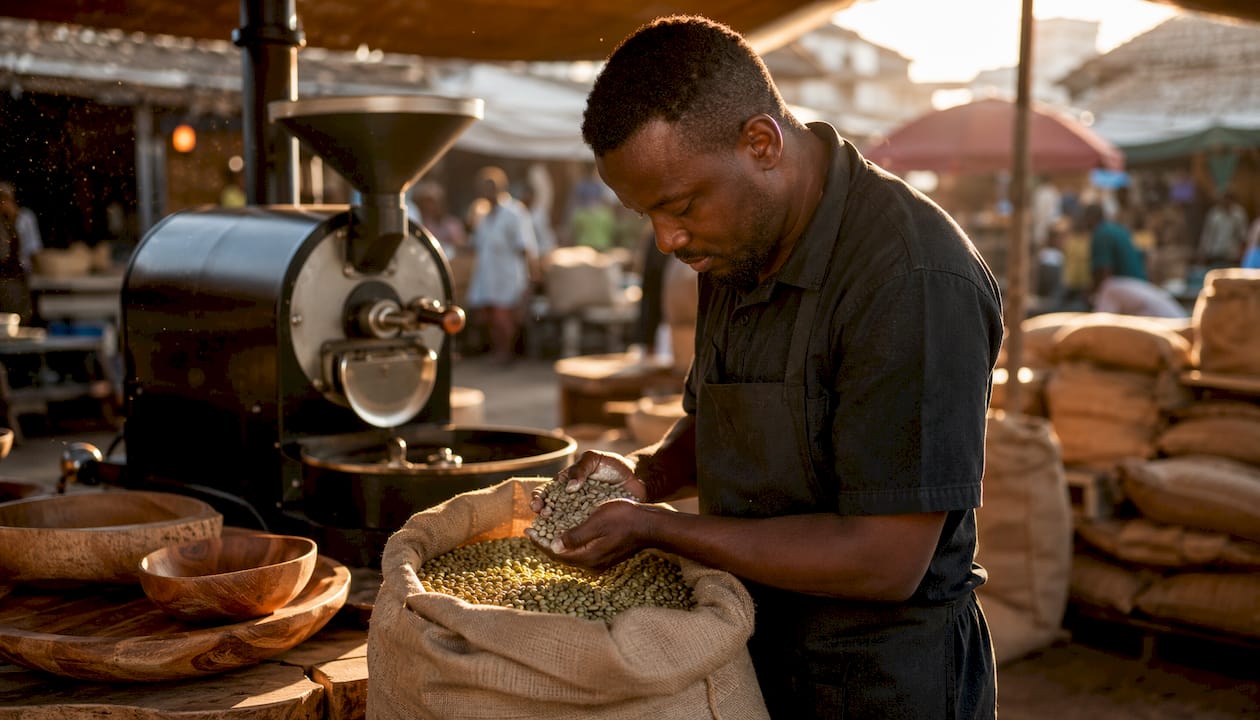
The income gap has a name in the research literature. A Frontiers in Sustainable Food Systems study found a sharp mismatch: farmers prioritize a dignified quality of life and living income, while roasters and consumers prioritize drinking experience and pleasure. That gap isn’t just philosophical. It explains why a $20 retail bag doesn’t automatically mean the farmer earned more.
For shoppers, the practical implications are:
- A higher retail price signals quality or branding, not necessarily a higher farm-gate price.
- Premiums paid to a cooperative reach farmers only if the cooperative’s governance is sound.
- Retailers that publish estimated producer prices or premium splits give you the clearest signal that value is actually moving upstream. Zscoffee’s fair pricing guide explains how to read those signals.
How big is the global coffee market, and why does it affect your shelf?
Global coffee exports are valued in the tens of billions of dollars, consumption is growing annually, and production has risen substantially over the past two decades. The USDA projects world production will reach a record 189.7 million bags in 2026/27, which should ease near-term supply pressure and moderate prices.
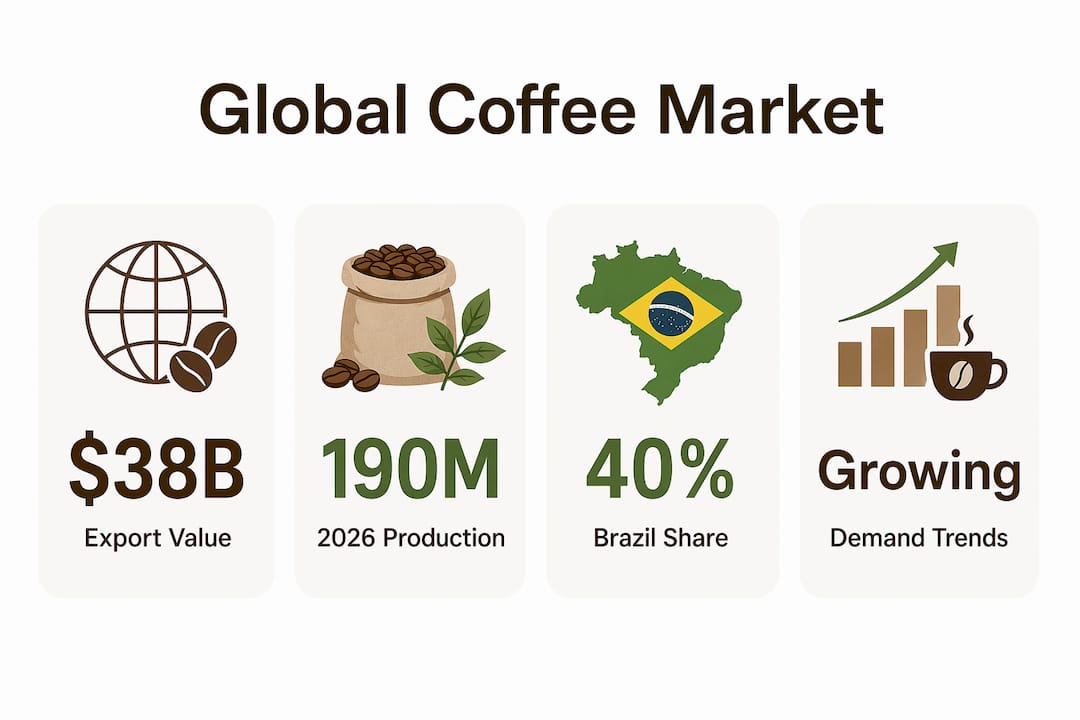
Brazil accounts for a significant share of world production, accounting for nearly two-fifths and its Arabica trees follow a biennial on/off yield cycle. In an “off” year, global Arabica supply tightens and futures spike. That single fact explains most of the price volatility U.S. shoppers have felt over the past few years.
| Metric | Figure |
|---|---|
| Global export value | ~$38 billion |
| USDA 2026/27 production forecast | 189.7 million bags |
Three trends shaping what you find on shelves: specialty demand keeps growing in North America and Europe; global stocks are forecast higher for 2026/27, which may soften prices; and new consumer markets in Asia, particularly China, are absorbing supply that once flowed primarily to the U.S. and EU.
Do sustainability certifications actually help farmers?
Certifications can open market access and set environmental floors, but they often fall short on income. A systematic review of coffee trade social impacts found that certifications deliver the most benefit when paired with direct income interventions. Without that pairing, farmers frequently bear the cost of compliance, including annual audits and documentation, without receiving a price premium in return.
What certifications typically promise versus what they deliver:
- Fairtrade: minimum price floor and cooperative social premiums, but requires membership in a well-governed cooperative.
- Rainforest Alliance: environmental and biodiversity standards, weaker on income guarantees.
- Organic: price premiums for chemical-free production, but a three-year transition period without income support can strain smallholders.
Pro Tip: On a product page, a certification badge alone isn’t enough. Look for a second signal: does the retailer also mention a living-income reference price, a direct-trade contract, or a named producer partnership? That combination is where real income improvement tends to happen. Zscoffee’s certification guide breaks down what each label actually covers.
Why do retail coffee prices keep changing?
Origin weather is the fastest trigger. When Brazil’s harvest slows due to drought or excess rain, Arabica futures move within days. But that price signal reaches your grocery shelf slowly. FAO and ICO analysis shows a 1% rise in international coffee prices translates to roughly a 0.20% retail price increase in the U.S. after about 13 months. Roasters absorb short-term swings through hedging and inventory; they pass costs through gradually.
The drivers, by time horizon:
- Short run (weeks): roasting delays, packaging costs, container availability.
- Medium run (months): shipping rates, currency exchange, futures positioning.
- Long run (years): climate change effects on yield, land-use shifts, varietal adaptation.
What can you do as a U.S. shopper to support fairer outcomes?
Shoppers can shift value distribution by choosing traceable, premium-paying options and asking the right questions before checkout. Here’s a practical checklist:
- Ask for traceability. Does the product page name a farm, cooperative, or processing station?
- Prefer single-origin or producer-linked lots. These are more likely to carry a traceable premium. The specialty vs. commodity distinction matters here.
- Look for a stated producer price or premium split. A retailer that publishes what the farmer received is a retailer with something to prove.
- Check for a living-income program. Certification plus a named living-income initiative is stronger than certification alone.
- Buy fresh-roasted. A roast date on the bag signals a roaster who controls the supply chain closely enough to date it.
- Use subscriptions for consistency. Consistent volume commitments give producers planning certainty, which is often more valuable than a one-time price premium.
Pro Tip: A direct-trade subscription from an origin-focused retailer delivers consistent premiums to producers across multiple harvests, which is more impactful than occasional single purchases at a higher price point.
How Zscoffee approaches sourcing and transparency
Zscoffee treats product pages as sourcing documents, not just listings. The goal is to give shoppers the origin detail, processing method, and producer context they need to connect a purchase to a real place and a real farmer. That means naming cooperatives, linking to sourcing blog posts, and explaining what makes a particular lot worth its price.
When you shop a transparent product page, look for: the specific origin and region, the cooperative or mill name, the processing method, the roast date, and any note about producer pricing or premium programs. Those five elements, together, tell you whether a retailer has done the sourcing work or just applied a label.
Key Takeaways
The global coffee trade shapes every cup you buy, and informed shoppers can use that knowledge to support better outcomes for farmers and better quality for themselves.
| Point | Details |
|---|---|
| Scale of the trade | Global coffee exports are worth roughly $38 billion, and about 25 million farming households depend on the crop. |
| Value stays downstream | Most coffee is exported as green beans, with processing value largely retained by roasters and retailers in high-income countries. |
| Certification limits | Certifications help most when paired with direct income support; compliance costs can fall on farmers without price premiums reaching them. |
| Price transmission lag | Retail prices typically respond slowly to international price changes, with increases taking about a year to affect shelf prices. |
| Zscoffee’s approach | Zscoffee offers traceable single-origin coffees with origin notes and sourcing context so shoppers can connect purchases to producer impact. |
The part that gets overlooked
The coffee industry has spent two decades layering certifications, sustainability pledges, and corporate commitments on top of a structure that still concentrates value at the consuming end. The Frontiers research is blunt about it: farmers want a living income, and most of the market is optimized to deliver a pleasurable drinking experience. Those two things aren’t incompatible, but closing the gap requires more than a badge on a bag.
What actually moves the needle is consistent buyer commitment: roasters and retailers who contract with specific producers across multiple harvests, publish what they pay, and build relationships that survive a bad crop year. Consumer demand for that kind of transparency is the pressure that makes it happen. Choosing a retailer that does the sourcing work, and asking questions when they don’t, is the most direct lever a U.S. shopper has.
Where to put this into practice
Zscoffee stocks traceable single-origin coffees and origin-focused blends that follow the sourcing principles this article covers: named origins, processing detail, and roast-date transparency. If you’ve been buying coffee on autopilot, this is a straightforward place to start doing it differently.
Browse the Zscoffee shop to find single-origin lots with full sourcing context, or read through the sourcing blog for deeper dives into specific origins and what makes them worth your attention. If you want to understand how retail pricing and loyalty programs factor into the value chain from the shop’s side, the loyalty pricing guide at Loyalty Leads offers useful context. The next step is simple: pick one bag, read the product page the way this article taught you, and see what the retailer is actually telling you.
Useful sources
| Source | What it covers |
|---|---|
| FAO: Coffee Markets and Trade | Global production, livelihoods, export earnings, and value chain structure |
| FAO: Global Coffee Market and Recent Price Developments | Price transmission rates, supply drivers, and recent market developments |
| International Trade Centre: Understanding the Coffee Market | Export values, consumption growth, and specialty vs. commodity market dynamics |
| Frontiers in Sustainable Food Systems: Value Chain Mismatches | Farmer vs. consumer priority mismatch; value distribution research |
| USDA/FAS: Coffee World Markets and Trade | Brazil production cycles, Arabica supply swings, and global trade data |
| Watts et al. Systematic Review (Trade Hub) | Social impact of certifications; evidence on when they help and when they don’t |
| ICO Coffee Development Report | Global value chain structure, specialty vs. commodity segmentation, value capture |
| USDA 2026/27 Production Forecast (Comunicaffe) | Record production forecast and near-term supply expectations |
This article is general educational information about global coffee markets, not financial or trade policy advice. For exact figures and current market data, consult the primary sources listed above.