TL;DR:
- By 2026, coffee shopping relies on integrated POS systems, AI-assisted discovery, and simplified subscription workflows. These technologies enable real-time inventory, personalized recommendations, and faster, more accurate orders, transforming consumer experience. Effective use of scan-to-buy apps, subscription planning, and strategic purchasing helps shoppers adapt to rising coffee prices and market volatility.
The coffee shopping workflow in 2026 is defined by the integration of POS technology, AI-assisted ordering, and subscription management that together reshape how you discover, buy, and receive coffee. What was once a simple cart-and-checkout process now involves mood-based AI recommendations, recipe-linked inventory systems, and scan-to-buy apps that read a bag’s origin and roast date before you even type a word. Platforms like Starbucks, Deelo, and Joe.coffee are setting the pace. Whether you’re managing a weekly subscription or hunting a single-origin Ethiopian, understanding how these systems work puts you in control of your purchasing decisions.
How does the coffee shopping workflow 2026 actually work?
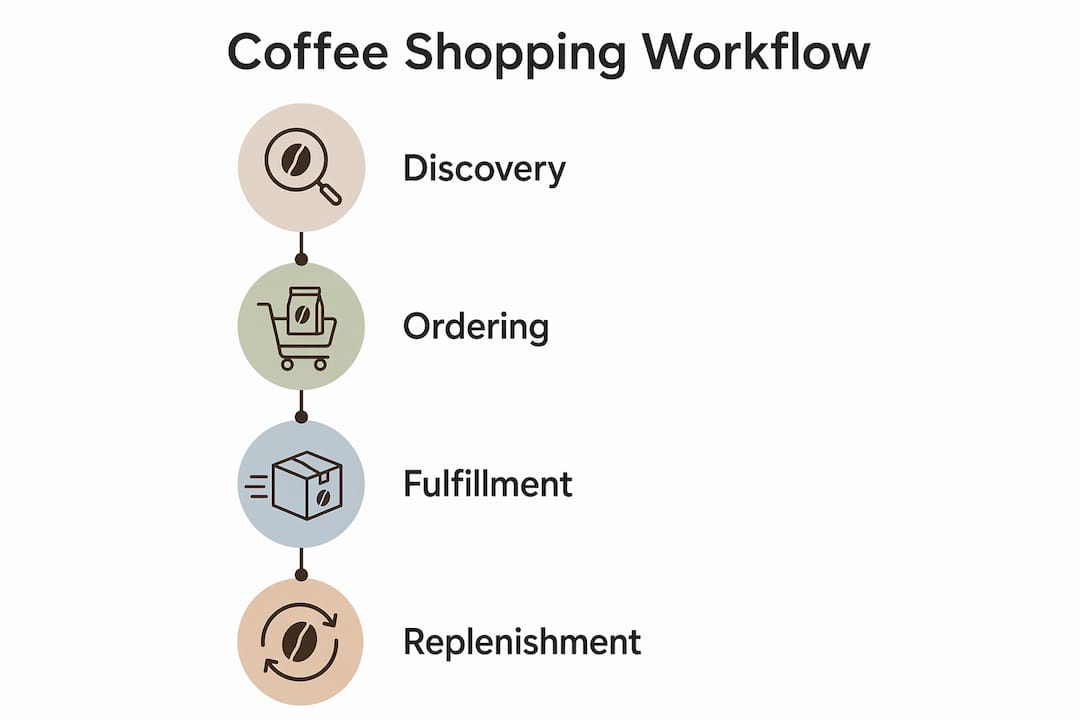
A modern coffee purchasing workflow connects four layers: discovery, ordering, fulfillment, and replenishment. Each layer now has a dedicated technology layer behind it, and they talk to each other in real time. The result is a buying experience that feels faster and more personalized than it did even two years ago.
Discovery starts with AI recommendations or label scanning. Ordering flows through a mobile app or web storefront connected to live inventory. Fulfillment is tracked at the ingredient level, not just the SKU level. Replenishment happens automatically through subscription cadence or par-level reorder triggers. Understanding this four-layer structure is the clearest way to evaluate any coffee platform you use in 2026.
The shift matters because it changes what you should expect from a coffee retailer. A platform that only offers a static product catalog with no inventory sync or subscription option is operating on a 2019 model. The 2026 coffee buying guide standard is real-time availability, AI-assisted selection, and flexible repeat ordering.
How do modern POS systems unify coffee shopping and inventory management?
POS systems in 2026 do far more than process payments. They act as the operational spine connecting your order to the roaster’s stock, the barista’s recipe, and the retailer’s reorder schedule. Connected POS and EPOS systems keep in-store, online, and mobile order workflows synchronized in real time, including menu syncing and stock tracking across platforms like Joe.coffee, Baseer, and Yumapos.
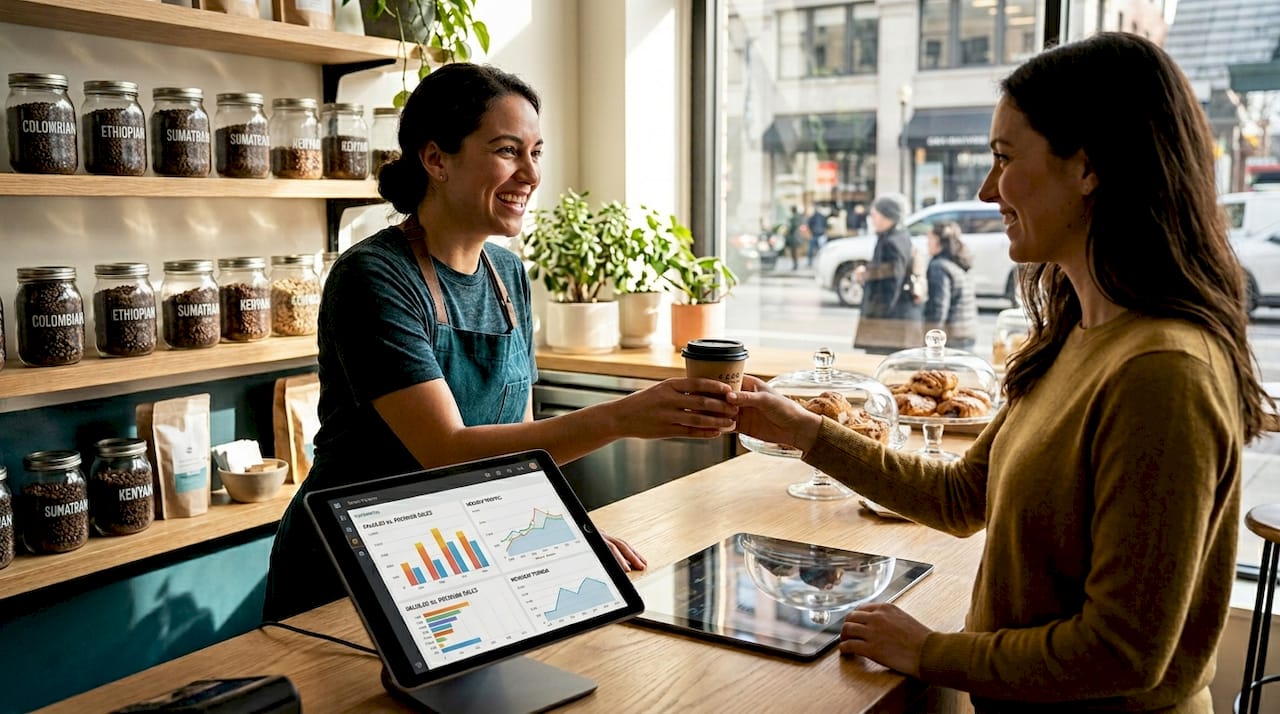
The most important technical shift is inventory management at the ingredient level. Rather than tracking “one bag of coffee sold,” a well-configured POS system tracks beans, milk, and syrups as separate ingredients tied to each recipe. Linking inventory to POS recipes avoids inventory count drift and enables automatic ingredient decrement for each drink sold, with accurate par-level reorder triggers firing when stock falls below threshold. This means the bag you order online is actually in stock, not just listed.
Here is what a unified POS workflow delivers for you as a consumer:
- Real-time availability: Menu items reflect actual stock, so out-of-stock surprises at checkout drop significantly.
- Price consistency: Promotions and price changes sync across the app, website, and in-store kiosk simultaneously.
- Faster checkout: Pre-saved preferences and loyalty data pull automatically, cutting the time from selection to confirmation.
- Accurate order history: Every purchase, whether placed via mobile or in-store, appears in one unified account view.
Pro Tip: When evaluating a coffee platform, check whether it shows real-time stock status on the product page. If availability only updates after you add to cart, the retailer is likely running a disconnected inventory system, and your order is more likely to face delays.
The Deelo platform is a strong example of this approach. Automatic PO and receipt updates keep inventory and payables current without manual input, which means the retailer spends less time on admin and more time sourcing quality beans. That operational efficiency eventually reaches you as a shopper through better stock reliability and faster shipping.
What role does AI play in enhancing coffee purchasing workflows in 2026?
AI in 2026 operates on two distinct tracks in the coffee world: one facing you as the customer, and one supporting the staff or retailer behind the scenes. Confusing the two leads to unrealistic expectations. Understanding both helps you get more from the platforms you use.
On the customer side, Starbucks tests ChatGPT-powered vibe ordering where users describe a mood or upload a photo, receive tailored drink suggestions, and set a pickup location inside ChatGPT before completing the purchase in the Starbucks app. This is mood-based discovery layered on top of a standard checkout flow. It does not replace the transaction. It makes the selection step faster and more personal.
On the store side, Starbucks is rolling out Green Dot Assist, a Microsoft Azure OpenAI-powered barista assistant that handles recipe lookup, ingredient substitutions, and equipment troubleshooting. This tool reduces staff cognitive load and improves order reliability, which means your customized order is more likely to be made correctly the first time.
The dual AI workflow breaks down like this:
- Customer-facing AI: Mood input, photo upload, flavor preference matching, personalized recommendations before checkout.
- Store-facing AI: Recipe accuracy, substitution logic, equipment alerts, and staff support during peak hours.
“Distinguishing between customer-facing AI and store-facing AI is crucial for workflow optimization and customer satisfaction.” — AI roles in coffee service workflow
This distinction matters for how to shop for coffee in 2026. When a platform advertises AI features, ask which track it operates on. A recommendation engine that suggests beans based on your past orders is customer-facing AI. An automated reorder system that adjusts your subscription based on consumption patterns is closer to the store-facing model applied to e-commerce. Both add value, but they solve different problems. The role of baristas in specialty coffee is also evolving alongside these tools, with AI handling the repetitive lookups so human expertise can focus on craft and customer connection.
How do subscription services simplify coffee shopping workflows?
Subscription coffee is not new, but the UX design behind it has matured significantly. Subscription workflow success depends more on UX design and timing policies than on product variety, and the data backs a clear principle: fewer options up front, with fine-tuning available later, outperforms a wide menu of cadence choices.
The standard cadence options in 2026 are two, four, and six weeks. That is it. Platforms like SimpleSubscription and Starbucks have moved away from open-ended frequency inputs because too many choices increase support load and billing errors. Limiting the options reduces cognitive overload and keeps the subscription active longer.
Here is how to set up a subscription that actually works for your routine:
- Choose your baseline cadence. Start with four weeks if you are unsure. You can always shorten to two weeks once you know your consumption rate.
- Note the change window. Most platforms require changes at least three days before the next order processes. Missing this window means waiting another full cycle.
- Set a calendar reminder. Put a recurring reminder two days before each order date so you can swap the roast, adjust the quantity, or pause if needed.
- Use the account dashboard, not email. Changes made through the subscription management UI process faster and leave a confirmation trail.
- Review after three cycles. Your first three orders reveal whether the cadence matches your actual consumption. Adjust once with data, not guesswork.
Pro Tip: If a subscription platform does not show your next order date prominently on the account dashboard, that is a UX red flag. The best platforms surface this information without requiring you to dig through settings.
The subscription cadence UX research is clear that billing complexity and customer service volume both drop when platforms limit upfront options. As a shopper, this means a simpler subscription interface is a sign of a well-run operation, not a lack of flexibility.
How do AI-driven scan-to-buy apps improve coffee selection and ordering?
Scan-to-buy apps represent one of the most practical advances in coffee purchasing strategies for 2026. Apps like BeanBook and Siip use vision AI to read a coffee bag’s label and extract the roaster name, origin country, roast date, and tasting notes in seconds. That data pre-fills an order or library form without manual typing.
The scan-to-buy workflow includes a user review step with a confidence banner before any data is saved or submitted. This is not a minor detail. Label printing varies widely across roasters, and vision AI makes extraction errors on low-contrast text or unusual label layouts. The confidence banner flags uncertain fields so you can correct them before the order goes through.
| Workflow step | What happens | Your role |
|---|---|---|
| Scan label | Vision AI reads roaster, origin, roast date, tasting notes | Point camera at bag |
| Review extracted data | Confidence banner highlights uncertain fields | Confirm or correct each field |
| Pre-fill order form | Verified data populates purchase or library entry | Approve and submit |
| Inventory update | Platform logs the purchase against your coffee history | Automatic |
The practical benefit for your coffee buying workflow is speed and accuracy. You stop manually entering roast dates and origin details, which means your coffee library stays current and your reorder history is actually useful. For specialty coffee shoppers tracking multiple roasters and origins, this is a significant time saving.
Pro Tip: Always check the confidence score on origin and roast date fields specifically. These two data points are most often misread due to small font sizes and label design variation across roasters.
What are the current pricing and market factors affecting coffee shopping workflows?
Pricing is the most immediate external pressure on your coffee purchasing strategy in 2026. Coffee prices increased from roughly $18 to $28 per bag, reflecting global supply chain pressures that hit consumer retail pricing with a three to six month lag. That lag is important. Price increases you see today at checkout reflect supply conditions from months ago, not the current market.
Here is what this means for how you shop:
- Subscription locks in current pricing. Many platforms honor the price at subscription signup for the active billing cycle, giving you a short-term buffer against further increases.
- Origin preferences are shifting. As prices rise across the board, shoppers are comparing value more carefully by region. Single-origin coffees from Ethiopia and Colombia are holding perceived value better than blends at the same price point.
- Bulk ordering makes more sense now. Buying two or three bags at once when a roast you trust is in stock is a rational response to price volatility, provided your storage setup keeps beans fresh.
- Retailer quality signals matter more. At $24 to $28 per bag, a poor purchase is a more expensive mistake. Platforms that surface roast dates, processing method, and tasting notes prominently earn more trust at this price level.
The coffee industry outlook for 2026 points to continued supply-side pressure, which means these pricing dynamics are not a short-term anomaly. Building a purchasing strategy around subscription stability and origin-specific quality signals is a practical response to a market that rewards informed buyers. For a deeper look at how these trends affect quality choices, the 2026 coffee buying guide from Zscoffee covers origin selection and value assessment in detail.
Key takeaways
The most effective coffee shopping workflow in 2026 combines POS-backed inventory accuracy, AI-assisted discovery, and subscription UX designed around simplicity rather than maximum choice.
| Point | Details |
|---|---|
| POS integration drives accuracy | Real-time inventory sync means the coffee you see in stock is actually available when you order. |
| AI serves two distinct roles | Customer-facing AI handles discovery; store-facing AI handles recipe accuracy and staff support. |
| Subscription simplicity wins | Limiting cadence to two, four, or six weeks reduces errors and keeps subscriptions active longer. |
| Scan-to-buy requires your confirmation | Vision AI pre-fills order forms, but a manual review step prevents data errors from label variations. |
| Pricing demands a strategy | With bags now at $24 to $28, subscriptions, bulk buying, and origin-specific selection protect your value. |
Why I think most coffee shoppers are underusing the tools already available to them
I have spent enough time watching how people actually buy coffee online to notice a consistent pattern. Most shoppers treat the technology layer as decoration. They ignore the subscription dashboard, skip the scan feature, and dismiss AI recommendations as gimmicks. Then they complain that online coffee shopping feels impersonal or unreliable.
The tools in 2026 are genuinely better than they were. Starbucks’ Green Dot Assist and vibe ordering through ChatGPT are not marketing stunts. They reflect real investment in making the ordering process less frustrating. The home barista workflow has also benefited from AI-driven recipe guidance, and the gap between what a well-informed home brewer can achieve and what requires a professional setup has narrowed considerably.
My honest view is that the biggest barrier is not the technology. It is the assumption that engaging with it takes more effort than it saves. Scanning a bag takes eight seconds. Setting a subscription cadence takes two minutes. Checking a confidence banner before submitting an order takes five seconds. The cumulative time saving over a year of coffee purchases is real, and the improvement in order accuracy is measurable.
The coffee experience itself does not become less authentic because you used an app to find it. A great Ethiopian natural process coffee is still a great coffee whether you discovered it through a mood-based AI prompt or a hand-typed search. The workflow is just the path to the cup. Make it efficient so you can spend your attention on what actually matters.
— zachary
Explore Zscoffee for your 2026 coffee shopping needs
Zscoffee is built for exactly the kind of shopper this article describes: someone who cares about origin, roast quality, and a purchasing process that does not waste their time.
The coffee and tea collection at Zscoffee covers single-origin beans, specialty blends, and curated teas with full product details including origin, roast profile, and tasting notes. The storefront is designed for international shoppers with regional currency and language options built in. Whether you are setting up a recurring order or exploring a new roast, Zscoffee gives you the product information you need to buy with confidence. Add a travel mug with a handle to complete your daily coffee setup.
FAQ
What is a coffee shopping workflow?
A coffee shopping workflow is the end-to-end process of discovering, selecting, purchasing, and receiving coffee, including the technology systems that connect each step. In 2026, this includes POS inventory integration, AI-assisted ordering, and subscription management tools.
How does AI vibe ordering work at Starbucks?
Starbucks’ vibe ordering lets users describe a mood or upload a photo inside the ChatGPT app, which then suggests tailored drinks. The pickup location is set in ChatGPT, but the final purchase completes inside the Starbucks app.
What cadence options do coffee subscriptions typically offer in 2026?
Most platforms limit subscriptions to two, four, or six week intervals. This reduces customer confusion and billing errors compared to open-ended frequency inputs, and most require changes at least three days before the next order processes.
Are scan-to-buy coffee apps accurate enough to trust?
Vision AI reads labels reliably for most standard roaster formats, but accuracy varies on low-contrast or unusual label designs. Well-designed apps like BeanBook display a confidence banner on uncertain fields so you can correct errors before submitting.
Why are coffee prices higher in 2026?
Coffee bag prices rose from roughly $18 to $28 due to global supply chain pressures, with retail pricing reflecting those conditions after a three to six month lag. Subscriptions and bulk purchasing at current prices are practical strategies for managing this volatility.