TL;DR:
- Fair pricing in coffee ensures producers are paid enough to cover costs, wages, and community investments. Without it, farmers often subsidize retail prices through unpaid labor, risking quality and sustainability. Consumers and industry players can promote fairness by supporting transparent, quality-based pricing models and demanding accountability from brands.
Fair pricing in coffee is defined as paying producers enough to cover their full production costs, support living wages, and fund community and environmental investments. Without it, the global coffee supply chain runs on a hidden subsidy. 10% of retail coffee’s cost is effectively covered by unpaid labor from farmers’ families. That figure exposes a structural problem: the retail price of coffee has almost no connection to what it actually costs to grow it. The role of fair pricing in coffee is not just ethical. It is the foundation that determines whether quality improves, whether farms survive climate stress, and whether the specialty coffee market has a future worth buying into.
What is the role of fair pricing in coffee quality and sustainability?
Fair pricing gives farmers the financial room to invest in better practices. When producers receive a stable, above-cost price, they can afford to improve fermentation techniques, upgrade drying infrastructure, and plant shade trees that protect soil health. Without that margin, every decision defaults to cutting costs, and quality suffers first.
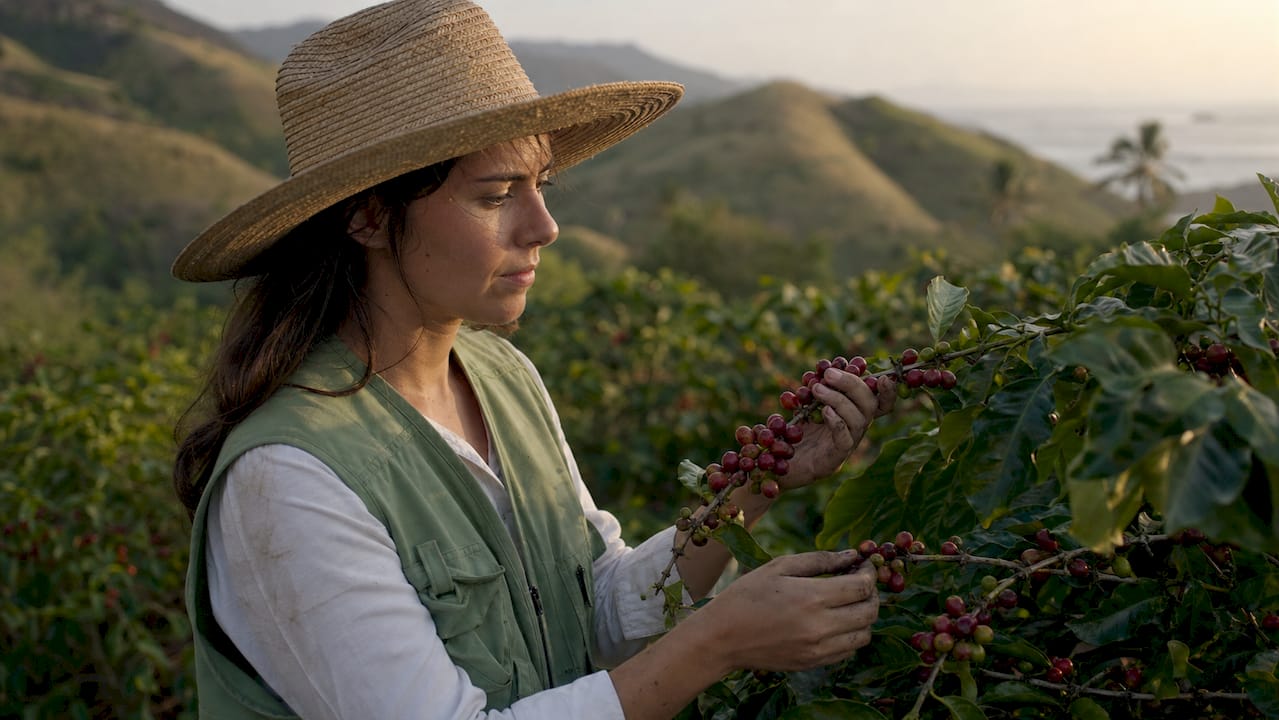
The connection between price and quality is direct. Farmers who receive stable minimum prices can finance sustainable agricultural practices that protect both land quality and crop consistency. A farmer earning below production cost cannot afford to replace aging trees, manage pests properly, or experiment with processing methods that raise cup scores. Ethical pricing in the coffee industry is not a charity model. It is a quality investment mechanism.
Cooperatives demonstrate this most clearly. When a cooperative receives Fairtrade’s $0.20 per pound social premium, that money flows into shared infrastructure: wet mills, storage facilities, and training programs. These investments raise the quality ceiling for every member. The social premium functions as collective capital that no individual smallholder could accumulate alone.
Environmental sustainability follows the same logic. Fair pricing enables climate adaptation measures like agroforestry, water conservation systems, and soil rehabilitation. Farms that cannot cover costs skip these investments entirely, accelerating land degradation. The impact of fair coffee pricing on environmental outcomes is measurable and direct.
Pro Tip: Look for certifications that publish their social premium spending reports. Fairtrade International and Rainforest Alliance both release annual impact data. A certification that cannot show where its premiums went is not worth the label.
What fair pricing mechanisms actually exist in the market?
Fairtrade’s minimum price system is the most widely recognized fair pricing structure in coffee. For washed Arabica, the floor is $1.80 per pound plus a $0.20 social premium. The floor price functions as insurance. During market crashes as low as $0.45/lb, Fairtrade cooperatives still received $1.26 per pound, which kept farms solvent when the open market would have destroyed them. That gap between $0.45 and $1.26 is the difference between a farm surviving and a family abandoning coffee entirely.
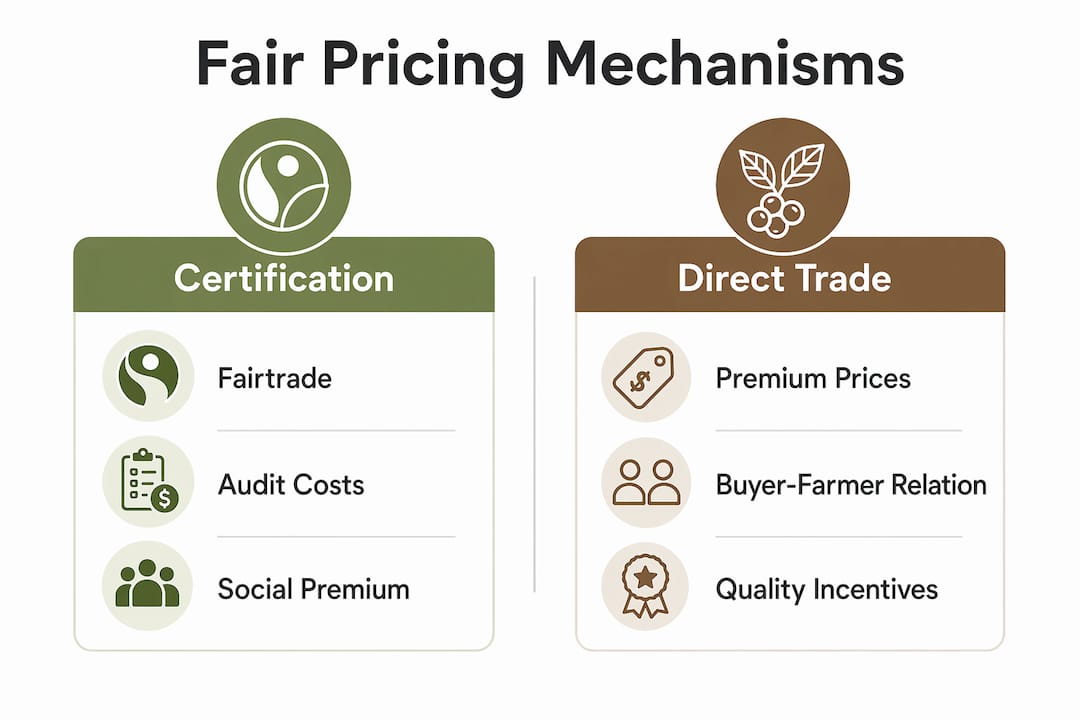
The income impact compounds over time. Fairtrade certification increases household income by about 25% in Central America when combining the price floor with social premiums. A cooperative producing 150,000 pounds generates $30,000 annually in social premiums alone. That money funds schools, health clinics, and processing equipment that no commodity price could ever support.
Beyond Fairtrade, two other mechanisms have reshaped how fair pricing works in specialty markets.
| Mechanism | Price basis | Transparency | Reach |
|---|---|---|---|
| Fairtrade certification | Minimum floor plus social premium | Moderate, audited | Large cooperatives |
| Direct trade | Negotiated quality premium | High, buyer-seller | Small to mid-scale farms |
| Cup of Excellence auctions | Competitive quality scoring | Very high, public | Top-tier specialty producers |
Direct trade removes the certification layer entirely. Roasters negotiate directly with farms, paying premiums tied to cup quality scores and relationship depth. This model produces some of the highest farmgate prices in the industry, but it reaches a small fraction of global producers.
Cup of Excellence auctions shift the pricing narrative from commodity scarcity to documented quality. Winning lots sell at multiples of commodity price because buyers bid on verified flavor profiles. The auction model proves that transparent quality information raises prices. The challenge is that most smallholders never produce at a score level that qualifies them for entry.
Certifications carry real costs too. Audit fees, compliance documentation, and annual renewal expenses burden small cooperatives disproportionately. The floor price also does not automatically adjust for inflation, which means the real value of the minimum erodes over time. Understanding the role of certifications in coffee helps buyers separate genuine impact from label marketing.
What challenges prevent fair pricing from reaching producers?
The most damaging problem in coffee pricing is decoupling. Retail specialty coffee prices are stable and high, but farm-level prices remain volatile and tied to commodity benchmarks. A $22 bag of single-origin Ethiopian coffee on a retail shelf does not mean the farmer received a premium. The price at origin is still often calculated against the New York C market, which has no relationship to the quality in that bag.
Farmers producing high-quality coffee see little of the retail premium unless their buyer explicitly pays on quality rather than commodity benchmark. This is the core structural failure of coffee pricing. The market charges consumers for quality but pays producers for volume.
Greenwashing compounds the problem. No major company discloses its pricing structures or premiums above commodity market despite publishing sustainability reports. A brand can claim ethical sourcing while paying commodity prices if no one requires them to show the numbers. The 2026 Coffee Barometer confirms that sustainability programs built on low-cost purchasing are structurally contradictory.
The industry narrative has also shifted in a way that hides producer poverty. The focus has moved from producer hunger to consumer price, framing affordability as the central concern. That framing obscures the fact that cheap coffee at retail is only possible because someone at origin is absorbing costs they cannot afford.
Pro Tip: Ask your coffee brand one question: “What percentage above commodity price did you pay at origin?” If they cannot answer, their sustainability claim is marketing. Brands with genuine fair pricing commitments publish farmgate price data or at minimum share it on request.
How does fair pricing affect consumer choices and industry sourcing?
Consumers hold real purchasing power in this system. Every bag of coffee bought from a brand with transparent pricing practices sends a market signal. Supporting direct-from-farm coffee is one of the most direct ways consumers can influence what farmers actually earn. The importance of coffee pricing becomes personal the moment you connect your purchase to a specific producer’s income.
Industry stakeholders carry even more weight. Roasters, importers, and retailers who adopt responsible procurement models share price risk with producers rather than passing it entirely downstream. Long-term contracts at above-commodity prices give farmers the planning horizon to invest in quality improvements. That investment returns to buyers as better, more consistent coffee.
Here are concrete steps both consumers and businesses can take to support fair pricing:
- Buy from brands that publish farmgate prices or origin premiums. Transparency is the baseline.
- Prioritize certified coffees where the certification body publishes audited impact reports.
- Choose cooperatives and direct-trade roasters who describe their pricing methodology on their website.
- Ask questions. Brands that support fair pricing welcome the conversation. Those that deflect it usually have something to hide.
- Support coffee quality standards by buying specialty grades, which create market incentives for quality-based pricing at origin.
Fair trade’s real value extends beyond cash transfers. Cooperative democracy and collective bargaining power give producers institutional strength that no single price premium can replicate. When farmers govern their own cooperative, they negotiate better contracts, access credit, and build market relationships that persist across price cycles.
Key Takeaways
Fair pricing in coffee is the single most direct lever connecting producer livelihoods, environmental sustainability, and the long-term quality of what ends up in your cup.
| Point | Details |
|---|---|
| Unpaid labor subsidizes retail coffee | 10% of retail coffee cost is covered by unpaid farmer family labor, exposing chronic underpayment. |
| Fairtrade floors prevent collapse | A $1.80/lb minimum price kept cooperatives solvent during market crashes as low as $0.45/lb. |
| Decoupling harms quality producers | High retail specialty prices do not reach farmers paid on commodity benchmarks, not quality scores. |
| Transparency is the real test | No major company publicly discloses farmgate premiums, making consumer scrutiny the primary accountability tool. |
| Cooperative governance multiplies impact | Fair trade’s institutional benefits, including democratic governance and bargaining power, outlast any single price premium. |
Why the pricing conversation in coffee needs to get uncomfortable
The coffee industry has spent decades making consumers feel good about sustainability without asking them to pay for it. That is the uncomfortable truth I keep coming back to. Every “ethically sourced” label that sits on a bag priced at commodity-level margins is a contradiction. You cannot build a sustainable supply chain on permanently cheap inputs. The math does not work, and the 2026 Coffee Barometer finally says so plainly.
What I find most revealing is the transparency gap. Brands publish carbon footprint reports, biodiversity commitments, and farmer empowerment stories. None of them publish what they actually paid at origin. That omission is not accidental. It is the gap where the real story lives.
The most promising shift I see is in cooperative governance. When producers control their own institutions, they negotiate from strength rather than desperation. That institutional power matters more than any single premium payment. A cooperative with strong governance can survive a bad price year. An isolated smallholder cannot.
Consumers who care about this issue need to move past certification logos and start asking harder questions. The fair trade coffee benefits are real, but they are not automatic. They require buyers who demand proof, not just promises.
— Zachary
Zscoffee’s approach to ethically sourced coffee
Zscoffee was built around the belief that what you pay for coffee should reflect what it actually costs to grow it well. The coffee and tea collection at Zscoffee features products selected with sourcing transparency in mind, connecting consumers with quality-driven options that go beyond commodity-grade purchasing.

Zscoffee’s global reach means customers across dozens of countries can access fairly sourced coffee without sacrificing quality or convenience. If you want your purchase to mean something at origin, the full product range at Zscoffee is a practical starting point. Good coffee and fair producer compensation are not competing goals. At Zscoffee, they are the same goal.
FAQ
What is fair pricing in coffee?
Fair pricing in coffee means paying producers enough to cover full production costs, living wages, and community investments. It goes beyond commodity market rates to reflect the true cost of quality coffee.
How does fair pricing affect coffee quality?
Farmers who earn above-cost prices can invest in better processing, equipment, and sustainable farming practices. Those investments directly raise cup quality and consistency over time.
What is the Fairtrade minimum price for coffee?
The Fairtrade minimum price for washed Arabica is $1.80 per pound plus a $0.20 social premium. During market crashes, this floor has kept cooperatives solvent when open-market prices fell below $0.50 per pound.
Why don’t specialty retail prices reach coffee farmers?
Retail specialty prices are set by branding and consumer demand, while farmgate prices are still tied to volatile commodity benchmarks. This decoupling means farmers rarely benefit from the premium consumers pay at retail.
How can consumers support fair pricing in coffee?
Consumers can buy from brands that publish farmgate prices, prioritize certified coffees with audited impact reports, and choose roasters who explain their pricing methodology. Asking brands directly what they paid at origin is the most effective accountability tool available.