TL;DR:
- Most coffee carries various certifications that focus on ethics and sustainability rather than flavor quality. Certifications like Fairtrade, Rainforest Alliance, and Organic differ in scope, audit procedures, and environmental or social emphasis, influencing sourcing practices and farm support. However, certification labels alone do not guarantee exceptional taste; factors like variety, harvest methods, and processing impact the sensory experience more significantly.
Over half of all coffee grown worldwide carries some form of certification label, yet most consumers have only a vague sense of what those labels actually promise. The role of certifications in coffee is far more nuanced than a simple stamp of approval for quality or taste. Certifications span ethical labor standards, environmental stewardship, biodiversity protection, and farm economics, and understanding the differences between them changes how you buy, brew, and appreciate what’s in your cup. This guide cuts through the logo clutter and gives you the knowledge to read certification labels like a professional.
Table of Contents
- Understanding coffee certifications: scope and significance
- How certifications affect coffee quality and sensory experience
- Comparing major certifications: Fairtrade, Rainforest Alliance, organic, and Bird Friendly
- The impact of certifications on sustainability and ethical sourcing
- How to use certification knowledge in your coffee buying decisions
- Why certifications are part of the story, not the full recipe for coffee quality
- Explore certified coffee selections at Z’s Coffee
- Frequently asked questions
Key Takeaways
| Point | Details |
|---|---|
| Certifications cover social and environmental standards | Coffee certifications mainly ensure ethical and sustainable production practices, not direct taste quality. |
| Rainforest Alliance and Fairtrade differ | Fairtrade sets fixed prices and premiums, while Rainforest Alliance focuses on training without fixed pricing. |
| Certification is no guarantee of flavor | Cup quality depends on many factors beyond certification, including harvest methods and processing. |
| Look beyond the logo for authenticity | Verify certifier names and transparency details to avoid misleading claims on coffee packaging. |
| Use certifications to support sustainability | Choosing certified coffee helps promote ethical sourcing and environmental stewardship in coffee farming. |
Understanding coffee certifications: scope and significance
Certifications are third-party schemes. An independent body audits farms, cooperatives, or supply chains against a defined set of social, environmental, and economic criteria. Pass the audit, pay the fees, and you earn the right to display the label. That’s the basic mechanic across virtually all certification programs for coffee.
What those criteria actually cover varies enormously. About 55% of coffee grown is certified globally, with Rainforest Alliance holding a larger market share than Fairtrade. Despite that scale, the two programs measure very different things and operate through different pricing and premium structures.
Here’s a snapshot of what the major types of coffee certifications address:
- Rainforest Alliance: Farm-level environmental and social standards, training programs, and market access support. No fixed minimum price.
- Fairtrade: Minimum price floors, community premiums, and democratic governance requirements for cooperatives.
- Organic (USDA or EU): Prohibition of synthetic inputs, soil health management, and supply chain auditing for chemical integrity.
- Bird Friendly (Smithsonian): Organic certification plus shade-grown canopy requirements to support bird habitat and biodiversity.
- Direct trade: Not a formal certification but a buyer-led relationship model, often used alongside or instead of third-party labels.
Understanding fair trade coffee as distinct from Rainforest Alliance is a starting point. Confusing them leads to misreading packaging, and more importantly, misjudging whether a coffee aligns with your values. If environmental regeneration is your priority, Rainforest Alliance matters more to you. If farmer income floors are your concern, Fairtrade speaks to that directly.
It’s also worth knowing that a single bag of coffee can carry multiple certifications simultaneously. A farm may be Rainforest Alliance certified and organic. The labels are not mutually exclusive, and stacking them usually signals a more rigorous sourcing commitment from the roaster. Learning about organic coffee in detail helps you understand what that particular layer adds to the picture.
How certifications affect coffee quality and sensory experience
Here’s where a lot of coffee consumers get tripped up. A certification logo does not mean the coffee in the bag tastes exceptional. Full stop.
Certifications are designed to protect people and ecosystems. They set floors for environmental and labor practices. What they do not do is dictate the microbiological conditions of fermentation, the drying curve after harvest, the altitude and varietal selection, or the roaster’s skill in developing the bean’s full potential. Certification cannot substitute for lot-specific grading or traceability when it comes to specialty coffee quality. A Rainforest Alliance certified farm may produce dozens of different lots in a single harvest season, ranging from mediocre commercial-grade coffee to exceptional micro-lots scoring above 87 on the SCA (Specialty Coffee Association) scale.
What actually drives sensory quality? Here’s a concise breakdown:
- Variety: Bourbon, Gesha, Typica, and SL28 each carry distinct flavor potential regardless of certification.
- Harvest practices: Selective hand-picking of ripe cherries at peak brix levels directly impacts sweetness and complexity.
- Processing method: Natural, washed, and honey processes produce dramatically different flavor outcomes from the same cherry.
- Drying and fermentation: Poorly managed fermentation introduces defects no certification catches.
- Roast profile: A certified bean can be destroyed by an aggressive, high-temperature roast that strips nuance.
Pro Tip: When evaluating a specialty coffee, ask your roaster for the lot number and harvest date alongside any certification. If they can’t provide those details, the certification label alone tells you very little about what’s in the bag.
That said, certified farms operating under structured training programs often show improvements in harvest practices over time. Learning how to taste coffee systematically puts you in a better position to judge the actual cup rather than relying on label signals. And understanding coffee processing methods helps you recognize what was done after harvest, which certification doesn’t address at all.
Comparing major certifications: Fairtrade, Rainforest Alliance, organic, and Bird Friendly
Each certification in the specialty coffee certification list operates by different rules. The following table makes the most important distinctions visible at a glance.
| Certification | Price floor | Environmental focus | Social focus | Audit type | Unique feature |
|---|---|---|---|---|---|
| Fairtrade | Yes (fixed minimum) | Moderate | Strong (cooperatives) | Third-party | Community premium fund |
| Rainforest Alliance | No | Strong | Moderate | Third-party | Regenerative ag training |
| USDA Organic | No | Strong (chemical-free) | None | Third-party | Supply chain audit |
| Bird Friendly | No | Very strong (shade) | None | Third-party | Canopy height requirements |
| Direct trade | No | Varies | Varies | Buyer-led | Relationship transparency |
Fairtrade’s fixed minimum prices and social premiums contrast sharply with Rainforest Alliance, which offers no price floors but instead emphasizes farm training, market access, and sustainability differentials negotiated between buyers and sellers. Neither model is inherently superior. They solve different problems for different farming communities.
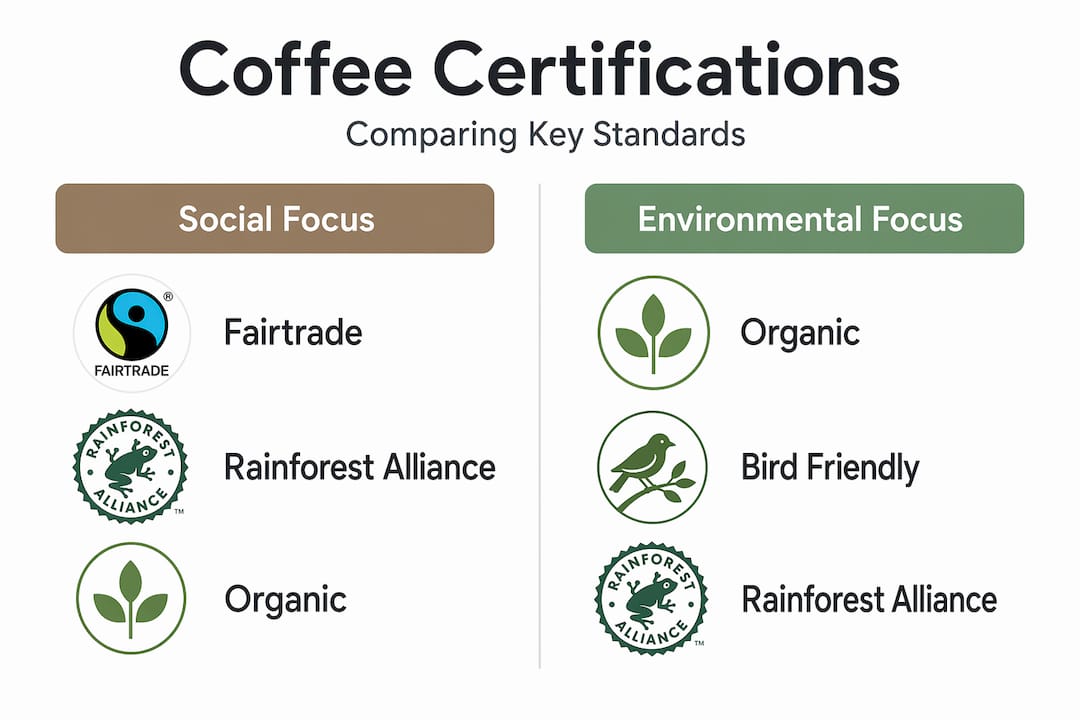
Bird Friendly certification from the Smithsonian Migratory Bird Center is arguably the most rigorous environmentally. It requires full organic certification plus specific canopy requirements, including minimum shade tree diversity and cover percentages that support migratory bird habitats. You don’t see this label often, which is exactly why it signals something meaningful when you do.
Pro Tip: Bird Friendly and organic together indicate a farm managing for ecosystem health at a level that goes well beyond most commercial certifications. If you find a Bird Friendly certified coffee from a reputable roaster, it’s worth your attention.
Explaining coffee certification labels fully means understanding that audit costs are a real barrier. Small farmers may choose not to pursue certifications even if their practices meet or exceed the standards, simply because the fees are prohibitive. That’s a key limitation of certification systems broadly. Visiting our article on coffee quality standards gives you a fuller picture of how quality is defined beyond the certification lens.
The impact of certifications on sustainability and ethical sourcing
The most defensible case for certifications is not cup quality. It’s accountability. Without third-party oversight, supply chains in commodity coffee are largely opaque.
Rainforest Alliance’s regenerative agriculture standard now measures farm progress across five pillars: soil health, biodiversity, climate resilience, water management, and community livelihoods. That’s a meaningful framework. It doesn’t guarantee spectacular espresso, but it does require farms to demonstrate movement toward measurable ecological and social goals.
The benefits of coffee certifications for sustainability include:
- Soil health auditing: Farms must monitor and improve organic matter and erosion control over time.
- Water protection: Buffer zones around waterways and restrictions on agrochemical runoff are verified.
- Labor standards: Child labor prohibitions and safe working conditions are audited, not just self-reported.
- Biodiversity indicators: Tree cover, native species planting, and pesticide reduction are tracked.
“Third-party certification schemes remain preferable to in-house or self-declared labels, even when enforcement is imperfect.” — Ethical Consumer Research Association
Some certifications face valid criticism for weak policing and the absence of mandatory pricing mechanisms, but the alternative, trusting roasters or retailers to self-certify, is objectively worse from a consumer transparency standpoint. When you buy certified coffee, you’re not just buying a product. You’re participating in a system of accountability that has real, if imperfect, consequences for farming communities and ecosystems.
Supporting fair trade ethics with your purchasing decisions has a measurable ripple effect across supply chains. The coffee certification importance in this context isn’t about taste. It’s about whether farmers and ecosystems get a fair return on the investment they make every growing season.
How to use certification knowledge in your coffee buying decisions
Reading a bag of coffee with certification intelligence is a learnable skill. Here’s a practical process.
- Identify the certifier, not just the logo. Rainforest Alliance, Fairtrade International, USDA Organic, and Bird Friendly are independent third parties. Vague phrases like “sustainably sourced” or “ethically grown” with no named certifier are marketing copy, not verified claims.
- Check for farm or cooperative origin. A certified coffee that also names the specific farm or co-op is more traceable than one that simply lists the country.
- Look for the harvest year. Certifications don’t expire annually with harvests. A bag labeled Fairtrade could contain coffee harvested two years ago. Freshness is a separate quality signal.
- Understand what premium was paid. Roasters committed to transparency will disclose what they paid above the commodity price, or whether a Fairtrade premium was directed to the cooperative’s community fund.
- Ask your roaster directly. Any specialty roaster worth your business should be able to tell you which certifications their coffees carry and what those certifications actually covered in that specific supply chain.
Pro Tip: Organic certification requires a minimum of three years without synthetic inputs and full supply chain auditing. If a roaster claims “organic practices” without the certification, ask why they haven’t pursued the formal credential. The answer is often revealing.
| What to look for | What it signals | Red flag |
|---|---|---|
| Named certifier | Third-party verified | “Sustainably sourced” with no certifier |
| Farm or co-op name | High traceability | Country-only origin labeling |
| Harvest year | Freshness transparency | No date information |
| Premium disclosure | Supply chain honesty | Vague “ethical” language |
| Multiple certifications | Layered accountability | Single logo with no details |
A solid coffee buying guide will reinforce these habits. And pairing certification knowledge with an understanding of why coffee origin matters gives you a genuinely complete picture. For aficionados who prefer single origin coffee, knowing both the certification status and the specific farm story is where real connoisseurship lives.
Why certifications are part of the story, not the full recipe for coffee quality
Here’s an opinion you won’t find on most certification advocacy pages: certifications, taken alone, are a blunt instrument for evaluating specialty coffee.
They were designed for commodity markets. The original logic was to create minimum floors, stop the worst labor abuses, and reduce environmental degradation in large-scale farming systems. That logic is sound. The problem is that specialty coffee culture has since built an entirely different vocabulary around quality: traceability, process transparency, varietal identity, and lot-level grading. These tools don’t slot neatly into the certification framework.
Certification programs primarily encourage continuous farm improvement and sustainability rather than guaranteeing sensory outcomes in any given harvest. That’s an honest description of what they do. A farm can improve its soil organic matter by 20% and still produce a flat, underdeveloped coffee that fails on cupping. A non-certified farm in a remote Ethiopian highland might produce a staggering natural-processed lot because the farmer has generational knowledge of how to read and manage the drying beds.
The risk for aficionados is treating certifications as a quality proxy when they’re actually an ethics and sustainability proxy. Conflating the two leads to buying decisions based on virtue signaling rather than genuine quality assessment. Both matter, but they’re separate conversations.
The most sophisticated approach combines both lenses. Use certifications to screen for ethical sourcing and environmental accountability. Use traceability data, cupping scores, and roaster relationships to assess cup quality. Ask the baristas and roasters you trust to tell you which certified coffees in their lineup are also genuinely exceptional in the cup. When ethics and quality overlap, that’s where the most satisfying coffees live.
Explore certified coffee selections at Z’s Coffee
Knowing how certifications work changes the way you shop for coffee. At Z’s Coffee, we’ve curated a selection of certified coffees that meet real sourcing and ethical standards, so you can apply everything you’ve learned here with confidence rather than guesswork.
Browse our full range at Z’s Coffee and filter by origin, certification, and roast profile to find exactly what aligns with your values. Whether you’re drawn to Fairtrade cooperatives, Rainforest Alliance farms, or certified organic lots, we’ve sourced with transparency in mind. And for your next brew session, pair your certified beans with a well-built travel mug with a handle that’s built to keep your coffee at its best wherever you take it.
Frequently asked questions
What do coffee certifications really guarantee?
Certifications mainly guarantee adherence to social, environmental, and sustainability standards, but standards and rigor vary among programs and they do not directly ensure flavor or quality in the cup.
Does organic certification mean the coffee tastes better?
Organic certification ensures no synthetic chemicals were used and promotes ecological health, but flavor depends on harvest and processing variables that organic standards don’t control, so taste can vary widely.
Are Rainforest Alliance and Fairtrade certifications the same?
No. Rainforest Alliance emphasizes training and market access without fixed price floors, while Fairtrade sets minimum prices and directs community premiums to support farmers financially.
How can I use certification labels to choose better coffee?
Look for named certifiers, farm origin, harvest year, and roaster transparency about premiums; checking certifier names and origin details ensures greater authenticity than relying on logos alone.