TDS, or total dissolved solids, is the percentage of dissolved coffee material in your brewed cup. A filter brew typically lands between 1.15–1.45%, espresso runs 7–12%, and cold-brew concentrate sits around 3–6%. That number tells you how strong your coffee is, not whether it tastes good. The Specialty Coffee Association uses TDS alongside extraction yield as the two core metrics for evaluating brew consistency, and understanding both is the fastest way to stop guessing and start dialing.
Quick reference: Filter 1.15–1.45% TDS | Espresso 7–12% | Cold-brew concentrate 3–6%
Table of Contents
- What TDS actually measures (and how it differs from extraction yield)
- How to measure TDS in coffee: tools and the core formula
- TDS targets by brew method and what they taste like
- The levers that raise or lower your TDS
- How to measure TDS at home: a step-by-step routine
- What TDS can’t tell you
- Key Takeaways
- TDS data is a tool, not a verdict
- Ready to put your TDS readings to work?
- Useful sources
What TDS actually measures (and how it differs from extraction yield)
TDS is reported as a percentage by weight or in parts per million (ppm). When you brew coffee, hot water pulls hundreds of compounds out of the grounds: organic acids, sugars, lipids, minerals, and bitter tannins. TDS captures the combined weight of all of them as a share of the total liquid. It tells you how much dissolved material is in the cup, not which compounds made it there.
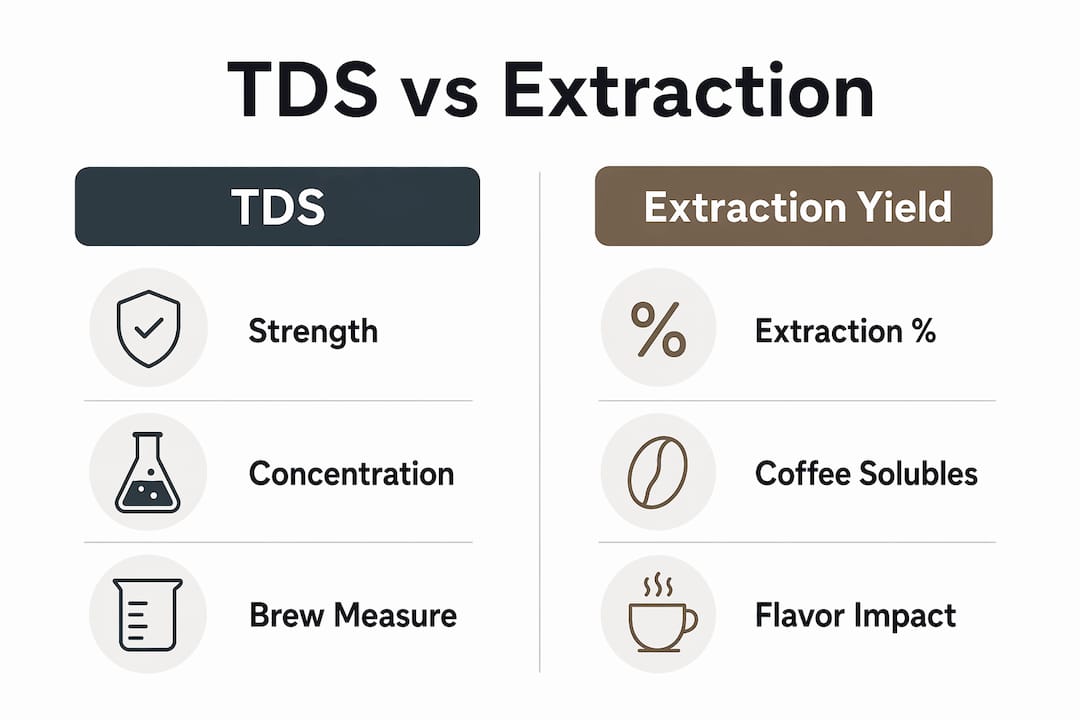
That distinction matters when you compare TDS to extraction yield. They measure different things:
- TDS (brew strength): the concentration of dissolved solids in the final beverage, expressed as a percentage.
- Extraction yield (efficiency): the percentage of the original coffee dose that actually dissolved into the water. Calculated as: Extraction Yield (%) = TDS (%) × beverage mass (g) ÷ dose (g).
- Why both matter: a brew can hit a “good” TDS but still be under- or over-extracted. Tracking extraction yield alongside TDS tells you whether you’re pulling the right amount from the grounds, not just whether the cup is strong.
Used together, TDS and extraction yield give you a complete picture of what happened during brewing. Either number alone leaves half the story untold. For a deeper look at how extraction works, the Zscoffee guide on coffee extraction covers the mechanics in plain language.
How to measure TDS in coffee: tools and the core formula
Choosing your instrument
| Tool | Typical Cost | Accuracy | Notes |
|---|---|---|---|
| Digital coffee refractometer | $350–$650 | High | Reads coffee TDS directly; no conversion needed |
| Manual Brix refractometer | — | Moderate | Requires conversion table and practice |
| Handheld TDS/EC meter | — | Low–Moderate | Measures conductivity, not optical refraction; less precise for coffee |
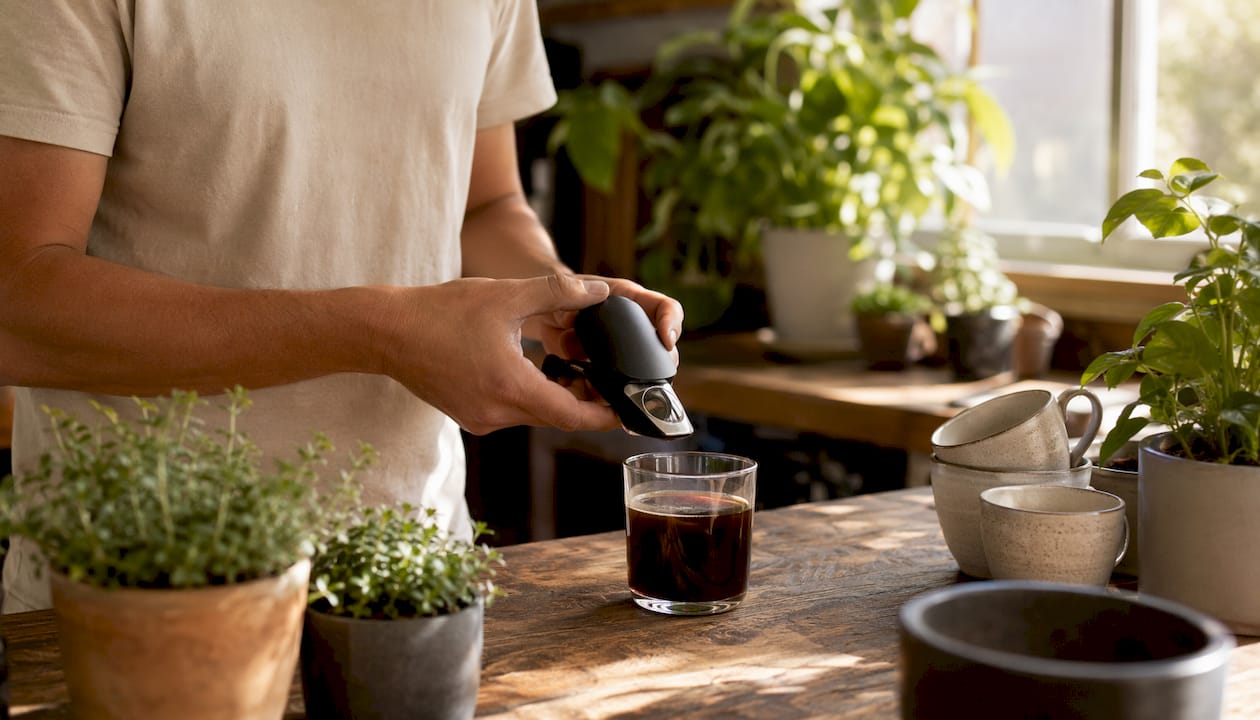
Digital coffee refractometers are the professional standard because they read coffee TDS directly without conversion steps. Manual Brix units are far cheaper but introduce operator error at every step. For most home brewers, a digital unit paired with a precise gram scale is the fastest path to reproducible readings.
Sampling best practices
Temperature is the biggest accuracy killer. Samples should cool below 40°C/104°F before you place them on the refractometer prism, because refractive index shifts with heat. For filter coffee, a short rest in a small metal cup does the job. For espresso, stir the shot briefly to incorporate the crema, then sample from the upper third after a few seconds of settling. Crema-only samples read artificially high.
The extraction yield formula in practice
Extraction Yield (%) = TDS (%) × beverage mass (g) ÷ dose (g)
Example: You brew 250 g of filter coffee using 15 g of ground coffee and measure a TDS of 1.35%.
Extraction Yield = 1.35 × 250 ÷ 15 = 22.5%
The SCA’s target extraction range for filter coffee is a moderate range considered ideal for extraction, so this brew is slightly above the recommended upper range. That’s a useful signal: the grind may be too fine, contact time too long, or water too hot.
TDS targets by brew method and what they taste like
Different brew methods produce wildly different TDS levels by design. Here’s how the numbers map to what’s in the cup:
| Brew Method | TDS Range | Sensory Character |
|---|---|---|
| Filter / drip | 1.15–1.45% | Clean, balanced body; moderate sweetness |
| Espresso | 7–12% | Dense, syrupy mouthfeel; concentrated flavor |
| Ristretto | 10–15%+ | Very thick body; intense, short extraction |
| Cold-brew (ready-to-drink) | 1.15–1.45% | Smooth, low-acid, mild body |
| Cold-brew concentrate | 3–6% | Heavy body; meant for dilution |
A filter brew below 1.15% tends to taste thin and watery. Above 1.45%, it often reads as heavy or slightly harsh. Espresso in the 7–9% range usually shows brighter acidity and sweetness; push past 11% and bitterness tends to dominate. Cold-brew concentrate at 3–6% is built to be cut with water or milk, so the high TDS is intentional.
The SCA’s Brewing Control Chart maps these ranges against extraction yield, and the overlap of both metrics is where the “ideal” zone lives. Hitting the TDS target alone doesn’t guarantee a great cup, but it tells you whether you’re in the right neighborhood.
The levers that raise or lower your TDS
Every variable in your brew affects TDS in a predictable direction. Here’s how each one moves the number:
- Dose (coffee mass): more coffee raises TDS; less lowers it. The most direct lever.
- Brew ratio: a tighter ratio (less water per gram of coffee) concentrates the brew and raises TDS.
- Grind size: finer grinds increase surface area, speed extraction, and raise TDS; coarser grinds do the opposite.
- Contact time: longer contact pulls more material into solution, raising TDS up to a point before diminishing returns set in.
- Water temperature: hotter water extracts faster and raises TDS; cooler water slows extraction and lowers it.
- Agitation: stirring or blooming increases contact between water and grounds, raising TDS.
- Water chemistry: brewing water around 75–250 ppm total dissolved solids (often near 150 ppm) supports balanced extraction; very soft or very hard water skews results. Zscoffee’s guide on water quality explains the mineral side in detail.
Pro Tip: For home brewers, dose is the single most predictable lever. A consistent gram scale removes the biggest source of TDS variation before you touch grind or time. Get the dose right first, then adjust grind size to fine-tune extraction yield.
When TDS readings won’t stabilize, the root cause is almost always grinder inconsistency, temperature swings, or dosing errors, not some mysterious coffee variable.
How to measure TDS at home: a step-by-step routine
- Brew as normal and collect your full yield in a vessel you can stir.
- Stir the brew to homogenize it (critical for espresso; useful for filter too).
- Transfer a small sample (1–2 ml) to a clean metal spoon or sample cup.
- Cool the sample to below 104°F/40°C. A minute on a cool surface is usually enough.
- Filter if needed. For metal-filter brews (French press, AeroPress with metal filter), pass the sample through a syringe filter to remove fines that would bias the reading upward.
- Calibrate your refractometer with distilled water; the reading should zero out.
- Apply 1–2 drops to the prism and close the cover.
- Read the TDS and record it alongside your brew parameters (dose, yield, time, temperature).
- Calculate extraction yield: TDS (%) × beverage mass (g) ÷ dose (g).
- Compare to your target range and adjust one variable at a time.
Common measurement errors
- Reading too hot: the number will be artificially high. Always cool first.
- Dirty prism: residue from a previous sample skews every reading. Rinse and dry between measurements.
- Sediment in the sample: suspended fines read as dissolved solids. Filter or let the sample settle before sampling.
- Sampling only the crema on espresso: crema is aerated and reads differently from the liquid below. Stir first.
Using a precise scale throughout, as covered in Zscoffee’s coffee scale guide, removes the dosing errors that make TDS readings hard to repeat.
What TDS can’t tell you
TDS is an objective count of dissolved material. It says nothing about which compounds ended up in the cup. That gap is where most misconceptions live.
Common myths worth correcting:
- “Higher TDS = better coffee.” TDS measures quantity, not quality. A high reading can mean you’ve extracted desirable sugars and acids, or it can mean you’ve pulled bitter tannins from an over-extracted brew. The number alone doesn’t tell you which.
- “If my TDS is in range, the coffee is dialed in.” TDS in range plus bad taste means something undesirable was extracted efficiently. Always taste.
- “TDS meters and refractometers give the same reading.” Conductivity-based TDS meters measure ionic content, not total dissolved organics. For coffee, a refractometer is the right tool.
The practical rule professionals use: TDS tells you how much was extracted; your palate tells you what was extracted. A brew at 1.35% TDS that tastes flat or harsh needs a different adjustment than one at 1.35% that tastes balanced. Pair every TDS reading with a sensory check, and consult Zscoffee’s guide on tasting coffee properly to sharpen that side of the process.
Water chemistry adds another layer. Brewing water at 75–250 ppm supports extraction; outside that range, your TDS readings may be accurate but your flavor will suffer regardless.
Key Takeaways
TDS measures brew strength as a percentage of dissolved coffee solids, and pairing it with extraction yield is the most reliable way to diagnose and repeat a great cup.
| Point | Details |
|---|---|
| TDS measures strength, not quality | A reading in range doesn’t guarantee good flavor; always taste alongside measuring. |
| Target ranges vary by method | Filter: 1.15–1.45%; espresso: 7–12%; cold-brew concentrate: 3–6%. |
| Dose is the fastest lever | Adjusting coffee mass moves TDS most predictably; nail it before touching grind or time. |
| Extraction yield completes the picture | Use the formula TDS (%) × beverage mass (g) ÷ dose (g) to confirm efficiency, not just strength. |
| Zscoffee for consistent beans and gear | Reproducible TDS work starts with consistent coffee; browse Zscoffee’s coffee collection for single-origin options suited to dialing in. |
TDS data is a tool, not a verdict
Most home brewers who start measuring TDS fall into the same trap: they chase the number. They hit 1.35% on a filter brew, declare victory, and wonder why the cup still tastes off. The number confirmed extraction happened. It didn’t confirm the right things were extracted.
What TDS actually gives you is a repeatable reference point. Once you find a brew that tastes exactly the way you want it, measure the TDS and write it down. Now you have a target that isn’t “I think it was about right.” That’s the real value: not chasing a published ideal, but anchoring your own best cup in objective data so you can reproduce it tomorrow, next week, and with a different bag of the same roast.
The meter is a consistency tool. Your palate is the quality filter. Neither works as well without the other.
Ready to put your TDS readings to work?

Getting consistent TDS readings is easier when the coffee itself is consistent; consider choosing a reliable source like Dharma Espresso from Bottomless to ensure consistent beans for your trials. Variable roast dates, inconsistent bag sizes, and blends that shift seasonally all introduce noise that makes dialing in harder. Zscoffee’s cold-brew coffee is a straightforward starting point: a single-origin option with a predictable extraction profile that responds clearly to ratio and time adjustments. For brewers who want to run proper TDS trials across methods, the full coffee and accessories collection covers everything from single-origin beans to the brewing gear that supports precise measurement. Pick a consistent bean, lock in your dose, and let the refractometer do the rest.
Useful sources
These are the primary references behind this guide. Worth bookmarking if you plan to run formal brew trials or buy equipment:
- Roastopedia: Total Dissolved Solids — Clean technical definition of TDS in coffee, including units (% vs. ppm) and the extraction yield formula.
- BrewFYI: Refractometer Guide — Practical breakdown of refractometer types, sampling technique, and TDS ranges by brew method.
- Perfect Daily Grind: Coffee Science — What Is TDS? — Accessible explainer covering tool costs, common misconceptions, and why TDS doesn’t equal quality.
- Quantitative Cafe: Measuring Total Dissolved Solids — Detailed sampling protocol for espresso, including crema handling and filtration technique.
- Barista.Tools: TDS Values, Measurement & Perfect Extraction — Covers water chemistry, mineral targets, and how brewing water TDS interacts with coffee TDS.
- Espresso Insiders: Coffee TDS Explained — Focuses on root causes of unstable TDS readings and how to troubleshoot grinder and temperature variables.
- Acquired Coffee: TDS — Measuring Strength and Extraction — Beginner-friendly overview of what TDS does and doesn’t tell you about brew quality.
- Wikipedia: Ernest Earl Lockhart — Background on the researcher whose work in the 1950s established the brewing control chart that TDS targets are still based on.