TL;DR:
- Proper extraction, not just coffee quantity, determines coffee’s flavor balance and complexity.
- Brewing method (immersion, percolation, pressure) directly influences flavor profiles through different extraction techniques.
- Adjusting variables like grind size, temperature, and contact time improves taste and avoids under or over-extraction.
Most home brewers assume that dumping in more coffee grounds is the shortcut to a stronger, more satisfying cup. It isn’t. What actually determines whether your coffee tastes bright, balanced, or bitter is extraction: the process of pulling flavor compounds out of ground coffee with water. Get it right, and even a modest amount of coffee can produce something complex and deeply satisfying. Get it wrong, and no amount of extra grounds will save you. This guide walks you through the principles behind extraction, the methods that shape your cup, the variables you can control at home, and how to taste and fix problems before they become habits.
Table of Contents
- Understanding coffee extraction: The foundation of flavor
- Extraction methods: How technique shapes your cup
- Variables that change everything: From grind to water chemistry
- Tasting and troubleshooting: Signs of perfect and failed extraction
- Why chasing perfect extraction isn’t enough: The art and the science
- Ready to taste the difference? Explore better brewing with Z’s Coffee
- Frequently asked questions
Key Takeaways
| Point | Details |
|---|---|
| Extraction drives flavor | The way coffee is extracted decides its taste, balance, and complexity. |
| Brewing method matters | Immersion, percolation, and pressure methods each create unique flavor profiles. |
| Control your variables | Adjusting grind, ratio, water temperature, and time can dramatically improve your cup. |
| Taste is your guide | Identifying sourness or bitterness can help you fine-tune your brewing. |
| Science and intuition | Great coffee blends extraction know-how with experimentation and personal taste. |
Understanding coffee extraction: The foundation of flavor
Extraction is simply the act of dissolving coffee solubles into water. When hot water meets ground coffee, it pulls out acids, sugars, oils, and bitter compounds in a specific sequence. Acids and fruity notes come out first, followed by sweetness, then heavier, bitter compounds last. The goal is to stop the process at just the right moment, capturing the good stuff and leaving the harsh notes behind.
Flavor and aroma are not just about how much coffee you use. They depend entirely on what gets extracted and in what proportion. A weak cup can still be over-extracted and taste unpleasantly bitter. A concentrated cup can be under-extracted and taste sour and thin. Strength and extraction are two separate things, and confusing them is one of the most common mistakes home brewers make.
The SCA coffee standards define the target extraction yield at 18 to 22 percent of the coffee’s dry weight, with a brew ratio of roughly 1:15 to 1:18 (coffee to water by weight). These numbers are not arbitrary. They represent the sweet spot where the most desirable flavor compounds are dissolved without tipping into over-extraction.
“Optimal extraction yield sits between 18% and 22%, with a total dissolved solids (TDS) target of 1.15% to 1.35% for a balanced cup.” — SCA Brewing Standards
The primary variables that control extraction are:
- Grind size: Finer grinds increase surface area, speeding up extraction
- Water temperature: Higher temps dissolve compounds faster
- Contact time: Longer contact pulls out more solubles
- Coffee-to-water ratio: Affects concentration and balance
- Water chemistry: Mineral content shapes how flavors are carried
| Variable | Too low/coarse/short | Too high/fine/long |
|---|---|---|
| Grind size | Under-extraction, sour | Over-extraction, bitter |
| Water temp | Flat, weak flavors | Harsh, bitter notes |
| Contact time | Thin, acidic cup | Astringent, dry finish |
| Coffee ratio | Watery, diluted | Dense, unbalanced |
| Water hardness | Muted, flat taste | Chalky, off flavors |
For a broader look at how all these pieces fit together, perfect coffee brewing is a great place to start building your overall framework.
Extraction methods: How technique shapes your cup
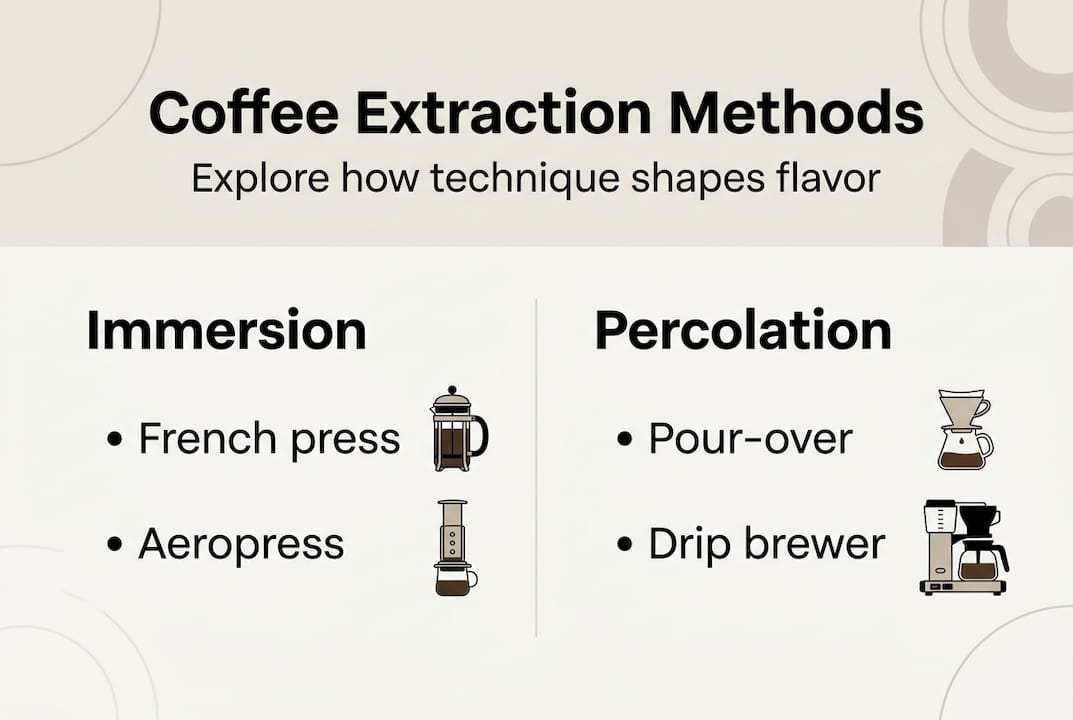
With a handle on extraction basics, it’s crucial to see how your chosen brewing method directly shapes what you taste. Not all brewing methods extract coffee the same way. They fall into three main categories: immersion, percolation, and pressure.
Immersion methods, like the French press, submerge grounds in water for an extended period. The water becomes saturated over time, which slows extraction naturally. This produces a full-bodied, heavier cup with more oils and texture. Brew time typically runs 4 to 5 minutes.

Percolation methods, like pour-over, continuously pass fresh water through the grounds. Because the water is never fully saturated, extraction stays efficient and even. The result is a cleaner, brighter cup with more clarity and distinct flavor notes. Brew time is usually 3 to 4 minutes.
Pressure methods, like espresso, force hot water through finely ground coffee in 25 to 35 seconds. The speed and pressure create a concentrated, syrupy shot with intense flavor and a characteristic crema. As immersion vs percolation research shows, each method’s physics produce genuinely distinct flavor profiles, not just variations in strength.
| Method | Brew time | Flavor profile | Extraction efficiency |
|---|---|---|---|
| French press | 4 to 5 min | Full-bodied, rich, oily | Moderate |
| Pour-over | 3 to 4 min | Clean, bright, complex | High |
| Espresso | 25 to 35 sec | Concentrated, bold, syrupy | Very high |
| Cold brew | 12 to 24 hrs | Smooth, low-acid, mellow | Low to moderate |
Pro Tip: If you want a robust, heavy cup, go with immersion. If you want clarity and brightness that lets origin flavors shine, use percolation. For both worlds in one shot, espresso rewards the effort. You can find more focused espresso extraction tips to dial in your machine, or explore flavor clarity methods for pour-over and beyond.
Variables that change everything: From grind to water chemistry
Knowing how extraction works by method, let’s look closer at the variables you control in your kitchen for the perfect cup. The good news is that you already have more control than you think. The five key variables below are all adjustable, and small changes produce noticeable results.
-
Grind size. Grind size determines surface area. A finer grind exposes more coffee to water, speeding up extraction. A coarser grind slows it down. This is often the fastest fix for a sour or bitter cup. The SCA’s extraction guidelines consistently identify grind size as the most impactful single variable in home brewing.
-
Water temperature. Water between 195 and 205°F (90 to 96°C) dissolves flavor compounds efficiently. Below that range, you get flat, underperforming extraction. Above it, you risk scorching the grounds and pulling out harsh bitterness. Let your kettle rest for 30 seconds off the boil if you don’t have temperature control.
-
Contact time. Every extra second water spends with your grounds pulls out more compounds. For immersion brews, this means not letting the steep run long. For pour-over, it means controlling your pour rate. Even 30 extra seconds can shift a balanced cup into bitter territory.
-
Coffee-to-water ratio. This controls concentration, not extraction yield. A 1:15 ratio produces a stronger cup than 1:18, but both can be correctly extracted. Adjusting ratio is how you dial in body and intensity without changing your grind or temperature.
-
Water chemistry. Soft water under-extracts and produces flat, muted flavors. Very hard water mutes delicate notes and adds a chalky taste. The SCA recommends water with 75 to 250 ppm total dissolved solids and 40 to 70 ppm alkalinity for best results. Filtered tap water usually works well. For more on how these standards apply to your setup, quality standards for brews breaks it down clearly.
Pro Tip: Change only one variable at a time. If you adjust grind size and temperature simultaneously, you won’t know which change fixed or broke your cup. Isolate each variable, taste, and then move on.
When you’re ready to push your palate further, experimenting with brewing gourmet blends is a great way to test how these variables interact with different roast profiles.
Tasting and troubleshooting: Signs of perfect and failed extraction
After adjusting your variables, it’s time to taste. But how do you know if you’ve hit the mark or need to tweak your technique? Your palate is your most honest instrument here.
Under-extracted coffee tastes sour, thin, or sometimes oddly salty. The sweetness never develops, and the cup feels incomplete. It happens when water moves through the grounds too fast, the temperature is too low, or the grind is too coarse.
Over-extracted coffee tastes bitter, dry, and astringent. There’s a hollow, papery quality that lingers on the back of your tongue. It happens when contact time is too long, grind is too fine, or water is too hot.
Properly extracted coffee hits the 18 to 22% yield range and tastes balanced, sweet, and layered. You’ll notice complexity without harshness and a clean finish.
“Extraction yield is calculated by dividing the mass of dissolved solids in the brew by the original mass of dry coffee used. TDS (total dissolved solids) measured via refractometer gives you the most accurate read.” — SCA Brewing Control Chart
Quick fixes for common problems:
- Sour cup: Grind finer, increase water temperature, or extend contact time
- Bitter cup: Grind coarser, lower water temperature, or shorten contact time
- Flat or weak: Check water mineral content, increase coffee dose, or slow your pour
- Inconsistent results: Use a scale for both coffee and water every time
Learning to taste critically is a skill. Practicing coffee cupping trains your palate to identify these faults quickly. Also, don’t overlook coffee freshness and bloom: stale coffee extracts unpredictably, and a proper bloom step ensures even saturation from the start.
Why chasing perfect extraction isn’t enough: The art and the science
Here’s what most brewing guides won’t tell you: the SCA’s 18 to 22% extraction target is a starting point, not a finish line. We’ve tasted exceptional coffees that measured outside that range, and forgettable ones that hit it precisely. Numbers give you a framework. They don’t give you a great cup on their own.
Coffee is personal. Some people genuinely prefer a slightly under-extracted, bright and acidic cup. Others love the depth of a longer steep that technically crosses into over-extraction territory. Once you understand the rules, you earn the right to break them intentionally.
The real skill is developing enough awareness to know why your cup tastes the way it does, and whether you want to change it. A refractometer is a useful tool. So is slowing down and actually tasting your coffee without distraction. Exploring different varietals and brewing combinations is where the science becomes genuinely creative. Trust your palate. Let the data inform it, not replace it.
Ready to taste the difference? Explore better brewing with Z’s Coffee
Once you understand extraction, elevating your home brewing is all about great ingredients and the right tools. The best technique in the world won’t save a stale or low-quality bean.

At Z’s Coffee, you’ll find a curated range of coffees and brewing gear designed to help you put these principles into practice. Try the smooth, low-acid cold brew coffee to experience immersion extraction at its most forgiving, or push your palate with the bold, earthy depth of mushroom coffee dark roast. Every product is chosen to reward curious, hands-on brewers who want to taste the difference that technique and quality actually make.
Frequently asked questions
What is coffee extraction in simple terms?
Coffee extraction is the process where water dissolves coffee solubles from ground coffee, pulling out flavors, oils, and aromatic compounds to create your drink.
What are the signs of under and over-extraction?
Under-extracted coffee tastes sour, thin, or salty, while over-extracted coffee delivers bitterness, dryness, and an unpleasant astringent finish.
How does grind size affect coffee extraction?
Finer grinds increase surface area and extract faster, while coarser grinds slow the process, directly controlling how much flavor is pulled from your coffee.
What is the ideal water temperature for coffee extraction?
The optimal extraction range is 195 to 205°F (90 to 96°C), which balances solubility of desirable flavor compounds without scorching the grounds.
Does water type really matter in coffee extraction?
Absolutely. Water chemistry shapes extraction significantly, with the SCA recommending 75 to 250 ppm TDS and 40 to 70 ppm alkalinity for the most balanced, flavorful results.