TL;DR:
- Proper coffee cupping reveals complex flavors by systematically evaluating aroma, taste, and texture.
- Consistency in variables like grind size and water temperature is essential for accurate assessment.
- Using tools like the SCA Flavor Wheel enhances precise flavor description and personal palate development.
You pour a fresh cup, take a sip, and it tastes… fine. Not bad, just flat. You know there’s supposed to be something more in that cup, maybe a hint of fruit, a chocolatey finish, a bright citrus note, but you just can’t find it. The good news is that you’re not missing a special gift. You’re missing a method. Coffee cupping, the standardized process professionals use to evaluate aroma, flavor, body, acidity, sweetness, and aftertaste, is something any coffee lover can learn. This guide walks you through every step so you can finally taste what’s actually in your cup.
Table of Contents
- What is proper coffee tasting and why does it matter?
- What you need to taste coffee properly: Tools, ingredients, and setup
- How to taste coffee: Step-by-step cupping protocol
- Evaluating and describing coffee flavors: Using the SCA Coffee Taster’s Flavor Wheel
- Interpreting scores and embracing new cupping protocols
- Why tasting coffee well is about more than just technique
- Want coffee worth tasting? Try specialty brews from Z’s Coffee
- Frequently asked questions
Key Takeaways
| Point | Details |
|---|---|
| Structured tasting matters | Using a professional cupping protocol helps you unlock and appreciate the full flavor spectrum in coffee. |
| Quality ingredients are key | Freshly roasted beans and clean, filtered water significantly enhance your tasting results. |
| Practice builds flavor skills | Regular, mindful tasting sharpens your palate and deepens appreciation for specialty coffee. |
| Use the Flavor Wheel | Refer to the SCA Coffee Taster’s Flavor Wheel to clearly describe and track unique tasting notes. |
| Update with new protocols | Adapting to modern scoring methods like the CVA can make your evaluations more accurate and enjoyable. |
What is proper coffee tasting and why does it matter?
Before diving into step-by-step technique, it’s worth clarifying what proper coffee tasting actually involves and why professionals rely on structured methods instead of just drinking and guessing.
Casual coffee drinking is reactive. You taste, you form a vague impression, and you move on. Coffee cupping is the opposite. It’s a deliberate, repeatable process designed to isolate and evaluate specific sensory attributes so you can compare coffees fairly and describe them accurately. According to coffee cupping basics, the method is used by roasters, buyers, and competition judges worldwide to set a common language for flavor.
The key attributes evaluated during a proper cupping session include:
- Aroma: The scent of dry grounds and the wet coffee after brewing
- Flavor: The overall taste impression in your mouth
- Aftertaste: What lingers after you swallow
- Acidity: The brightness or liveliness of the cup, not sourness
- Body: The weight and texture of the liquid on your tongue
- Sweetness: Natural sugars expressed in the cup
- Balance: How well all attributes work together
The cupping standard is a systematic approach that brings out complexity in coffee that casual sipping simply misses. When you slow down and evaluate each attribute one at a time, you start noticing layers that were always there.
“Systematic tasting removes the noise of habit. When you evaluate coffee the same way every time, you stop tasting your expectations and start tasting the coffee.”
This matters because specialty coffee standards are built on this shared evaluation framework. If you want to understand why one coffee costs more, tastes different, or earns higher praise, cupping gives you the vocabulary and the framework to find out for yourself.
What you need to taste coffee properly: Tools, ingredients, and setup
Now that you understand the value of proper tasting, let’s get into the exact equipment and steps you’ll need for a standardized home session.
The good news is that you don’t need a professional lab. You need consistency. Every variable you control, from water temperature to grind size, directly affects what ends up in your cup and whether you can compare two coffees fairly.
| Tool or ingredient | Purpose |
|---|---|
| Kitchen scale | Measure exact coffee and water ratios |
| Cupping bowls or wide mugs | Allow aroma to collect above the surface |
| Cupping spoon or large tablespoon | For breaking the crust and slurping |
| Burr grinder | Consistent medium-coarse grind |
| Filtered water | Neutral base, no chlorine interference |
| Kettle with thermometer | Heat water to exactly 93°C (200°F) |
| Timer | Control steep time precisely |
| Notepad or tasting sheet | Record observations in real time |
| Fresh coffee beans | 3 to 10 days post-roast for peak flavor |
The standard cupping ratio is 8.25g of coffee to 150ml of water, roughly 55g per liter, ground medium-coarse to a texture similar to sea salt, with filtered water heated to 93°C (200°F). Stick to these numbers every time.
A few preparation tips that make a real difference:
- Use beans roasted 3 to 10 days before your session. Too fresh and CO2 interferes with flavor. Too old and the oils have degraded.
- Grind immediately before tasting. Pre-ground coffee loses volatile aromatics within minutes.
- Use the same cup size for every sample to keep body perception consistent.
- Taste in a neutral environment. Strong kitchen smells, perfume, or even a recent meal can skew your perception.
When exploring coffee flavor profiles, keeping variables consistent is what lets you attribute differences to the coffee itself rather than your setup.
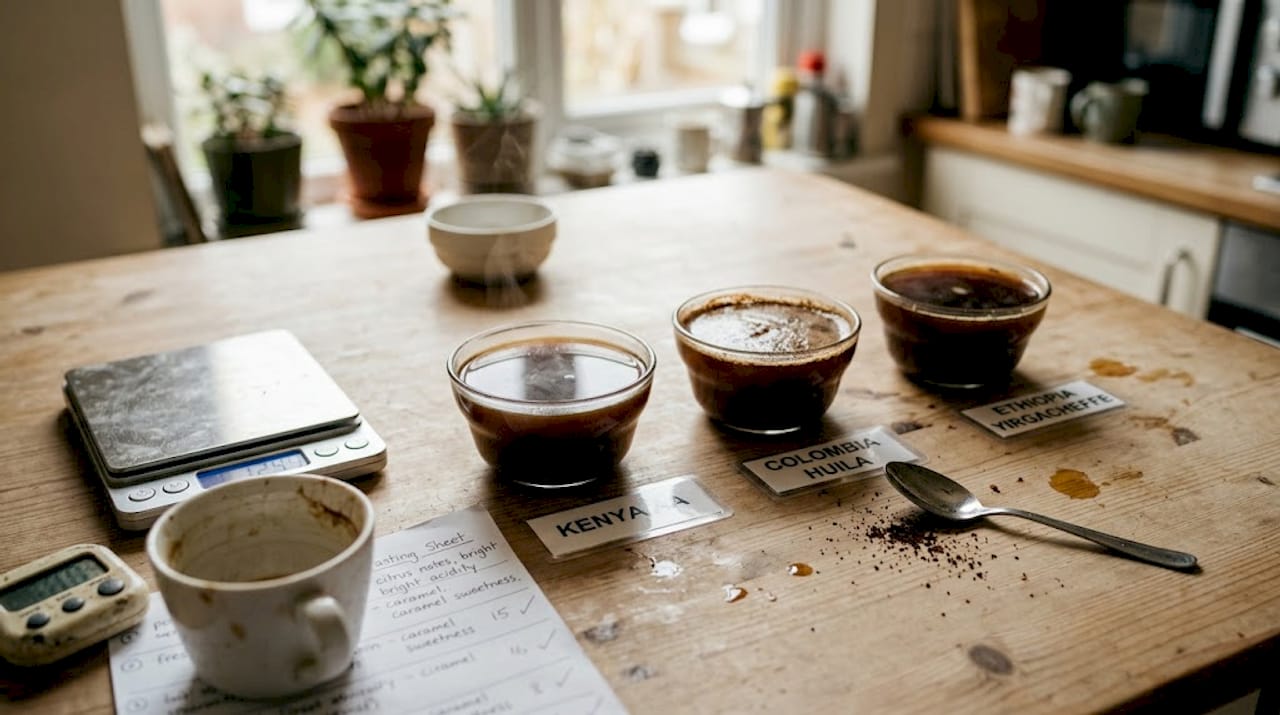
Pro Tip: Limit your session to 3 to 5 coffees at a time. Palate fatigue is real, and after too many samples your ability to detect subtle differences drops sharply. Consider blind tasting by having someone else label the cups so your expectations don’t influence your results.
How to taste coffee: Step-by-step cupping protocol
Once your tasting station is set, follow these essential steps for a true evaluation of your coffee’s flavors.
-
Smell the dry fragrance. After grinding, hold the bowl close and inhale slowly. Note any initial impressions: floral, nutty, earthy, fruity. This is the fragrance, before water touches the grounds.
-
Add hot water and steep for 4 minutes. Pour water evenly over all cups at the same time. Start your timer. Don’t stir. Let the crust form naturally on top.
-
Break the crust and smell the wet aroma. At 4 minutes, use your spoon to push the crust forward three times while leaning in close. This releases a concentrated burst of coffee aroma. It’s one of the most revealing moments in the entire session.
-
Skim the foam and grounds. Use two spoons to remove the floating crust material. You want a clean surface before tasting.
-
Slurp the coffee at multiple temperatures. Use your spoon to take a small amount and slurp it loudly across your entire palate. Slurping aerates the coffee and spreads it across every taste receptor at once, which is why it’s essential for accurate flavor perception. Begin tasting around 60°C and keep returning to the same cups as they cool. Flavors shift noticeably as temperature drops.
-
Record observations and retaste. Note flavor, body, acidity, sweetness, and aftertaste after each slurp. The cupping protocol recommends observing objectively before scoring subjectively.
How processing methods and flavor interact becomes obvious during this step. A washed Ethiopian and a natural Brazilian will taste dramatically different even at the same temperature.
Pro Tip: Taste each cup at least three times as it cools. A coffee that seems flat at 60°C might reveal bright fruit notes at 45°C and a rich chocolatey finish at room temperature.
Evaluating and describing coffee flavors: Using the SCA Coffee Taster’s Flavor Wheel
With your cup in hand, the next challenge is expressing exactly what you taste and how to compare coffees accurately.
The SCA Coffee Taster’s Flavor Wheel is the industry standard for this. It’s a circular diagram that moves from broad outer categories like “fruity” or “nutty” toward increasingly specific descriptors in the center, like “blackberry” or “hazelnut.” The method is simple: start at the outside, pick the broadest category that fits, then narrow inward until you find the most precise word.
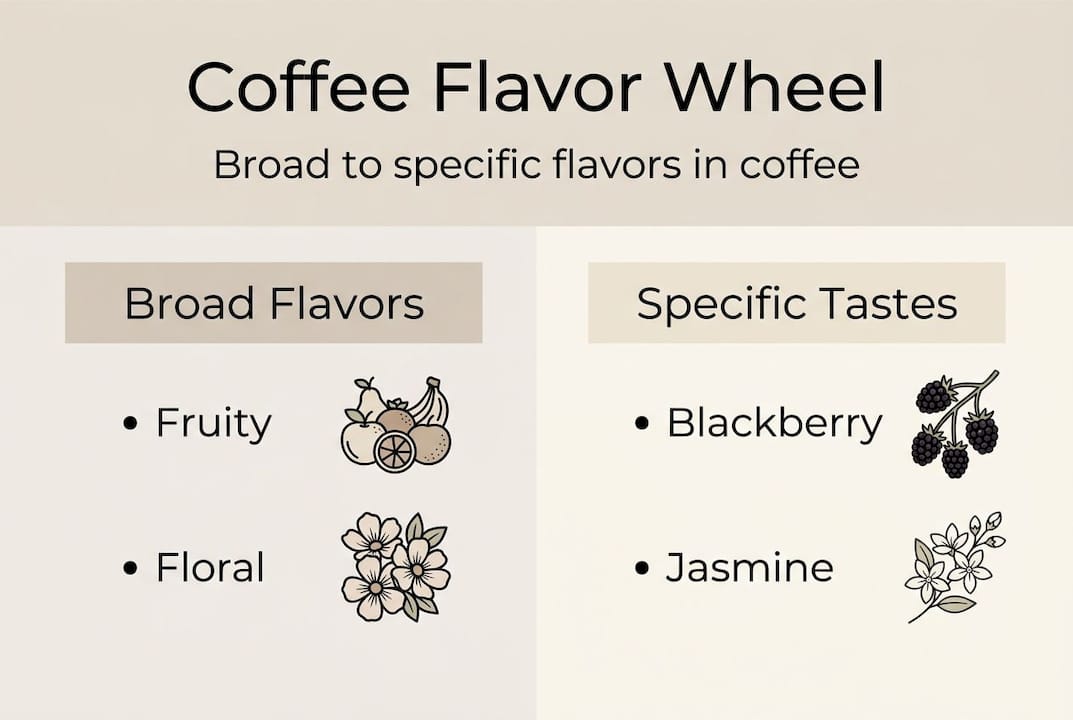
Here’s a quick reference for how descriptor categories work in practice:
| Broad category | Mid-level | Specific example |
|---|---|---|
| Fruity | Berry | Blackberry, blueberry |
| Floral | Black tea | Jasmine, rose |
| Nutty/cocoa | Chocolate | Dark chocolate, cocoa |
| Spices | Pepper | Black pepper, clove |
| Sweet | Vanilla | Brown sugar, caramel |
Pairing the Flavor Wheel with the World Coffee Research Sensory Lexicon adds another layer. The Lexicon gives you reference points, actual foods or substances that match each descriptor, so you’re not guessing. Regular cupping sharpens your ability to detect how processing and origin affect flavor over time.
Practical tips for building your palate:
- Taste the same coffee weekly for a month. Notice what changes as the beans age.
- Compare coffees from different origins side by side using the same protocol.
- Use the flavor profiles reference to connect what you taste to what you read about a coffee’s origin.
- Explore flavor pairing ideas to understand how complementary foods can highlight notes you might otherwise miss.
- Try tasting techniques from other beverage disciplines to cross-train your sensory awareness.
The goal isn’t to memorize every descriptor. It’s to build a personal reference library in your memory so each new cup gives you more to work with.
Interpreting scores and embracing new cupping protocols
Once you’ve described flavors, you’ll want to make sense of your experience using scoring frameworks now used by pros and better understand what makes a coffee “specialty.”
The classic SCA cupping form scores coffee across ten attributes on a 6 to 10 scale. A coffee that earns 80 points or above qualifies as specialty coffee. Each attribute, fragrance, aroma, flavor, aftertaste, acidity, body, balance, sweetness, uniformity, and clean cup, contributes to the final score.
The attributes evaluated include:
- Fragrance/Aroma: Dry and wet scent impressions
- Flavor and Aftertaste: Taste and finish
- Acidity: Brightness and liveliness
- Body: Mouthfeel and texture
- Balance, Sweetness, Uniformity, Clean Cup: Overall harmony and consistency
“Scoring is not about perfection. It’s a structured way to remember what you experienced and compare it to the next cup.”
In 2024, the SCA introduced the Coffee Value Assessment (CVA), a significant update to the 2004 protocol. The CVA separates tasting into three distinct parts: Descriptive assessment (objective attributes using CATA, or Check All That Apply, descriptors), Affective assessment (personal liking and perceived quality), and Extrinsic assessment (context and packaging influence). It also expands the sweetness scale and reduces the bias that crept into the original system when tasters mixed objective description with personal preference.
For home tasters, the practical takeaway is this: focus on quality standards for coffee as a learning tool, not a judgment. Scores help you track progress and compare coffees. They’re not a grade on your ability.
Why tasting coffee well is about more than just technique
With this foundation, let’s take a step back and consider what mastering coffee tasting truly adds to your everyday ritual.
Here’s something the technique guides don’t always say: the tasters we admire most aren’t the ones who score highest. They’re the ones who are genuinely curious. They remember the Ethiopian natural they tasted two years ago and can tell you exactly how it compared to the one in front of them today. That kind of memory isn’t built through perfection. It’s built through consistency and openness.
The biggest mistake new tasters make is treating the cupping protocol as a test to pass. It’s not. It’s a framework that quiets the noise so you can actually listen to the coffee. Some of the most interesting discoveries happen when something surprises you, when a coffee from a region you’d dismissed suddenly tastes like nothing you expected.
We’d encourage you to track your own preferences over time rather than chasing what experts say you should like. Read about single origin coffee stories to connect flavor to place and process. Let your palate evolve on its own terms. The protocol is your tool. The curiosity is yours.
Want coffee worth tasting? Try specialty brews from Z’s Coffee
Learning how to taste properly is only half the equation. The other half is having coffee that actually rewards the effort.
At Z’s Coffee, we source and curate specialty coffees specifically for people who want to taste the difference. If you want to put your new cupping skills to work right away, our flavored coffees sample pack is a great starting point. It gives you multiple distinct profiles to compare in a single session. You can also explore our full coffee and tea collection to find single origins, blends, and limited roasts worth evaluating. Every cup you taste with intention is a cup that teaches you something new.
Frequently asked questions
Can I taste coffee properly without professional tools?
Yes, you can follow the cupping protocol at home using common kitchen tools like a kitchen scale, wide mugs, and a large spoon, as long as you keep your variables consistent and use freshly ground beans.
How soon after roasting should I taste coffee for best results?
Taste coffee 3 to 10 days post-roast for peak flavor. Before that window, excess CO2 from the roasting process can mask delicate notes and create a hollow, gassy taste.
What is the SCA Coffee Taster’s Flavor Wheel?
The SCA Flavor Wheel is a visual tool that guides you from broad flavor categories like “fruity” or “floral” down to specific descriptors like “blackberry” or “jasmine,” helping you describe coffee with precision.
Why is slurping important when tasting coffee?
Slurping aerates coffee across your entire palate at once, which releases volatile aromatics and dramatically improves your ability to detect subtle flavor notes that a quiet sip would miss entirely.
How is the new CVA protocol different from classic coffee cupping?
The Coffee Value Assessment introduced after 2024 separates objective flavor description from personal preference scoring, which reduces evaluator bias and gives a clearer, more structured picture of what’s actually in the cup.
Recommended
- How to enhance coffee flavor: brew, beans & tips – Z’s Coffee
- What is coffee cupping? A 2026 guide to tasting like a pro – Z’s Coffee
- Unlock Coffee Extraction: Brew Better, Bolder Flavor – Z’s Coffee
- Creative coffee flavor pairing ideas for richer brews – Z’s Coffee
- How Coffee Is Grown: A Complete Guide for Beginners – EcoVibe Roast