You’ve probably heard the term specialty coffee thrown around at your favorite cafe or seen it on bags of premium beans. But what does it actually mean? Many people assume specialty coffee is just expensive coffee or a marketing gimmick. In reality, specialty coffee is defined by rigorous quality standards, detailed sensory evaluations, and a holistic assessment framework developed by the Specialty Coffee Association. Understanding these criteria helps you appreciate what sets specialty coffee apart from mainstream options and why it commands higher prices. This article breaks down the official scoring systems, explains how evaluation methods have evolved, and shows you how origin, sustainability, and processing impact quality and value.
Table of Contents
- Key takeaways
- What defines specialty coffee: official standards and scoring
- From cupping to Coffee Value Assessment: evolving methods for specialty coffee evaluation
- Why origin, variety, and sustainability matter in specialty coffee quality and value
- How to appreciate specialty coffee: tasting, scoring, and buying tips for connoisseurs
- Explore premium coffee offerings at Z’s Coffee
- What is specialty coffee? Frequently asked questions
Key Takeaways
| Point | Details |
|---|---|
| SCA standards | Specialty coffee is defined by rigorous quality benchmarks and a holistic assessment framework rather than by price alone. |
| CVA integration | The Coffee Value Assessment combines physical quality, descriptive sensory analysis, consumer preference, and extrinsic factors to provide a bias minimized evaluation. |
| Cupping limitations | Traditional cupping can be influenced by cupper bias and process variables, potentially misaligning scores with actual quality. |
| Market impact | Higher scores and holistic evaluations typically command premium prices in specialty coffee markets. |
What defines specialty coffee: official standards and scoring
The Specialty Coffee Association establishes clear benchmarks for what qualifies as specialty coffee. According to SCA research, specialty coffee is defined by unique attributes and high market value determined through holistic Coffee Value Assessment. This isn’t just about taste. The evaluation considers multiple factors that contribute to a coffee’s overall quality and worth.
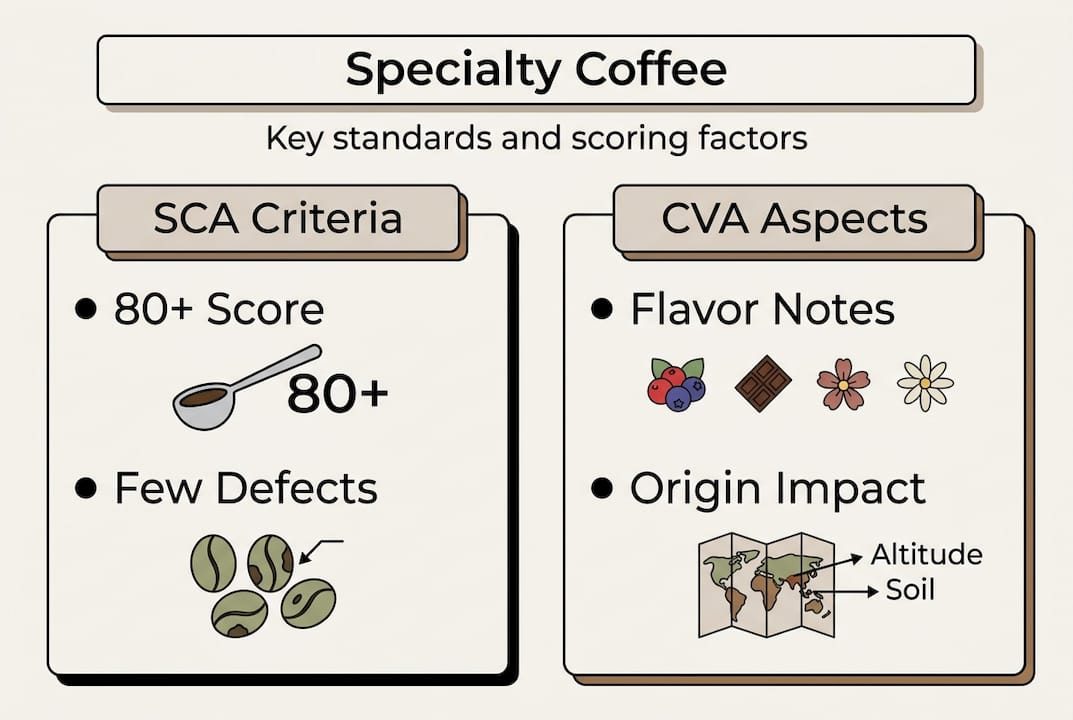
Traditional cupping uses a 100-point scale where coffees scoring 80+ points earn specialty designation. Higher scores indicate exceptional quality. Professional cuppers evaluate specific categories including aroma, flavor, aftertaste, acidity, body, balance, uniformity, clean cup, sweetness, and overall impression. Each category receives points based on intensity, complexity, and quality of characteristics.
The CVA framework expands beyond sensory evaluation alone. It incorporates physical assessment examining defects and moisture content, descriptive sensory analysis measuring flavor attributes, affective evaluation capturing consumer preference, and extrinsic factors including origin, variety, and sustainability practices. This comprehensive approach provides a more scientific, bias-minimized quality assessment compared to traditional cupping alone.
| Score Range | Quality Classification | Market Positioning |
|---|---|---|
| 90-100 | Outstanding specialty | Rare, auction-grade, exceptional prices |
| 85-89.99 | Excellent specialty | Premium pricing, distinctive character |
| 80-84.99 | Very good specialty | Specialty market entry, quality focused |
| Below 80 | Commercial grade | Mainstream market, commodity pricing |
Understanding coffee cupping categories helps you identify what contributes most to specialty coffee’s distinguished quality. Flavor complexity, balanced acidity, and clean finish typically separate specialty coffee from commercial grades. Learning these evaluation dimensions empowers you to recognize quality when tasting and purchasing.
Pro Tip: When exploring specialty coffee, pay attention to cupping scores and tasting notes provided by roasters. These details reveal which sensory categories scored highest and help you select coffees matching your flavor preferences.
The coffee quality standards established by SCA create consistency across the specialty coffee industry. Roasters, importers, and cafes use these benchmarks to source, price, and market their offerings. As a consumer, familiarity with these standards helps you make informed decisions and appreciate the craftsmanship behind truly exceptional coffee.
From cupping to Coffee Value Assessment: evolving methods for specialty coffee evaluation
Traditional cupping remains influential in the specialty coffee market, but it has limitations. Sensory scoring can be influenced by individual cupper bias, roasting variations, and environmental factors during evaluation. Small score differences between samples may not reflect actual quality gaps but significantly impact classification and pricing. Recognizing these challenges, the SCA developed a more comprehensive evaluation system.
The Coffee Value Assessment replaces traditional cupping with four distinct assessment categories designed to minimize bias and capture coffee quality more holistically. Physical assessment examines green bean characteristics including defect counts, moisture levels, water activity, and bean size distribution. This objective measurement identifies potential quality issues before roasting.
Descriptive sensory evaluation uses trained panels to identify and quantify specific flavor attributes without subjective quality judgments. Affective assessment captures consumer preference through hedonic testing, measuring how much people actually enjoy the coffee rather than how experts rate it. Extrinsic evaluation considers factors beyond the cup including origin story, varietal information, processing methods, and sustainability certifications.
| Evaluation Method | Focus Areas | Key Benefits | Limitations |
|---|---|---|---|
| Traditional Cupping | Sensory scoring across 10 categories | Established protocol, widely recognized | Subject to bias, roast dependent |
| CVA Physical | Defects, moisture, bean metrics | Objective measurements, pre-roast assessment | Doesn’t predict flavor directly |
| CVA Descriptive Sensory | Flavor attribute identification | Reduces subjective bias, detailed profiles | Requires trained panels |
| CVA Affective | Consumer preference testing | Real-world appeal measurement | Varies by consumer segment |
| CVA Extrinsic | Origin, sustainability, story | Captures market value drivers | Non-sensory factors |
Experts note that differences in cupping scores may not necessarily reflect true quality differences but significantly affect buying categories and pricing structures. A coffee scoring 84 points versus 86 points might taste nearly identical to most consumers, yet the classification difference impacts market positioning and cost. CVA addresses these limitations by providing multiple quality perspectives.
Learning the CVA framework helps you better understand how specialty coffee value reflects both quality and ethical factors. When you see sustainability certifications or origin stories highlighted alongside cupping scores, you’re seeing the extrinsic assessment category at work. These elements contribute to overall value even when sensory scores are similar.
Pro Tip: Ask your coffee roaster about their sourcing and evaluation processes. Roasters using CVA principles often provide more detailed information about physical quality, sustainability practices, and origin characteristics beyond basic cupping scores.
The evolution from traditional cupping to comprehensive value assessment reflects the specialty coffee industry’s maturation. Understanding both systems helps you navigate product descriptions, interpret quality claims, and recognize when coffee beans genuinely meet rigorous standards versus simple marketing language. This knowledge transforms you from a passive consumer into an informed connoisseur.
Why origin, variety, and sustainability matter in specialty coffee quality and value
Specialty coffee quality extends beyond what happens in the roastery or cafe. The extrinsic factors captured in CVA evaluation including variety, origin, and sustainability practices significantly influence both actual quality and market value. These elements shape flavor potential, environmental impact, and producer livelihoods.
Origin region strongly influences flavor profiles through terroir. Altitude, soil composition, rainfall patterns, and temperature fluctuations create distinct characteristics. Ethiopian coffees often display floral and fruity notes, while Colombian beans typically offer balanced sweetness and nutty undertones. Processing methods vary by region too, with natural processing common in Ethiopia and washed processing prevalent in Central America. These regional practices directly impact the flavors you taste.
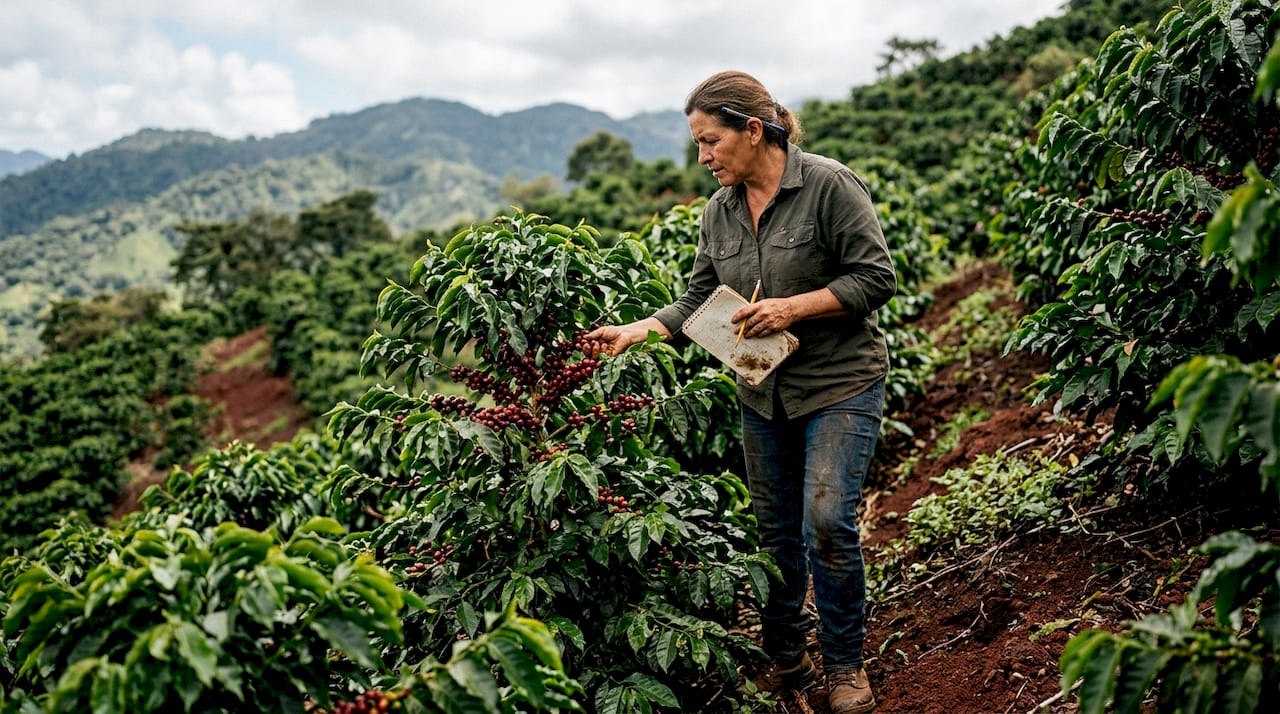
Coffee varietals determine genetic flavor potential and how beans respond to roasting and brewing. Bourbon and Typica varietals produce complex, nuanced flavors but yield lower harvests. Gesha (or Geisha) commands premium prices for its distinctive floral character and tea-like body. Understanding coffee origin helps you predict flavor profiles and appreciate regional uniqueness.
Sustainability practices affect multiple value dimensions. Fair trade certifications ensure producers receive living wages. Organic certifications indicate environmentally responsible farming without synthetic pesticides. Shade-grown coffee protects biodiversity and often produces more complex flavors due to slower cherry maturation. Direct trade relationships between roasters and farmers improve transparency and quality feedback loops.
Key extrinsic factors shaping specialty coffee value:
- Origin terroir: Altitude, climate, soil composition creating regional flavor signatures
- Plant varietals: Genetic characteristics determining flavor potential and complexity
- Harvest and processing: Picking selectivity, fermentation methods, drying techniques
- Sustainability certifications: Organic, fair trade, rainforest alliance, direct trade relationships
- Producer relationships: Transparency, quality feedback, fair compensation models
- Traceability: Farm-level sourcing, lot separation, harvest date documentation
These factors contribute to specialty coffee’s broader definition beyond cupping scores alone. A coffee might score 84 points but command higher prices due to rare varietal, exceptional sustainability practices, or compelling origin story. Conversely, a coffee scoring 86 points from conventional farming might sell for less than a lower-scoring but ethically sourced alternative.
Consumer preference increasingly values sustainability and transparency. Many specialty coffee drinkers willingly pay premiums for coffees supporting farmer livelihoods and environmental stewardship. This preference validates the CVA approach of including extrinsic factors in value assessment. When you choose specialty coffee with strong sustainability credentials, you’re supporting a supply chain that prioritizes quality, fairness, and ecological responsibility.
Understanding coffee varietals and their flavor implications helps you select coffees matching your taste preferences. If you enjoy bright, fruity notes, seek out Ethiopian heirlooms or Kenyan SL varieties. For chocolatey, nutty profiles, explore Brazilian or Guatemalan beans. This knowledge transforms coffee shopping from guesswork into intentional selection.
How to appreciate specialty coffee: tasting, scoring, and buying tips for connoisseurs
Developing your palate for specialty coffee requires practice and intentional tasting. You can apply SCA cupping protocols at home to evaluate coffee systematically and train your sensory perception. This process deepens appreciation for quality differences and helps you identify personal preferences.
How to taste specialty coffee using cupping protocol:
- Grind fresh: Use medium-coarse grind, measure 8.25 grams per 150ml water for standard ratio
- Evaluate dry fragrance: Smell the grounds immediately after grinding, noting aromatic intensity and character
- Add hot water: Pour 200°F (93°C) water directly onto grounds, let steep 4 minutes
- Break the crust: Push floating grounds aside with spoon, inhale deeply to capture wet aroma
- Skim and taste: Remove floating grounds, let cool slightly, slurp coffee from spoon to aerate across palate
- Assess categories: Note flavor, acidity, body, aftertaste, balance, and overall impression
- Compare samples: Cup multiple coffees side by side to identify differences and preferences
Identifying flavor notes requires focused attention. Start with broad categories like fruity, nutty, chocolatey, or floral. As your palate develops, distinguish specific notes such as blueberry versus strawberry, or dark chocolate versus milk chocolate. Acidity registers as brightness or liveliness, ranging from citric to malic to phosphoric. Body describes weight and texture, from tea-like to syrupy.
Interpreting scores helps you understand market categories when buying. Remember that higher scores correlate with premium prices, but personal preference matters most. An 84-point coffee you love offers better value than a 90-point coffee you find unpleasant. Use scores as quality indicators, not absolute taste predictors.
Buying tips for selecting quality specialty coffee:
- Look for certifications: Organic, fair trade, or direct trade labels indicate sustainability commitments
- Check score reports: Reputable roasters provide cupping scores and detailed tasting notes
- Ask about processing: Washed, natural, or honey processing significantly impacts flavor profiles
- Consider origin details: Farm names, regional specifics, and altitude information suggest quality focus
- Evaluate freshness: Roast dates within 2-4 weeks ensure optimal flavor, avoid undated bags
- Start with samples: Purchase small quantities when trying new origins or roasters
Pro Tip: Regular tasting practice sharpens your palate and helps you appreciate subtle differences in high-quality specialty coffee. Set aside time weekly to cup 2-3 different coffees side by side, taking notes on your observations.
Applying your knowledge about coffee cupping transforms casual coffee drinking into intentional appreciation. You’ll notice nuances previously overlooked and develop preferences based on actual sensory experience rather than marketing claims. This expertise enhances enjoyment and ensures your specialty coffee purchases deliver genuine value.
Experimenting with brewing methods reveals how preparation affects flavor expression. The same specialty coffee tastes different when brewed as espresso versus pour over versus French press. Understanding these variables helps you optimize extraction and fully appreciate the quality you’re paying for. Your investment in specialty coffee deserves preparation methods that showcase its distinctive characteristics.
Explore premium coffee offerings at Z’s Coffee
Now that you understand what defines specialty coffee and how to evaluate quality, you’re ready to experience exceptional beans firsthand. Z’s Coffee offers a curated selection of specialty coffee that exemplifies the standards and practices discussed throughout this guide. Each offering is selected for quality, sustainability, and distinctive flavor profiles.
Our collection includes unique blends like Coffee with Mushrooms Medium Roast, combining specialty coffee with functional ingredients for enhanced wellness benefits. We source beans that meet rigorous quality criteria, provide detailed origin information, and support sustainable farming practices. Whether you’re seeking single-origin coffees showcasing regional terroir or carefully crafted blends, you’ll find options that reflect true specialty standards.
Explore our full range of coffee and tea products to discover flavors matching your preferences. Detailed product descriptions include tasting notes, origin details, and processing methods, giving you the information needed to make informed selections. Our commitment to quality ensures every purchase delivers the exceptional experience specialty coffee promises.
Pro Tip: Choosing products from a trusted specialty coffee provider guarantees adherence to quality standards covered in this guide, ensuring your investment delivers genuine value and superior taste.
Key product categories at Z’s Coffee:
- Specialty coffee: Single-origin and blended options meeting SCA quality standards
- Unique blends: Innovative combinations like mushroom coffee for functional benefits
- Tea options: Premium tea selections for beverage variety
- Brewing accessories: Tools to optimize extraction and flavor expression
What is specialty coffee? Frequently asked questions
What exactly is specialty coffee?
Specialty coffee is coffee scoring 80 points or higher on the SCA’s 100-point cupping scale, or meeting comprehensive Coffee Value Assessment criteria. It represents the highest quality tier in the coffee market, distinguished by superior sensory characteristics, minimal defects, and often sustainable sourcing practices. The specialty designation reflects both objective quality measures and market value.
How does specialty coffee differ from commercial coffee?
Specialty coffee differs from commercial coffee in quality standards, sourcing practices, and flavor complexity. Commercial coffee typically scores below 80 points, contains more defects, and prioritizes yield over quality. Specialty coffee emphasizes traceability, sustainable farming, selective harvesting, and careful processing. These differences result in cleaner flavors, greater complexity, and more distinctive regional characteristics compared to commercial grades.
Why is the 80-point threshold important for specialty coffee?
The 80-point threshold represents the quality level where coffee exhibits consistently excellent sensory characteristics with minimal defects. Scores below 80 indicate quality issues like off-flavors, inconsistency, or processing flaws that disqualify coffee from specialty classification. This benchmark creates market differentiation, justifies premium pricing, and sets clear standards for producers, roasters, and consumers. Understanding this threshold helps you recognize genuine quality when purchasing.
Does roasting affect specialty coffee grade or just flavor?
Roasting affects flavor expression but not the underlying specialty grade, which is determined by green bean quality. However, poor roasting can mask or destroy the characteristics that earned a coffee its specialty score. Skilled roasting reveals and enhances inherent quality, while improper roasting creates defects or imbalances. When evaluating specialty coffee, consider both green bean grade and roaster expertise for optimal results.
How can I verify a coffee’s specialty status when buying?
Verify specialty status by checking for cupping scores on product packaging or descriptions, looking for SCA certification or third-party quality assessments, and asking roasters about their sourcing and evaluation processes. Reputable specialty roasters provide detailed origin information, roast dates, and tasting notes. Lack of specific quality information often indicates commercial-grade coffee regardless of marketing language. Learning to cup coffee yourself also helps you independently assess quality claims.