TL;DR:
- Coffee defects are physical or chemical flaws in green beans that harm cup quality and roasting consistency. The Specialty Coffee Association classifies these flaws into primary defects, which disqualify a lot from specialty grade, and secondary defects, which reduce quality but are permitted in small numbers. Proper detection and removal of defects before roasting are essential for maintaining high-quality coffee.
Coffee defects are defined as physical or chemical imperfections in green coffee beans that degrade cup quality and roasting consistency. The Specialty Coffee Association (SCA) classifies these flaws into two tiers: primary defects, which are severe enough to disqualify a lot from specialty grade, and secondary defects, which reduce quality but do not automatically disqualify a batch. Understanding this explanation of coffee defects is the foundation of every quality assessment decision, from farm to cup. Black beans, full sour beans, and quakers are the most cited defect examples in grading labs worldwide. Knowing what causes them, how to spot them, and what they taste like separates a skilled coffee professional from someone who just follows a recipe.
What are the main types of coffee defects?
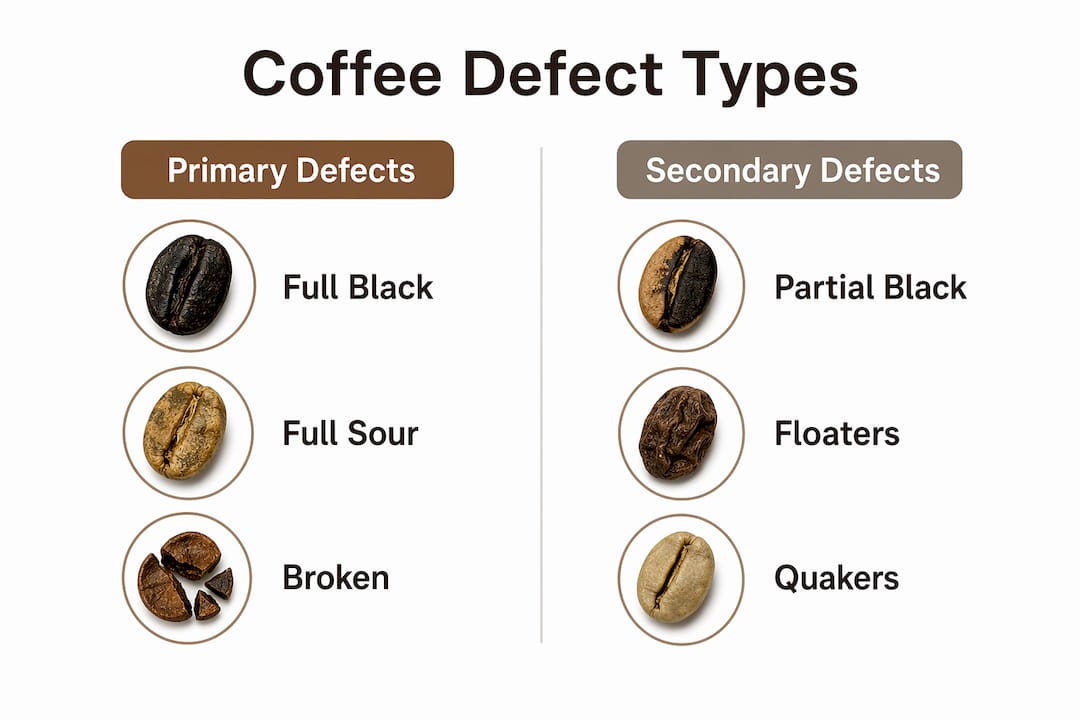
Coffee defects split into two categories based on severity. Primary defects are severe flaws that directly disqualify a lot from specialty grade. Secondary defects reduce quality but are permitted in small numbers.
Primary defects include:
- Full black beans: Caused by over-ripening, disease, or contact with soil. They produce burnt, ashy, and fermented flavors.
- Full sour beans: Over-fermentation causes these beans to deliver sharp, vinegary acidity in the cup.
- Insect damage (Coffee Berry Borer): The Coffee Berry Borer drills holes and internal tunnels through the bean. The result is a musty, contaminated flavor that classifies this as a primary defect.
- Fungus-damaged beans: Mold growth during drying or storage creates earthy, phenolic off-notes.
Secondary defects include:
- Quakers: Immature beans with low density that roast pale. They produce papery, hollow, and flat flavors.
- Floaters and bleached beans: Low-density beans that roast unpredictably. Five floaters equal one full defect count in SCA grading.
- Broken or chipped beans: Caused by mechanical processing errors. They roast unevenly and contribute bitter notes.
- Shells (elephant ears): Genetic mutations that separate during roasting and scorch easily.
| Defect | Category | Primary Cause | Flavor Impact |
|---|---|---|---|
| Full black bean | Primary | Over-ripening, soil contact | Burnt, ashy, fermented |
| Full sour bean | Primary | Over-fermentation | Vinegary, sharp acidity |
| Insect damage | Primary | Coffee Berry Borer | Musty, contaminated |
| Quaker | Secondary | Immature picking | Papery, hollow, flat |
| Floater | Secondary | Low density, improper drying | Flat, unpredictable roast |
| Broken bean | Secondary | Mechanical processing | Bitter, uneven roast |
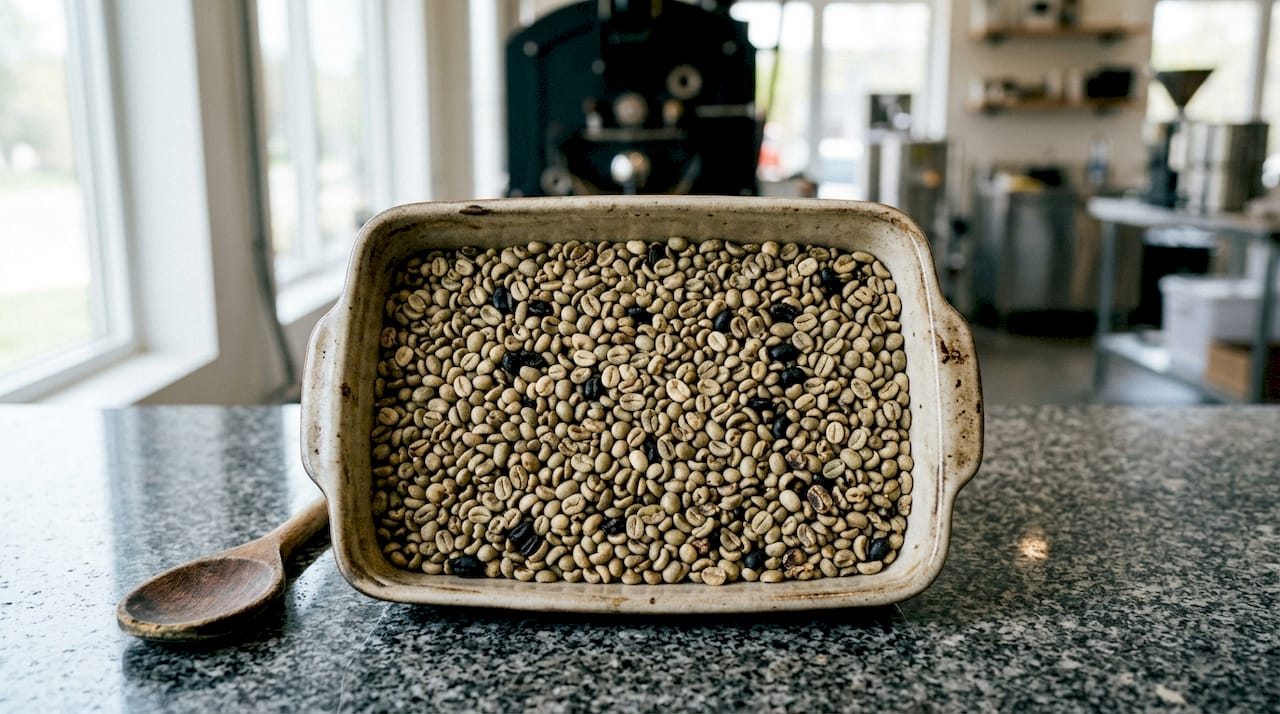
Pro Tip: Sort green beans under bright light before roasting. Black beans and full sours are visually distinct. Catching them early takes less than five minutes per batch and protects the entire cup.
How do coffee defects affect flavor and roasting?
Defects cannot be roasted out. A full sour bean carries its vinegary compounds through every roast stage. A black bean amplifies its burnt, fermented character as heat increases. The roast does not fix the problem. It often makes it worse.
Each defect type produces a recognizable flavor signature:
- Full sour beans deliver sharp, vinegary acidity. Even one or two in a batch can sour an entire brew.
- Black beans contribute burnt, ashy, and fermented notes. They are the most damaging single defect by flavor impact.
- Quakers produce papery, hollow sweetness. They dull the overall flavor without adding anything distinct.
- Insect-damaged beans introduce musty, earthy contamination that reads as a processing fault to most tasters.
- Floaters roast unpredictably, creating light and dark spots within the same batch and producing flat, inconsistent flavor.
Roasting also introduces its own faults that coffee professionals must separate from green bean defects. Baking, which occurs when heat stalls during the roast, produces flat, bread-like flavors. Scorching happens when beans contact an overheated drum surface and creates harsh, acrid notes on the outside while the interior stays underdeveloped. Roasting defects like baking and scorching require corrections to the roast process, not the green bean selection. Confusing the two leads to wrong diagnoses and wasted effort.
Pro Tip: When a cup tastes flat or papery, pull the roasted batch and look for pale, tan-colored beans. Those are quakers. Remove them manually before brewing. Quakers evade automatic sorting and appear even in specialty-grade lots.
Defect-related flavor problems also affect roast uniformity. A batch with mixed densities, caused by floaters and broken beans mixed with healthy beans, will never roast evenly. Some beans finish early. Others stay underdeveloped. The result is a cup that tastes simultaneously over-extracted and thin.
What are the industry standards for defect grading?
The SCA sets the global benchmark for coffee defect grading. Quality control involves inspecting 300–350g samples, counting defects by type, and assigning a grade based on the total defect score. The system is strict and leaves little room for error at the specialty level.
The grading thresholds are clear:
- Zero primary defects are allowed in a 350g sample to qualify as specialty grade.
- No more than five secondary defects are permitted in the same sample.
These limits reflect how severely even a single primary defect can damage a cup. One full sour bean in a 350g sample is enough to fail an entire lot. That standard exists because specialty coffee grading standards protect both the buyer and the producer’s reputation.
| Grade | Primary Defects Allowed | Secondary Defects Allowed |
|---|---|---|
| Specialty | 0 | 0–5 |
| Premium | 0–3 | 0–8 |
| Exchange | Up to 9 | Up to 23 |
| Below standard | More than 9 | More than 23 |
Visual inspection is the first step in quality control. Trained graders spread the sample on a white tray and sort by color, size, and surface condition. Defects are counted individually, with some secondary defects grouped (five floaters equal one full defect). The final count determines grade and, in commercial transactions, price. Transparency in defect identification is vital for resolving trade disputes and maintaining quality assurance across the supply chain.
Pro Tip: Keep a sealed reference sample from every green coffee lot you purchase or roast. If a quality dispute arises, that sample is your evidence. Label it with origin, harvest date, and purchase date.
How can you manage defects during roasting and brewing?
Defect management starts before the roaster turns on. Sorting green beans by hand before roasting removes the most obvious flaws and protects the batch. Home roasters can detect problem beans with smaller samples by focusing on visible defects: color anomalies, holes, shriveled shapes, and size inconsistencies.
Practical steps for defect management at every stage:
- Pre-roast sorting: Spread green beans on a white surface. Remove black, sour, insect-damaged, and visibly shriveled beans. This takes five to ten minutes and directly improves cup quality.
- Post-roast inspection: After roasting, look for pale, tan-colored beans among the darker roasted batch. These are quakers. Remove them before grinding.
- Brewing adjustments: If defects are suspected but cannot be fully removed, use a coarser grind and shorter brew time. This reduces extraction of off-flavors without eliminating them entirely.
- Traceability: Record the origin, processing method, and lot number of every coffee you buy. When a cup tastes wrong, traceability helps you identify whether the fault is at the farm, the processor, or the roaster.
Certain defects signal problems that no roasting or brewing adjustment can fix. Full sour beans indicate fermentation failures at the processing stage. Insect damage points to pest management failures at the farm. These are farm-level quality issues that require upstream solutions, not downstream workarounds. Understanding this distinction helps professionals communicate clearly with producers and importers about where quality broke down.
Pro Tip: When evaluating a new green coffee lot, brew a small sample using a cupping protocol before committing to a full roast. Defect flavors show clearly in a cupping bowl, especially vinegary sourness and mustiness.
Brewing methods also interact with defects differently. Espresso concentrates all flavors, including defect-driven off-notes. A batch with even a small number of quakers will taste noticeably flat in espresso. Filter brewing is more forgiving but still reveals mustiness and sourness from primary defects. Choosing the right brewing approach for your beans is part of managing the final cup experience.
Key Takeaways
Coffee defects are the single most controllable variable between a mediocre cup and a specialty-grade experience, and they must be addressed at the green bean stage before roasting begins.
| Point | Details |
|---|---|
| Primary vs. secondary defects | Primary defects disqualify specialty grade; secondary defects reduce quality but are permitted in small counts. |
| Defects persist through roasting | No roast technique removes defect-driven flavors; green bean quality is the starting point. |
| SCA grading is strict | Zero primary defects and no more than five secondary defects per 350g sample qualify as specialty grade. |
| Sort before you roast | Manual pre-roast sorting removes visible defects and directly protects cup quality. |
| Roasting faults are separate | Baking and scorching are roast-process errors, not green bean defects, and require different corrections. |
Why defect knowledge changed how I buy and roast coffee
Most coffee enthusiasts focus on origin, variety, and processing method when choosing beans. Those factors matter. But after years of cupping hundreds of lots, I’ve found that defect load is the single most reliable predictor of whether a coffee will perform consistently. A beautifully processed Ethiopian natural with high quaker counts will disappoint in the cup every time, regardless of how good the origin story sounds.
The most common mistake I see is blaming the roast for problems that started in the green bean. A flat, papery cup gets attributed to underdevelopment. A vinegary note gets blamed on too much heat. In reality, those flavors often trace back to quakers and sour beans that were never removed. Distinguishing farm-level faults from roasting errors is a diagnostic skill that takes time to build, but it changes everything about how you troubleshoot.
Defect transparency also matters commercially. Producers who provide defect counts and keep reference samples earn more trust from buyers. Importers who disclose defect levels honestly build longer relationships. The knowledge of specific defects helps everyone in the chain communicate with precision instead of vague complaints about “off flavors.” That precision is what separates professional coffee buying from guesswork. If you want to improve your coffee quality, start by learning to read the green bean before you ever touch the roaster.
— zachary
Quality coffee starts with defect-free beans
Understanding coffee defects is only half the equation. The other half is sourcing beans that meet the standards you’ve just learned to recognize.

At Zscoffee, every coffee selection is chosen with quality and minimal defect load in mind. Whether you prefer a clean, bright filter coffee or a rich, full-bodied cold brew, the starting point is always the green bean. Browse the cold brew coffee range at Zscoffee for a ready-to-drink option crafted from carefully selected, high-grade beans. For a wider look at what Zscoffee carries, the full product collection covers everything from single-origin coffees to brewing accessories. Quality in the cup starts with quality at the source.
FAQ
What is the definition of a coffee defect?
A coffee defect is a physical or chemical imperfection in a green coffee bean that negatively affects cup quality, roasting consistency, or both. The SCA classifies defects as either primary (severe) or secondary (less severe).
What causes full sour beans?
Full sour beans result from over-fermentation during coffee processing. They produce sharp, vinegary acidity in the cup and are classified as a primary defect under SCA grading standards.
Can roasting remove coffee defects?
Roasting cannot remove coffee defects. Defect-driven flavors persist through the roast and often intensify with heat, which is why green bean sorting before roasting is the most effective quality control step.
How many defects are allowed in specialty coffee?
Specialty grade coffee requires zero primary defects and no more than five secondary defects in a 350g sample, according to SCA standards. Even one full sour or black bean fails the entire lot.
How do quakers affect coffee flavor?
Quakers are immature, low-density beans that roast pale and produce papery, hollow, and flat flavors. They can appear even in specialty-grade lots and should be removed manually after roasting.