A coffee estate is a single, identifiable farm or plantation where coffee is cultivated, harvested, processed, and prepared for export entirely under unified ownership and management. The term, formalized in the specialty coffee world through sources like Roastopedia, carries a specific guarantee: every bean in the bag traces back to one piece of land, one management team, and one unbroken chain of custody from tree to export-ready green bean.
A few things define a true coffee estate:
- Single property origin: All coffee comes from one clearly bounded farm, not a blend of neighboring plots.
- Unified management: One ownership structure oversees agronomy, harvesting, and processing decisions.
- Full production arc: The estate handles everything from growing the coffee tree to milling the green bean on-site or immediately adjacent.
- Traceable identity: The estate name itself functions as a quality marker and brand guarantee.
- Size range: Estates span from small family plots of a few acres to vast plantations covering hundreds or thousands of hectares.
The word “estate” shares roots with the Old French estat and Latin status, both implying a defined domain of property under deliberate management. In coffee-producing regions, the same concept appears under different names: hacienda or finca in Spanish-speaking countries, fazenda in Brazil, and quinta in Portuguese-speaking Africa.
How estate coffee differs from single-origin and other coffee types
Estate coffee sits within the single-origin category, but the two terms are not interchangeable. Single-origin coffee only requires that beans come from one country or defined region, which can include blends from dozens of smallholder farms. Estate coffee goes further: it demands one named property under unified management.
| Term | What it requires | Traceability level |
|---|---|---|
| Single-origin | One country or region | Country or region |
| Estate coffee | One named farm, unified management | Farm level |
| Micro-lot | A specific block, altitude band, or variety within one estate | Sub-farm level |
| Cooperative coffee | Pooled production from multiple smallholders at a shared mill | Cooperative level |
Micro-lots represent the most granular tier, carved out from within a single estate based on a specific field, altitude band, or processing batch. They often fetch the highest prices in the specialty market precisely because the traceability is so tight.
The term “estate” can be used loosely in trade, sometimes applied to coffee collected from multiple farms and processed at one central mill. That usage does not meet the strict definition.
Pro Tip: Ask your roaster or importer whether the estate operates its own wet mill. On-site processing is the clearest signal that the “estate” label reflects genuine single-property control, not just a marketing choice.
What agricultural and processing practices look like on a real estate
Unified management is what separates an estate from a cooperative in practice. One team decides which varietals to plant, when to harvest, and how to process, and those decisions stay consistent from season to season.
- On-site wet and dry mills: A true estate operates both, taking coffee from cherry on the tree to bagged green bean without handing off to a third-party processor.
- Varietal selection: Management can plant specific cultivars suited to the farm’s altitude, soil, and microclimate, then keep those lots separate.
- Altitude-based micro-lots: Farms with significant elevation changes often process coffee from different altitude bands separately, since ripening rates and flavor profiles vary.
- Labor models: Estates typically employ permanent or seasonal workers directly, unlike cooperatives where each smallholder manages their own labor.
The contrast with cooperative processing is real. Cooperatives aggregate coffee from many farms to achieve scale, which benefits smallholders who lack their own mills. Estates sacrifice that scale in exchange for control over coffee processing methods and the flavor clarity that comes with it.
Why coffee estates matter economically
Estate coffee gives growers a path to higher, more consistent prices by stepping off the commodity market treadmill. When a farm builds a recognized name, buyers pay for that identity, not just the weight of green beans.
- Roasters benefit from year-to-year consistency in flavor character, which simplifies menu planning and customer communication.
- Growers reduce exposure to commodity price swings by selling on reputation rather than exchange rates.
- The estate model scales differently by region: large Brazilian fazendas use mechanized harvesting and technology to produce commercial-to-specialty coffee at volume, while boutique estates in Hawaii’s Kona district operate on just a few acres with hand-picked harvests.
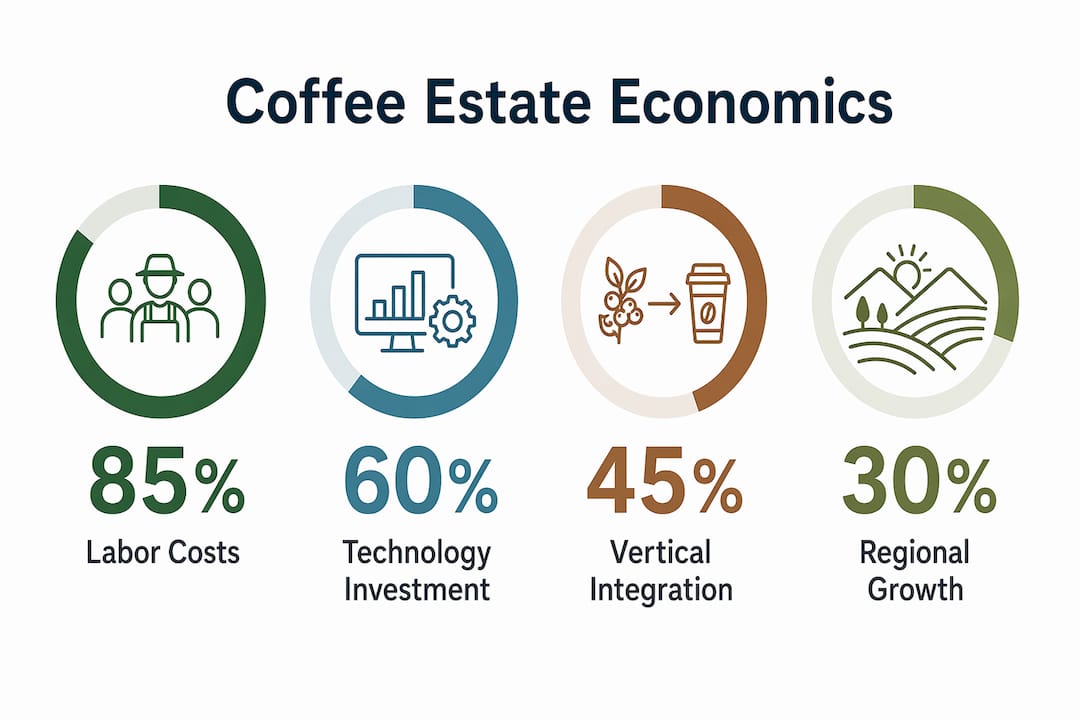
The estate model often emerges in regions with higher labor costs, where investment in technology and vertical integration makes economic sense. Brazil, Australia, and Hawaii illustrate this pattern clearly. India offers a different version: large, shade-grown plantations in Karnataka and Kerala represent the most classic estate model globally, with generations of management history behind each named property.
Ethical and quality considerations on coffee estates
The estate label carries ethical weight alongside its quality signal. Because one management team controls the entire operation, labor practices and sustainability decisions are visible and attributable in a way that cooperative models cannot always match.
- Direct labor oversight: Estate owners can implement and enforce specific wage standards, housing conditions, and safety practices across their workforce.
- Sustainability decisions: Shade-grown canopy management, water recycling in wet mills, and soil health programs are easier to implement consistently under unified control.
- Certification alignment: Estates pursuing Rainforest Alliance, UTZ, or organic certification do so as a single entity, which simplifies auditing compared to certifying hundreds of individual smallholders.
“Estates provide ethical assurances by allowing direct oversight of labor practices and sustainability measures, although challenges such as climate and pests remain significant.” — Zscoffee, Fair Trade Coffee Explained
The flip side is accountability. When labor abuses or environmental violations occur on an estate, there is no diffuse cooperative structure to absorb the blame. The estate name is on the bag, and the reputation consequence is direct. That accountability cuts both ways, which is part of why transparency in coffee sourcing has become a selling point rather than just a compliance exercise.
How estates drive coffee quality and traceability
Quality on a coffee estate is not accidental. The unified management model allows deliberate decisions at every stage: which blocks to harvest first, how long to ferment, whether to sun-dry or use raised beds. Those decisions compound across a season into a flavor profile that a roaster can count on.
Traceability works the same way. When a roaster buys from a named estate, they can return to that exact source the following year and reasonably expect the same character. That repeatability is what coffee origin advocates point to when arguing that farm-level sourcing produces better outcomes than regional blending.
Where in the world are coffee estates concentrated?
Coffee estates cluster within the Bean Belt, the band between roughly 25 degrees north and 30 degrees south latitude where climate supports arabica and robusta cultivation. Within that band, estate concentration varies sharply by region.
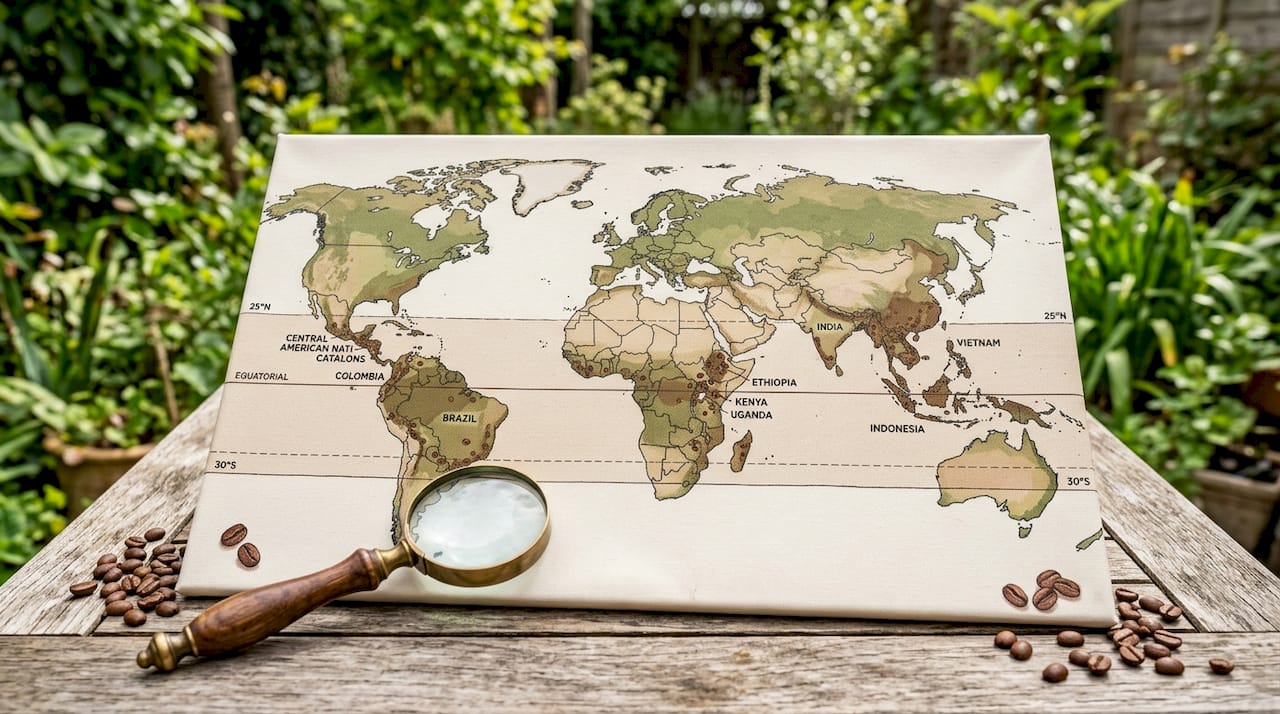
India’s Karnataka and Kerala states host some of the world’s most established estate operations, many dating back to British colonial administration. Latin America’s estate culture centers on Costa Rica, Guatemala, and Colombia, where the finca model is deeply embedded. Brazil’s fazendas dominate by sheer volume, with some properties covering tens of thousands of acres. Hawaii’s Kona district represents the small-farm end of the spectrum, where three-acre plots qualify as estates by virtue of their single-origin identity and on-site processing.
East Africa presents a more mixed picture. Ethiopia and Kenya have strong cooperative traditions, though named estates do exist, particularly in Kenya’s Central Province. Papua New Guinea uses “plantation” as the standard term for what other regions call an estate.
How the coffee estate model developed historically
The modern estate branding concept traces directly to one farm. William McAlpin of La Minita in Costa Rica’s Tarrazú district began in the 1980s to market his farm’s coffee by name, using a color brochure and a documentary video to build consumer awareness of origin and preparation standards. The approach was borrowed consciously from the wine industry’s “estate-bottled” designation, which signals that grapes were grown, fermented, and bottled on the same property.
La Minita’s commercial success triggered a wave of imitation. Farms across Latin America, India, and East Africa began attaching their names to their coffee, and specialty roasters responded by building their menus around named estates rather than regional grades. That shift, from “Colombian Supremo” to “Finca El Paraíso,” changed how the specialty market communicates value to consumers.
What challenges do coffee estates face today?
Climate change sits at the top of the list. Rising temperatures and shifting rainfall patterns are pushing viable growing altitudes higher, compressing the land available for quality arabica production. Estates with fixed land boundaries cannot simply relocate uphill.
Coffee leaf rust (Hemileia vastatrix) remains the most destructive pest threat, capable of wiping out a season’s crop across an entire estate. Unlike cooperatives that can source from unaffected members, an estate has no geographic buffer. Estates in Central America lost significant production to rust outbreaks in the early 2010s, and the threat has not receded.
Labor costs and availability create pressure on smaller estates in particular. Hand-picking selective harvests is labor-intensive, and in regions where rural populations are migrating to cities, finding enough skilled pickers at harvest time is a recurring problem. Larger estates in Brazil have responded with mechanical harvesting, but that approach suits flat terrain and strip-picking, not the selective picking that specialty quality demands.
Zscoffee carries estate coffees worth exploring
If reading about estate coffee has made you want to taste the difference, Zscoffee stocks a range of traceable, high-quality coffees sourced with origin in mind.
Zscoffee’s catalog includes options across roast profiles and origins, so you can compare what single-farm sourcing actually tastes like against regional blends. Browse the coffee and tea collection to find estate and single-origin options, or explore the full product catalog if you want to see everything available. For those new to estate coffee, a sampler is a practical way to taste the traceability story without committing to a full bag.
Key Takeaways
Estate coffee is the most traceable category in specialty coffee, defined by single-property origin, unified management, and on-site processing from cherry to export-ready green bean.
| Point | Details |
|---|---|
| Core definition | An estate is one named farm under unified ownership, covering the full production arc from cultivation to export. |
| Estate vs. single-origin | Single-origin allows regional blends; estate coffee requires one specific, named property. |
| Processing control | True estates operate both wet and dry mills on-site, maintaining quality without third-party processors. |
| Economic value | Estate branding lets growers command consistent price premiums and reduces exposure to commodity market swings. |
| Zscoffee selection | Zscoffee’s catalog includes traceable estate and single-origin coffees available for direct purchase online. |