TL;DR:
- Fair trade coffee offers minimum pricing and social premiums to support small farmers but often benefits roasters more. Certification requires cooperative membership, demanding standards, and payment of fees, excluding many farmers. Critics highlight issues like premium leakage, overproduction, and limited benefits for the poorest farmers.
Most people assume that buying fair trade coffee automatically sends more money to struggling farmers. The label feels reassuring, almost like a promise. But the reality is more complicated, and more interesting, than a simple stamp of approval. Fair trade certification involves minimum pricing, social premiums, cooperative structures, and environmental requirements that genuinely help some producers while leaving others behind. This guide breaks down exactly what fair trade coffee means, how certification works, who captures the real value, and what critics say about the system’s limits. By the end, you’ll know how to read the label with more confidence.
Table of Contents
- What does fair trade coffee mean?
- How the fair trade coffee certification process works
- Who really benefits from fair trade coffee?
- Criticisms and complex realities of fair trade coffee
- Why fair trade coffee isn’t the silver bullet, but still matters
- Discover purpose-driven coffee choices
- Frequently asked questions
Key Takeaways
| Point | Details |
|---|---|
| Fair trade definition | Fair trade coffee is certified by third parties that set minimum prices and community premiums for small producers. |
| Certification complexity | Certification involves annual audits, environmental practices, and is mainly open to cooperatives. |
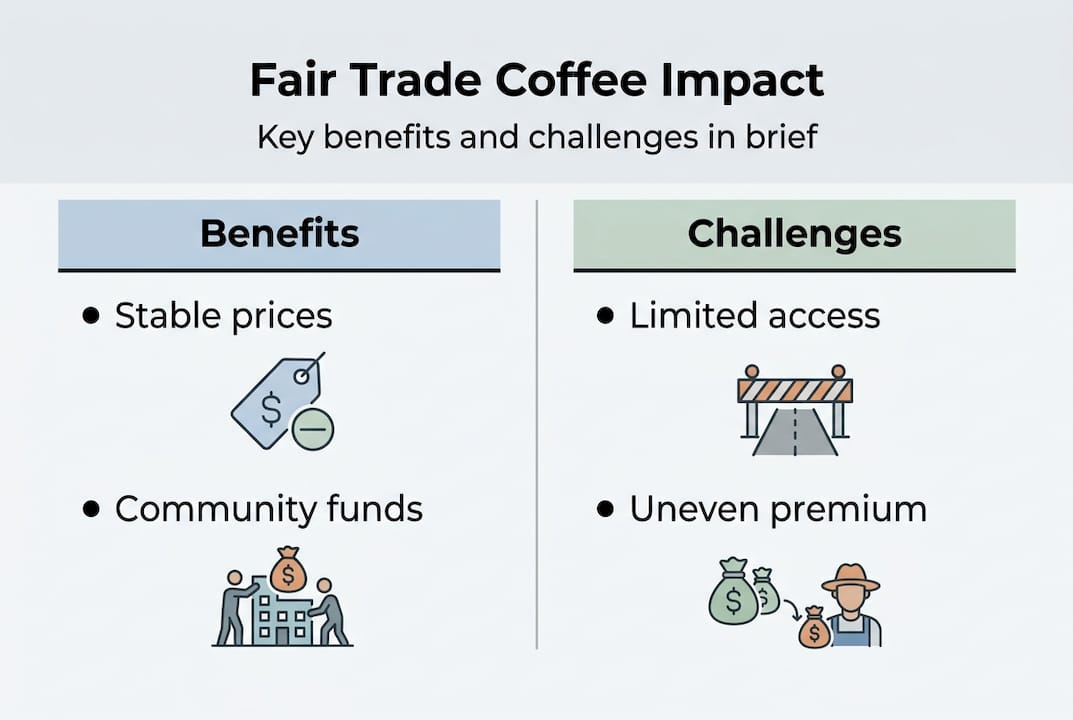
| Benefits and limits | While fair trade improves stability and funds community projects, much of the price premium remains with middlemen. |
| Informed choices | Smart coffee buyers look beyond labels and ask about real producer impact, transparency, and sourcing. |
What does fair trade coffee mean?
Fair trade coffee is not just a marketing term. It represents a structured system designed to address the power imbalance between global coffee buyers and the small farmers who grow the beans. Conventional coffee markets are notorious for price volatility. Farmers can plant and harvest a crop only to find that global commodity prices have dropped below their cost of production. Fair trade was built to cushion that blow.
At its core, fair trade coffee guarantees producers a minimum price per pound regardless of what global markets do. When market prices drop below that floor, certified buyers must pay the minimum. When markets rise above it, producers get the higher market rate. On top of the minimum price, buyers also pay a social premium, a fixed additional sum that cooperatives must invest in community projects like schools, health clinics, and clean water infrastructure.
Fair trade coffee is certified by organizations like Fairtrade International or Fair Trade USA, ensuring small producer organizations receive a minimum price and a social premium. These are not the same organization. Fairtrade International focuses primarily on small producer cooperatives and sets global standards. Fair Trade USA split from Fairtrade International in 2011 and allows larger plantations to certify, which remains controversial among advocates.
Fair trade coffee is distinct from specialty coffee quality standards, which focus on sensory scores and traceability. A coffee can be fair trade without being specialty grade, and vice versa. It’s also different from organic coffee practices, which address pesticide and chemical use but don’t require minimum pricing or social premiums.
Key certifying organizations at a glance:
| Organization | Primary focus | Who can certify | Notable feature |
|---|---|---|---|
| Fairtrade International | Small cooperatives | Cooperatives only | Global standard setter |
| Fair Trade USA | Cooperatives and estates | Cooperatives and large farms | Broader eligibility |
| IMO Fair for Life | Supply chain ethics | Cooperatives and companies | Includes non-food sectors |
| Rainforest Alliance | Sustainability | Farms of any size | Merged with UTZ in 2018 |
The social premium structure is one of the most tangible benefits. Cooperatives vote democratically on how to spend it. Some communities fund teacher salaries. Others invest in irrigation systems or processing mills. This democratic decision-making element is a defining characteristic that separates fair trade from charity models.
- Minimum price protection against market crashes
- Social premium for community investment
- Democratic governance of cooperatives
- Prohibition on forced and child labor
- Environmental standards including limits on harmful chemicals
How the fair trade coffee certification process works
Understanding the meaning of fair trade, the next step is uncovering how coffee earns this certification. The process is more demanding than many consumers realize, which partly explains why not every small farmer participates.
Certification involves application to FLOCERT, audits for labor rights, environmental standards, and annual surveillance, mainly for cooperatives of small producers. FLOCERT is the independent certifier for Fairtrade International, operating globally with offices across multiple continents.
Here is how the certification process typically unfolds:
- Application submission. The cooperative applies to FLOCERT and submits organizational documents, member lists, and production records.
- Initial audit. Auditors visit farms and cooperative facilities to check labor rights compliance, environmental practices, and bookkeeping accuracy.
- Decision and certification. FLOCERT reviews the audit and either grants certification, requests corrective actions, or denies the application.
- Annual surveillance. Certified cooperatives undergo ongoing audits to maintain compliance. Any violations can lead to suspension or decertification.
- Fee payment. Cooperatives pay annual certification fees based on their size and turnover. These fees are a significant barrier for the smallest and poorest producers.
Environmental requirements include planting shade trees to protect bird habitats and soil quality, reducing synthetic pesticide use, and implementing waste management plans. These standards align with what coffee quality standards increasingly demand from premium-tier producers.
One major structural reality: individual farmers almost never certify on their own. Certification requires cooperative membership because the process demands organized record-keeping, democratic governance structures, and collective bargaining capacity. This means subsistence farmers outside cooperative networks are largely excluded from fair trade’s benefits.
The role of certification organizations in shaping quality expectations has grown significantly over the last decade. When choosing coffee beans for home brew, checking for certification alongside freshness and origin information gives you a fuller picture of what you’re buying.
Pro Tip: When you see a fair trade label, ask the roaster which certifying body issued it and which cooperative produced it. Legitimate fair trade sourcing should come with traceable cooperative names and regions, not just a generic logo.
Who really benefits from fair trade coffee?
After understanding certification, it’s essential to see who truly gains from fair trade coffee. The answer depends heavily on where in the supply chain you look.
Benefits include economic stability for producers, community development with 54% of the premium going to education and health, environmental practices, 1.9 million farmers supported, and over €190 million in premiums distributed globally. Those are significant numbers. But they need context.

Who captures the fair trade premium?
| Supply chain actor | Share of premium captured |
|---|---|
| Roasters and retailers | 61–70% |
| Cooperatives and co-op admin | 15–20% |
| Individual producers | 24–31% |
Empirical studies show that roasters and retailers capture 61–70% of the premium while producers receive only 24–31%. This distribution is one of the most cited critiques of the system. The consumer pays more at the checkout, but the majority of that extra money does not reach the farmer.
That said, the benefits that do reach producers are meaningful:
- Price stability reduces the financial shock of market downturns
- Social premium funds have built schools and clinics in coffee regions across Latin America, Africa, and Asia
- Cooperative strengthening gives farmers collective bargaining power they wouldn’t have individually
- Environmental standards encourage practices that protect long-term soil health and biodiversity
- Access to credit through cooperative structures helps farmers invest in better equipment
The coffee origins and community impact are deeply connected. In Ethiopia, fair trade premiums have funded water wells in regions where clean water was previously hours away by foot. In Colombia, cooperative investments have improved post-harvest processing, which in turn raised cup quality and opened doors to specialty markets.
Yet the system’s reach has limits. Farmers who are not part of cooperatives, who are too isolated, or who cannot afford membership fees are left out entirely. The benefits for different producers vary widely depending on geography, cooperative quality, and local market conditions. Reading expert tips for quality beans alongside certification claims helps you make more grounded purchasing decisions.
Criticisms and complex realities of fair trade coffee
With the benefits outlined, it’s also vital to examine the controversies and criticisms behind fair trade coffee. Fair trade has genuine defenders, but the academic literature reveals persistent structural problems.
Critics argue that fair trade encourages overproduction, primarily benefits cooperatives rather than individual farmers, charges high fees that exclude the poorest producers, allows most of the premium to stay with intermediaries, and can trap farmers in low-productivity crop cycles by subsidizing inefficiency.
Here are the four most substantive criticisms in detail:
- Overproduction problem. The minimum price guarantee can incentivize cooperatives to produce more coffee even when global supply is already excessive. This collectively worsens the market conditions fair trade was designed to protect farmers from.
- Premium leakage. By the time the premium travels from consumer to farmer, most of it has been absorbed by roasters, importers, and cooperative administration costs. The farmer at the end of the chain sees only a fraction.
- Exclusion of the poorest. Annual fees and bureaucratic requirements mean the cooperatives that certify tend to be the more established and financially stable ones. The farmers who need price protection most are often left outside the system.
- Productivity trap. Some research suggests that fair trade prices reduce the pressure on farmers to innovate, upgrade their plants, or shift to higher-value crops. Guaranteed minimums can, paradoxically, discourage the improvements needed for long-term competitiveness.
“While indirect gains exist, systemic issues persist, making fair trade a partial solution rather than a transformative one.” Oxfam’s analysis of fair trade’s development impact captures the measured optimism that serious researchers maintain.
The impact of fair trade on producers is real but uneven. It works best where cooperatives are well-managed, members are educated about their rights, and local infrastructure supports effective premium use.
Pro Tip: Look beyond the fair trade label and ask whether the roaster uses direct trade relationships, publishes sourcing reports, or has visited the farms they source from. Transparency documents from the roaster often tell you more about actual farmer benefit than any certification alone.
Why fair trade coffee isn’t the silver bullet, but still matters
Here’s an uncomfortable truth we’ve come to accept after looking closely at the data: fair trade coffee was never going to fix global commodity markets. It was designed as a corrective mechanism, not a revolution. Expecting it to deliver instant transformation to millions of farmers sets it up to disappoint.
What fair trade does remarkably well is build infrastructure. Cooperative institutions that might otherwise collapse during market downturns survive because of the price floor. Community projects that governments underfund get built because of the social premium. Consumer awareness about where coffee comes from has grown enormously, partly because of the fair trade movement.
The real mistake is treating the certification as an endpoint. It’s a starting point. Buying fair trade puts pressure on the industry and signals to roasters that sourcing ethics matter to you. But combining that choice with curiosity, asking your roaster where their beans come from and whether they’ve visited the farms, pushes the conversation further. Resources on coffee quality and sustainability help you understand what else to look for beyond the label.
Fair trade coffee matters. Just not in the simple, automatic way the label sometimes implies.
Discover purpose-driven coffee choices
Ready to put fair trade knowledge to work in your cup? At Z’s Coffee, we believe that knowing your coffee’s story is just as important as knowing its flavor profile. Ethical sourcing and traceability sit at the heart of how we curate our collection.

Our coffee and tea collection includes options sourced from regions where producer relationships and community impact are part of the story, not an afterthought. Browse by origin, read the sourcing notes, and find a cup that reflects your values. Because the best coffee does more than taste good. It connects you to the people who grew it.
Frequently asked questions
What price difference does fair trade make for coffee farmers?
Fair trade guarantees a minimum price and social premium, but producers receive only 24–31% of the premium while retailers and roasters retain the largest share of the markup.
Can an individual farmer get fair trade certified?
No. Certification applies mainly to cooperatives of small producers, not individual farmers, because the process requires collective governance and record-keeping capacity.
Does fair trade coffee have environmental benefits?
Yes. Certified coffee must meet environmental standards, and certification includes practices like shade tree planting and reduced pesticide use that protect biodiversity and soil health.
What are the main criticisms of fair trade coffee?
Most premiums don’t reach farmers directly. The system can trap producers in low-productivity crops and excludes the poorest growers who can’t afford certification fees.
What should I look for when buying ethical coffee?
Check for a recognized certification label, ask the roaster which cooperative or region produced the beans, and look for transparent sourcing documentation that shows the roaster has a real relationship with producers.
Recommended
- Coffee Origins Explained: Regions, Processing & Flavor – Z’s Coffee
- Master coffee quality standards for superior brews in 2026 – Z’s Coffee
- Washed coffee explained: clean flavors and brewing insights – Z’s Coffee
- Single origin coffee: taste, quality, and story in 2026 – Z’s Coffee
- Creating Community-Driven Brands for Sustainable Impact – Starfireblast