TL;DR:
- Terroir includes environmental factors like soil, altitude, and climate that shape coffee flavors.
- Higher altitudes and volcanic soils tend to produce coffees with brighter, more complex profiles.
- Climate change threatens terroir diversity, affecting future coffee flavor and regional identity.
Two bags of Ethiopian Yirgacheffe sit on your counter. Same variety, same roast level, one from a farm at 1,800 meters and one from 1,200 meters below it. You brew both. They taste nothing alike. One is bright, almost tea-like, with jasmine and lemon. The other is earthy, heavier, more muted. This isn’t a roasting fluke or a brewing mistake. It’s coffee terroir at work, the invisible architecture of environment that shapes every bean before it ever reaches your grinder. Understanding terroir transforms how you shop, taste, and appreciate coffee at every level.
Table of Contents
- What is coffee terroir?
- The main components of coffee terroir
- How terroir impacts coffee flavor: Evidence and examples
- Terroir vs. human influence: Processing, varietals, and the bigger picture
- The future of coffee terroir: Challenges and why it matters
- Our take: Why terroir isn’t a flavor guarantee (and what actually matters)
- Experience the world of coffee terroir at Z’s Coffee
- Frequently asked questions
Key Takeaways
| Point | Details |
|---|---|
| Terroir shapes flavor | A coffee’s taste is deeply influenced by its growing environment, from soil to microclimate. |
| Many factors at play | Altitude, soil minerals, climate, and human techniques all interact to create unique flavor profiles. |
| Processing also matters | How coffee is processed, roasted, and the type of bean can be as important as its origin. |
| Climate change threat | Warming patterns could make half of current coffee terroirs unsuitable, risking future diversity. |
| Taste terroir yourself | Explore single-origin coffees from various regions to experience terroir’s impact firsthand. |
What is coffee terroir?
Terroir is a French word borrowed from the wine world, but coffee has fully claimed it. In coffee, terroir refers to the unique combination of environmental factors including soil composition, altitude, climate, temperature, rainfall, sunlight, microclimates, and sometimes human farming practices that influence how a coffee plant grows, how its cherries develop, and what flavors end up in your cup.
Think of it as the fingerprint of a place. No two farms share the exact same fingerprint, even if they’re a few miles apart.
The major factors that make up coffee terroir include:
- Soil composition: Mineral content, pH, drainage, and organic matter
- Altitude: Elevation above sea level and how it affects temperature and oxygen
- Climate: Annual rainfall patterns, seasonal temperature swings, and sun exposure
- Microclimate: Hyperlocal weather conditions within a small geographic zone
- Human practices: Farming techniques, shade management, and irrigation choices
“Terroir is not just where coffee grows. It’s the story of everything the plant experienced from seed to harvest, written in flavor.”
Understanding coffee origin and flavor starts with recognizing that geography isn’t just a label on a bag. It’s a direct cause of what you taste. When you see “single origin” on packaging, terroir is the reason that label carries weight. It signals that the environment of one specific place shaped the cup in ways a blended coffee cannot replicate. Exploring coffee flavor profiles across origins becomes far more meaningful once you understand what created those differences in the first place.
The main components of coffee terroir
Each element of terroir plays a distinct role. None of them work in isolation, and their combined effect is what makes certain coffees genuinely irreplaceable.
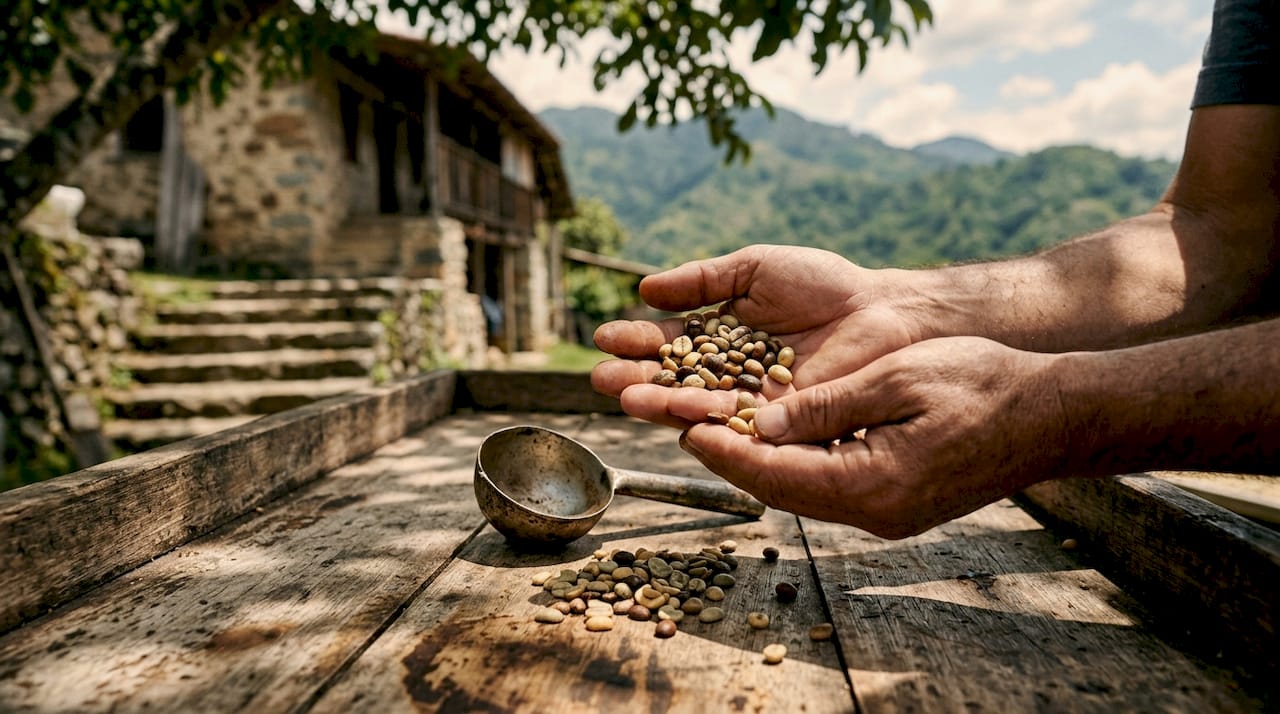
Altitude is one of the most powerful variables. Higher altitudes slow cherry maturation, giving beans more time to develop dense cell structures and complex flavor compounds. Coffees grown above 1,500 meters tend to carry brighter acidity, more intricate aromatics, and a longer finish. Lower elevations produce beans that mature faster, often yielding a softer, rounder, simpler cup.
Soil is the chemistry lab beneath the roots. Volcanic soils in Guatemala and Costa Rica deliver minerals like potassium and phosphorus directly to the plant, promoting vibrant acidity and a fuller body. Sandy or clay-heavy soils produce very different results, often flatter and less complex.
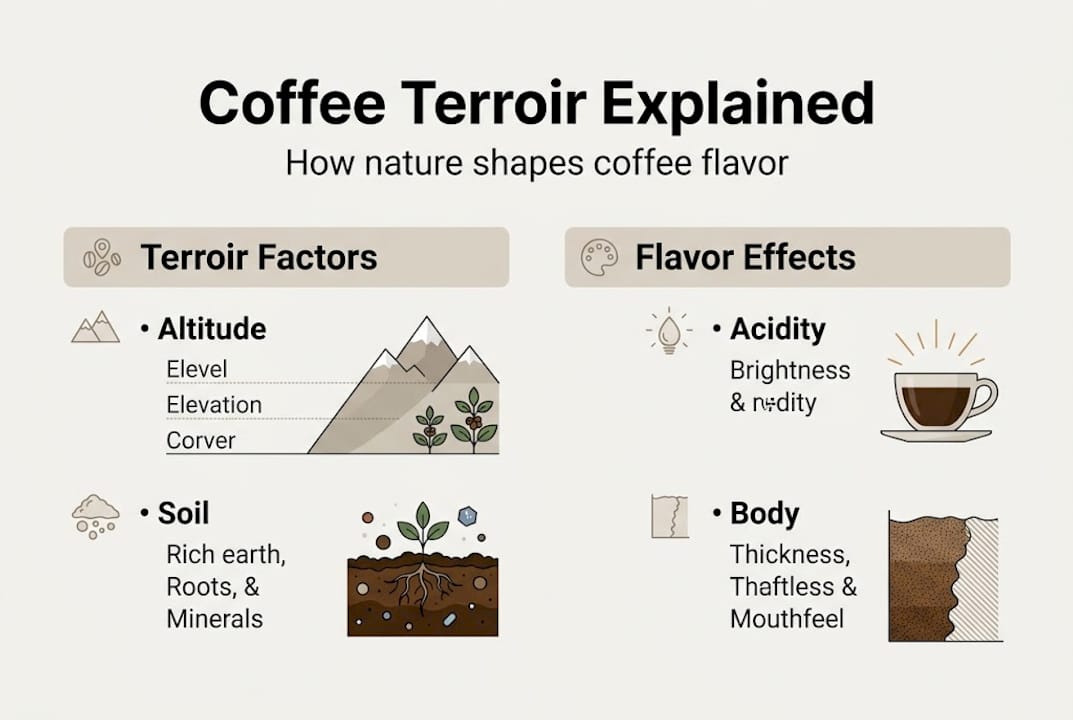
Climate and microclimate shape the rhythm of the plant’s life. Diurnal temperature swings, consistent rainfall, and shade all encourage the slow, careful development of flavor compounds inside the cherry. A farm that experiences cool nights and warm days will almost always produce more complex coffee than one with flat, hot temperatures year-round.
| Terroir factor | Primary influence | Flavor outcome |
|---|---|---|
| High altitude | Slows maturation | Bright acidity, complexity |
| Volcanic soil | Mineral-rich nutrition | Vibrant body, clarity |
| Diurnal swings | Stress-driven development | Layered sweetness |
| Consistent rainfall | Even cherry growth | Clean, balanced cup |
| Shade canopy | Slower ripening | Nuanced aromatics |
Pro Tip: When reading a coffee’s origin notes, pay attention to elevation first. It’s often the single biggest predictor of acidity and aromatic complexity, more than country of origin alone. This is also where coffee aroma science connects directly to geography. The volatile compounds responsible for floral and fruity aromas form more abundantly at higher, cooler elevations. Choosing types of coffee beans by elevation data gives you a real head start on predicting what you’ll taste.
How terroir impacts coffee flavor: Evidence and examples
The connection between terroir and flavor isn’t just sensory intuition. Science backs it up. A significant altitude effect on phenolic content, tocopherols, and volatile organic compounds has been measured in controlled studies, with higher-altitude coffees showing greater antioxidant levels and more intense aroma profiles. That’s not marketing language. That’s measurable chemistry.
Here’s how three major origins illustrate terroir in action:
| Region | Elevation | Soil type | Signature flavor |
|---|---|---|---|
| Ethiopia (Yirgacheffe) | 1,700 to 2,200m | Clay-loam, rich organics | Jasmine, bergamot, lemon |
| Guatemala (Antigua) | 1,500 to 1,700m | Volcanic, mineral-dense | Dark chocolate, spice, body |
| Peru (Cajamarca) | 1,400 to 2,000m | Sandy loam, high drainage | Caramel, mild citrus, soft finish |
These aren’t arbitrary tasting notes invented by marketers. They reflect the chemistry of beans shaped by their specific environments, confirmed through coffee origins and flavor processing research and cupper evaluations.
Want to taste terroir yourself? Here’s a simple approach:
- Choose two single-origin coffees from different altitudes or soil types
- Use the same brew method and grind size for both
- Brew at the same water temperature and ratio
- Taste side by side without milk or sugar
- Note acidity, body, sweetness, and any fruit or floral notes
The differences you detect are terroir speaking directly to you. Pairing this exercise with knowledge of coffee flavor pairings can make the tasting even more rewarding, helping you understand which flavors complement each other and why certain origins work better in certain contexts.
Terroir vs. human influence: Processing, varietals, and the bigger picture
Here’s where things get more honest. Terroir is foundational, but it doesn’t act alone. What happens after harvest can shift, amplify, or even override the flavors that geography created.
Processing, roasting, and varietal selection can sometimes dominate over terroir effects, especially when extreme methods are used. A naturally processed coffee from a mediocre terroir can taste more interesting than a washed coffee from a great terroir, simply because fermentation introduced new flavor compounds that the environment never provided.
Here’s how the layers interact:
- Terroir sets the raw potential: altitude, soil, and climate create the flavor ceiling
- Varietals determine the template: Gesha, Bourbon, and Typica each express terroir differently
- Processing shapes the final character: washed, natural, and honey methods each extract different qualities
- Roasting either reveals or masks: light roasts preserve terroir; dark roasts can flatten it
“The best coffees are a conversation between place and process. Terroir gives the words; everything else determines how clearly they’re spoken.”
Pro Tip: When you’re evaluating a new coffee, ask about both the origin and the processing method before forming expectations. A Kenyan washed coffee and a Kenyan natural from the same farm will taste dramatically different. Understanding coffee processing methods is just as important as knowing the region. Similarly, learning about coffee varietals and brewing helps you understand why two coffees from the same altitude can still taste worlds apart. For those interested in exploring certified options, organic whole coffee beans can offer a clean lens on terroir without the interference of chemical inputs.
The future of coffee terroir: Challenges and why it matters
Terroir isn’t just an abstract concept for enthusiasts. It’s a fragile system under real pressure. By 2050, up to 50% of current coffee-growing areas may become climatically unsuitable for coffee production. That’s not a distant projection. It’s a trajectory already visible in shifting harvest seasons, increased pest pressure, and erratic rainfall in key growing regions.
What does this mean for the cup?
- Flavor profiles we associate with specific origins may disappear or change permanently
- Farmers may be forced to shift to lower-quality, more heat-tolerant varieties
- The diversity of taste experiences available to coffee drinkers will narrow
- Prices for high-terroir coffees will likely rise as supply shrinks
- Entire regional identities built around coffee flavor may be lost
Understanding terroir empowers you to make better choices right now. When you buy single-origin coffee from a specific farm or cooperative, you’re supporting the economic model that keeps those farms viable. You’re also sending a signal to the market that flavor diversity matters.
Simple steps you can take include choosing coffees with transparent sourcing information, prioritizing farms at higher elevations that are currently under climate stress, and learning to enhance coffee flavor through brewing techniques that honor what the terroir already built into the bean. Every intentional purchase is a small vote for the future of coffee diversity.
Our take: Why terroir isn’t a flavor guarantee (and what actually matters)
Here’s a perspective most terroir guides won’t give you: chasing terroir alone will frustrate you. We’ve seen it happen. A coffee lover reads about the legendary volcanic soils of Antigua, buys a Guatemalan bag, and feels let down because the roast was too dark or the processing method buried everything the soil created.
Terroir sets potential. It doesn’t guarantee delivery.
What most “single origin” guides get wrong is treating region as a flavor promise. It isn’t. A Yirgacheffe processed naturally tastes almost nothing like a Yirgacheffe processed with a washed method, even if both came from the same farm. The region is the same. The terroir is identical. The cup is completely different.
Our practical advice: ask three questions before buying any coffee. Where was it grown? How was it processed? What roast level? The answers to all three matter more than any origin story alone. Knowing how processing methods matter and understanding specialty coffee quality standards will take you further than memorizing growing regions. Terroir is the foundation, but your choices at every step of the chain determine what actually ends up in your cup.
Experience the world of coffee terroir at Z’s Coffee
Ready to taste what terroir actually does to a cup? Z’s Coffee brings together coffees from distinct origins and processing traditions so you can experience these differences firsthand, not just read about them.
Whether you’re drawn to the bright, floral complexity of high-altitude African coffees or the rich, chocolatey depth of volcanic Central American beans, our explore coffee products page is the place to start. For something quick and convenient without sacrificing origin character, our instant coffee selection covers a range of profiles. And if you’re ready to try something genuinely different, our mushroom coffee dark roast pairs earthy depth with bold flavor in a way that opens up a whole new conversation about what terroir can taste like.
Frequently asked questions
Can I taste coffee terroir at home?
Yes. Brew two single-origin coffees from different regions using the same method and compare them side by side to detect how environment changes flavor.
Which country is famous for distinct coffee terroir?
Ethiopia, Guatemala, and Costa Rica are celebrated for their unique terroirs. Volcanic soils in Guatemala and Costa Rica in particular enhance acidity and body through mineral-rich growing conditions.
Does roasting erase the effect of terroir?
Not entirely, but dark roasting can minimize terroir differences significantly. Lighter roasts preserve the nuanced flavors that altitude, soil, and climate created in the bean.
How is coffee terroir different from wine terroir?
Both involve natural factors shaping flavor, but coffee has greater microclimate variation within small regions and lacks the strict classification systems that wine regions use to define and protect terroir expressions.
Is coffee terroir at risk due to climate change?
Yes. By 2050, up to 50% of current coffee-growing areas may become climatically unsuitable, threatening the regional diversity and unique flavor profiles that terroir creates.
Recommended
- How coffee varietals shape flavor and brewing methods – Z’s Coffee
- Why coffee origin matters for flavor and quality in 2026 – Z’s Coffee
- Coffee Origins Explained: Regions, Processing & Flavor – Z’s Coffee
- What is coffee aroma: science and sensory impact explained – Z’s Coffee
- Terroir And Iberico Ham – How Landscape Shapes Flavour
- Coffee from around the world – Autoryzowany dystrybutor i serwis Jura Wrocław