TL;DR:
- Understanding and accurately applying brew ratio, the weight of water to coffee grounds, is essential for consistently great coffee. Using a digital scale to measure this ratio ensures proper strength and helps you fine-tune brewing methods to match personal preferences. Adjusting the ratio, along with grind size and brew time, ultimately controls the balance between strength and flavor extraction.
Most coffee drinkers blame their grinder or their beans when a cup falls flat. Rarely do they look at the one variable that controls strength more directly than anything else. Understanding what is brew ratio, the weight-based relationship between dry coffee and water, is the single clearest step you can take toward a consistently great cup. Get this number right and you have a real foundation to build on. Get it wrong and no amount of expensive gear will save you.
Table of Contents
- Key takeaways
- What is brew ratio: definition and measurement basics
- How brew ratio affects strength and extraction
- Optimal brew ratios by brewing method
- Calculating and applying brew ratio at home
- My take on mastering brew ratio
- Put your ratio knowledge to work with Zscoffee
- FAQ
Key takeaways
| Point | Details |
|---|---|
| Brew ratio defines strength | It is the weight of coffee to weight of water, and it directly controls how concentrated your cup is. |
| Weight beats volume every time | Volumetric measurements can be off by 20 to 30%; a digital scale removes that guesswork entirely. |
| Method changes the number | Espresso, pour-over, French press, and cold brew each call for a different ratio range. |
| Strength and bitterness are separate | Ratio controls concentration; grind size and brew time control flavor balance and extraction quality. |
| Start at 1:16, then adjust | A 1:16 ratio is a solid starting point for most brews before you dial in personal taste preferences. |
What is brew ratio: definition and measurement basics
At its core, brew ratio is weight-based, expressing how many grams of water you use for every gram of dry coffee grounds. The standard format is 1:X. A 1:16 ratio means one gram of coffee for every 16 grams of water. That is it. Simple math, significant impact.
Why weight instead of volume? Because coffee grounds are not uniform. A tablespoon of a light roast Ethiopian and a tablespoon of a dark roast Sumatra will weigh completely different amounts. Whole beans versus pre-ground adds another layer of inconsistency. Volumetric measurements are inaccurate by 20 to 30%, which means your “two tablespoons” could mean something totally different from one bag to the next. A digital scale removes all of that noise.
The coffee brew ratio is the primary lever controlling strength. Higher water to coffee ratios, like 1:18 or 1:20, produce lighter, thinner cups. Lower ratios, like 1:12 or 1:15, produce more concentrated, heavier cups. This is not about bitterness or sourness. That is a separate conversation. Brew ratio is purely about concentration.
The Specialty Coffee Association (SCA) has formalized this through its Golden Cup standard. The SCA Golden Cup is approximately 1:18, calibrated specifically for automatic drip machines. Manual methods like pour-over and French press typically perform at 1:15 to 1:16 to hit the same strength because extraction efficiency differs between brewing styles. Think of the SCA standard as a verified reference point, not a rigid rule.
Key facts about the coffee brewing ratio:
- Written as 1:X, where X is grams of water per gram of coffee
- Controls Total Dissolved Solids (TDS), the measure of how much coffee material is in your cup
- Applies universally across every brewing method
- Starting around 1:16 is a reliable rule of thumb for most home brews before any personal adjustments
How brew ratio affects strength and extraction
Here is where most home brewers get confused, and it is worth spending time here. Strength and extraction are not the same thing. They feel related because a bad cup can be both weak and sour or both strong and bitter, but the causes are different.
Strength is concentration. It is controlled by your brew ratio. More coffee relative to water equals a stronger, denser cup. Less coffee equals a thinner, lighter one.
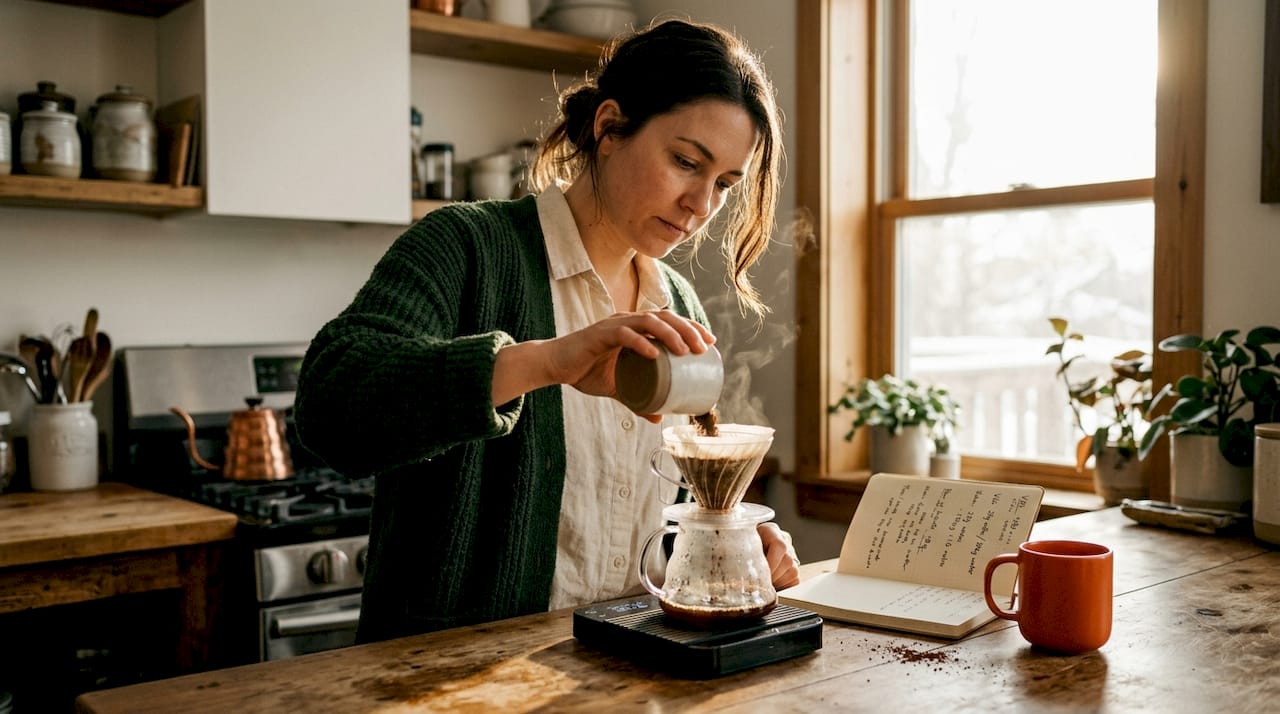
Extraction is how much of the coffee’s soluble compounds actually end up in your water during brewing. Extraction is controlled by grind size, water temperature, and brew time. Under-extraction pulls too few compounds and produces sour, sharp, or flat flavors. Over-extraction pulls too many and produces bitter, harsh, or astringent ones.
Strength is concentration controlled by ratio, while bitterness results from over-extraction controlled by grind size and brew time. This distinction matters because it tells you which variable to adjust when something goes wrong. If your cup is too weak, adjust your ratio first. If it tastes sour or bitter, look at your grind.
“Brew ratio is the finishing dial for coffee strength, while grind size is the primary control for balancing flavor extraction.” — Fond Coffee Glossary
The SCA Brewing Control Chart maps this relationship visually. It shows zones for under-extracted, over-extracted, and balanced coffee across strength and extraction axes. The goal is the “Golden Cup Zone,” where ratio, grind, and temperature all work together. You get there by fixing one variable at a time, starting with ratio.
Pro Tip: If your coffee tastes consistently weak no matter how fine you grind, your ratio is too high. Try dropping from 1:17 to 1:15 before touching your grinder.
It is also worth noting that a strong cup and a bitter cup are completely different things. A 1:12 brew can be smooth, sweet, and syrupy if the extraction is dialed in. A 1:17 brew can be pleasant and complex without tasting thin. Getting your coffee grinding technique right compounds the benefit of a solid ratio.
Optimal brew ratios by brewing method
Not every brewing method extracts coffee the same way, so the ideal brew ratio shifts depending on your equipment. Here is a practical breakdown.
| Brewing method | Recommended ratio range | Notes |
|---|---|---|
| Espresso | 1:1.5 to 1:2.5 | Highly concentrated; ratio by yield weight |
| Pour-over | 1:15 to 1:17 | Classic range for clarity and brightness |
| French press | 1:12 to 1:15 | Fuller body; immersion brewing extracts differently |
| Cold brew concentrate | 1:4 to 1:8 | Dilute before serving; steep time compensates |
| Auto drip | 1:15 to 1:18 | SCA standard targets the higher end |
Optimal ratios vary significantly by method: espresso runs 1:1.5 to 1:2.5, pour-over sits at 1:15 to 1:17, French press at 1:12 to 1:15, and cold brew concentrate at 1:4 to 1:8.
For espresso, the ratio is measured differently than other methods. You measure the weight of the dry coffee puck going in (the dose) against the weight of liquid espresso coming out (the yield). A 18-gram dose producing 36 grams of liquid is a 1:2 ratio. Most specialty baristas work in this range, though espresso brew ratios can run as long as 1:2.5 for a lighter, more tea-like shot.
Pour-over is where ratio flexibility really shines. If you prefer bright, fruit-forward cups, lean toward 1:16 or 1:17. If you want more body and richness, try 1:15. The clarity of pour-over brewing means small ratio shifts are very noticeable in the final cup.
Cold brew is the wild card. A cold brew concentrate at 1:4 or 1:5 is not meant to be drunk straight. You dilute it with water or milk before serving, which effectively brings it back into a more standard strength range. Skipping the dilution step is one of the most common mistakes beginners make with cold brew.
Pro Tip: Bean roast level affects how you should dial in ratio. Darker roasts tend to extract faster and can taste harsh at lower ratios; try 1:16 or 1:17 with dark beans before going stronger.
Calculating and applying brew ratio at home
Once you understand the concept, applying it is straightforward. Here is a step-by-step process to calculate your ratio for any cup size.
- Decide your target water volume. Say you want a 300-gram cup of coffee (roughly 10 ounces).
- Pick your ratio. Start with 1:15 for a fuller cup or 1:17 for something lighter.
- Divide water by the ratio number. 300 divided by 15 equals 20 grams of coffee.
- Weigh your coffee. Place your portafilter, basket, or filter on a scale and add exactly 20 grams of grounds.
- Weigh your water. Use 300 grams of water at the right temperature for your method.
- Brew and taste. If it is too strong, increase the ratio next time. If too weak, decrease it.
Here is a quick reference table for common cup sizes at a 1:15 ratio:
| Target cup size | Coffee dose needed | Water weight |
|---|---|---|
| 200g (6.7 oz) | 13.3g | 200g |
| 300g (10 oz) | 20g | 300g |
| 400g (13.5 oz) | 26.7g | 400g |
| 600g (20 oz) | 40g | 600g |
One thing most brew ratio calculators do not explain upfront is coffee absorption. Coffee grounds absorb roughly twice their weight in water, which means your final cup yield will always be less than the total water you poured. If you pour 300 grams of water over 20 grams of grounds, expect roughly 260 grams of brewed coffee in your cup. Plan for this when sizing your brew.
Using a digital scale is non-negotiable if you want repeatable results. Eyeballing it works sometimes, but not consistently.
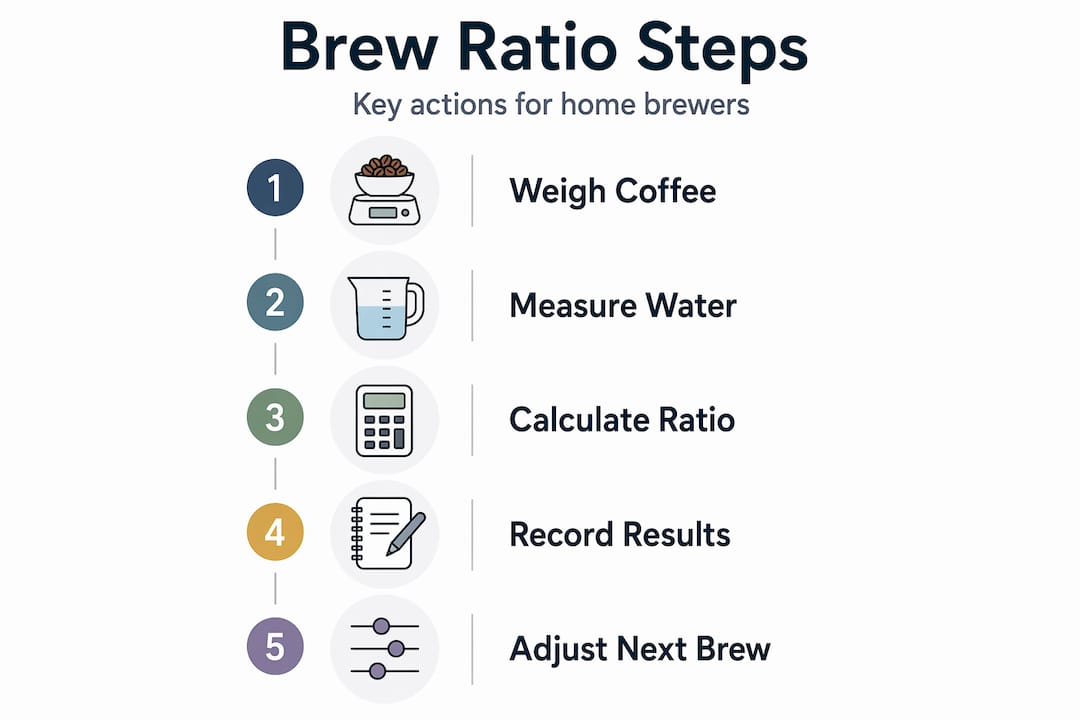
Pro Tip: Write down your ratio and coffee dose every time you brew. After a week, you will have a clear picture of what you actually enjoy and why, making future adjustments much faster.
My take on mastering brew ratio
I spent a long time chasing grind size as the fix for every bad cup I made. Too bitter? Grind coarser. Too weak? Grind finer. It helped sometimes and confused me the rest of the time. The real shift came when I started treating brew ratio as its own separate variable.
Once I understood that ratio controls strength and grind size controls flavor balance, the whole system clicked. I started weighing everything. Not because I am obsessive about precision, but because the scale gave me a record. When a cup was great, I could repeat it. When it was off, I knew exactly which dial to turn.
The most common mistake I see from newer home brewers is conflating “strong” with “bitter.” They chase a stronger cup by grinding finer, which actually pushes extraction into over-extracted territory and adds harshness. The right move is to drop the ratio from 1:17 to 1:15 and keep the grind where it is. That single change often produces the cup they were looking for all along.
What I have learned through consistent brewing is that ratio is flexible within a range. The specialty coffee community often prefers stronger brews at 1:15 or 1:16, not the SCA’s 1:18 target. Neither is wrong. The SCA standard is a calibrated baseline, not a decree. Experiment inside that range, adjust one variable at a time, and trust what your palate tells you.
— zachary
Put your ratio knowledge to work with Zscoffee

Knowing your brew ratio is only half the equation. The other half is starting with coffee that actually responds well to precise brewing. At Zscoffee, you will find a curated selection of high-quality beans sourced from regions known for clarity, complexity, and consistency across all brewing methods. Whether you are dialing in a pour-over at 1:15 or pulling espresso shots at 1:2, the right beans make every gram count. Browse the coffee and tea collection at Zscoffee to find your next bag and pair it with brewing accessories designed for home brewers who take their ratios seriously.
FAQ
What is brew ratio in simple terms?
Brew ratio is the weight-based relationship between dry coffee grounds and water, expressed as 1:X. A 1:15 ratio means 1 gram of coffee for every 15 grams of water.
What is the best brew ratio for beginners?
Starting at 1:15 or 1:16 works well for most manual brewing methods. Adjust up or down based on whether your cup tastes too strong or too light.
How is brew ratio different from extraction?
Brew ratio controls strength, meaning how concentrated your coffee is. Extraction controls flavor balance, meaning whether your coffee tastes sour, bitter, or smooth, and is governed by grind size and brew time.
What is the brew ratio for espresso?
The standard brew ratio for espresso is 1:1.5 to 1:2.5, measured by the weight of dry grounds going in versus the weight of liquid espresso coming out.
Do I need a scale to use brew ratios?
Yes. Volumetric measurements like tablespoons can be off by 20 to 30% depending on grind size and bean density. A digital scale is the only reliable way to apply and repeat a brew ratio consistently.