TL;DR:
- Co-fermented coffee is processed by fermenting coffee cherries with added organic ingredients to modify flavor during production. It creates genuine fruit and spice notes through biological activity, offering a distinct category in specialty coffee. Proper control and transparency are essential for consistent quality and market success.
Co-fermented coffee is defined as coffee processed by fermenting coffee cherries alongside added organic substrates such as fruits, spices, or cultured yeasts to deliberately modify flavor at the source. This technique borrows directly from wine production, where co-fermentation has shaped flavor for centuries. The result is a cup profile that goes far beyond what terroir alone can produce. As of 2026, co-fermented coffee stands as its own recognized specialty coffee category, sitting alongside washed, natural, and honey processing. If you’ve ever tasted a coffee that reminded you of strawberry jam or ripe peach and wondered how that was possible, co-fermentation is the answer.
What is co-fermented coffee and how does it work?
Co-fermented coffee is a processing method where coffee cherries ferment together with other organic ingredients to change the coffee’s biology and flavor development. This is not flavoring added after the fact. The flavor modification happens during fermentation itself, making it a biological process rather than a cosmetic one.
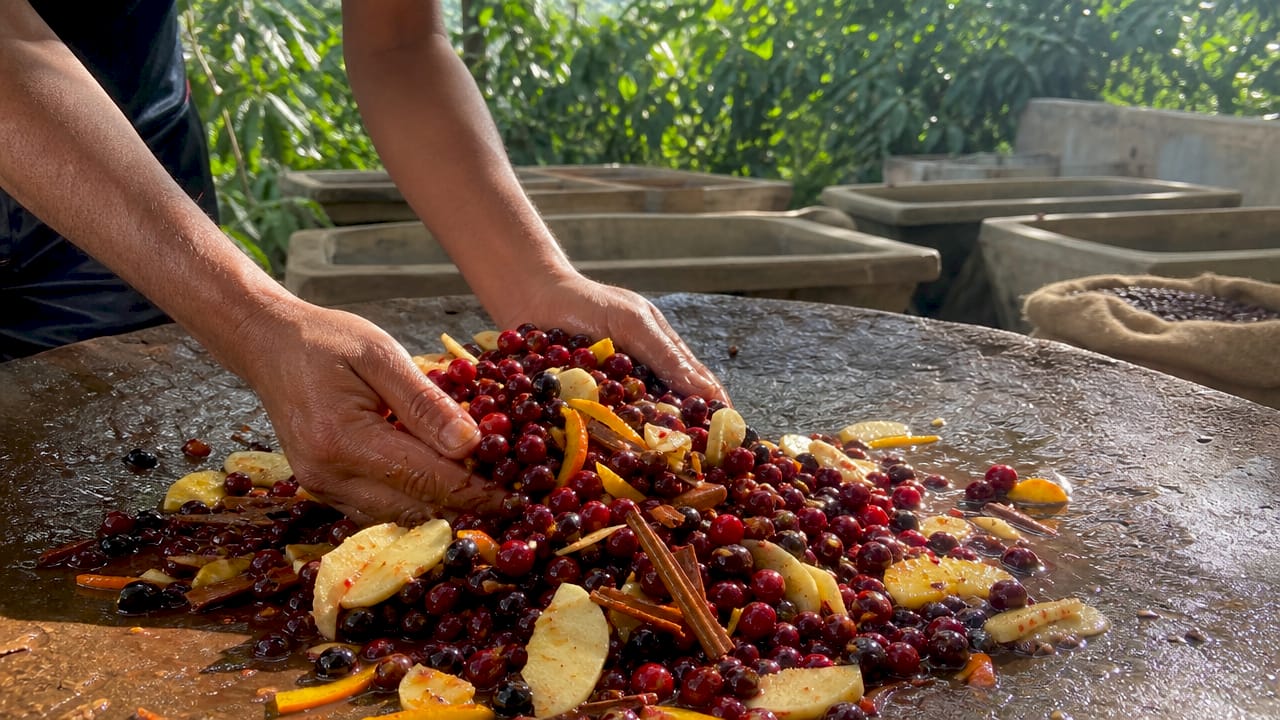
The technique mirrors wine industry practices, where winemakers have long co-fermented grapes with other fruits or yeasts to shape the final wine’s character. Coffee producers adopted this logic and applied it at the farm or mill level during the post-harvest processing stage. The coffee cherry’s natural fermentation environment becomes a shared biological space where both the coffee and the added substrate interact.
The flavor outcomes are genuine. Co-fermented coffees produce flavor notes like strawberry, peach, passionfruit, and complex sweetness that result directly from microbial activity. These are not added aromas. They are biological byproducts of fermentation.
What ingredients are used in co-fermentation?
The range of organic substrates used in co-fermentation is wide, and each one shapes the final cup differently. Producers choose ingredients based on the flavor profile they want to achieve and the microbial activity each substrate introduces.
Common co-fermentation ingredients include:
- Fruit pulps and juices: Melon, strawberry, peach, and passionfruit are popular choices. Each brings its own sugars and microbial populations into the fermentation tank.
- Fruit musts: Partially fermented fruit juice, similar to what winemakers use, adds concentrated sugar and yeast activity.
- Herbs and spices: Less common but used by experimental producers to introduce aromatic complexity.
- Cultured yeast strains: Specific yeast cultures are added to guide fermentation in a controlled direction.
- Bacterial cultures: Lactic acid bacteria can be introduced alongside yeasts to shape acidity and sweetness.
The key mechanism is sugar. When fruit pulps or juices enter the fermentation environment, they introduce new sugars and microbes that alter the flavor profile more significantly than yeast inoculation alone. Yeast inoculation only adds yeast strains. Co-fermentation adds an entirely new food source for those microbes to consume, which produces a wider range of flavor compounds.
Pro Tip: If you want to understand a co-fermented coffee’s flavor before brewing, look at the substrate listed on the bag. A strawberry co-ferment will lean toward bright, jammy sweetness. A melon co-ferment will read as softer and more floral.
Producers who work with coffee processing methods at a technical level understand that ingredient selection is as deliberate as a recipe. The substrate is not random. It is chosen to hit a specific sensory target.
How does the co-fermentation process work step by step?
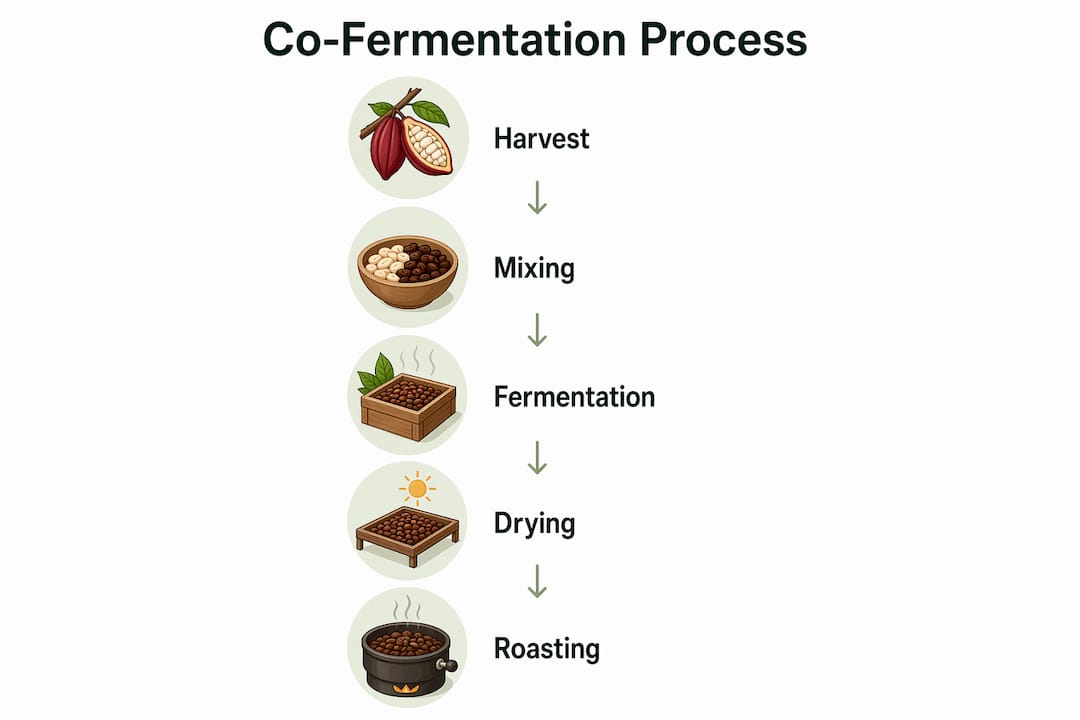
Co-fermentation takes place at the farm or mill level, integrated into the post-harvest processing stage. The process follows a structured sequence that producers control carefully to achieve consistent results.
- Harvest and sorting: Coffee cherries are picked at peak ripeness and sorted to remove defects. Ripe cherries produce more fermentable sugars, which matters when adding external substrates.
- Preparation of the substrate: The co-fermentation ingredient, whether fruit pulp, juice, must, or cultured yeast, is prepared separately and measured for the batch size.
- Combined fermentation: Coffee cherries and the substrate are placed together in a fermentation vessel. This can be an open tank, a sealed anaerobic container, or a controlled-environment bioreactor depending on the producer’s setup.
- Fermentation monitoring: Temperature, pH, and time are tracked throughout. This is where technical expertise becomes critical. Uncontrolled fermentation produces off-flavors or spoilage.
- Washing or drying: After fermentation, the coffee is either washed to remove the fermented mucilage or dried with it intact, depending on whether the producer is targeting a washed or natural-style finish.
- Milling and grading: The dried coffee is hulled, graded, and prepared for export or roasting.
The contrast with traditional processing is significant. Washed coffees ferment only in water to remove mucilage. Natural coffees dry with the full cherry intact. Honey processes leave partial mucilage on the bean during drying. Co-fermentation adds an entirely new biological variable to any of these base methods.
| Processing method | Fermentation environment | Flavor influence |
|---|---|---|
| Washed | Water tank, no additives | Clean, origin-driven acidity |
| Natural | Whole cherry drying | Fruity, wine-like body |
| Honey | Partial mucilage drying | Sweet, balanced complexity |
| Co-fermented | Added organic substrate | Engineered fruit or spice notes |
Traceability and technical training are critical for safe, repeatable co-fermentation. Experts like Dr. Osorio-Perez at Cenicafe have emphasized that the biological complexity of co-fermentation requires rigorous controls to avoid inconsistent or undesirable results.
What are the benefits of co-fermented coffee?
Co-fermented coffee delivers measurable advantages for both producers and the consumers who drink it. The benefits span flavor, economics, and market positioning.
For producers:
- Co-fermentation increases cup scores by adding distinct flavors that help producers stand out in competitive specialty markets.
- Producers can command higher prices by accessing niche markets that value exotic, consistent flavor profiles.
- Co-fermentation allows producers to create flavors that terroir alone may not achieve, giving farms in less celebrated growing regions a path to premium pricing.
- The method opens economic opportunities for smallholder growers who can differentiate their lots without changing their farm’s geography.
For consumers:
- Co-fermented coffees offer flavor experiences that are genuinely novel, not just variations on familiar profiles.
- The biological origin of the flavors means they are integrated into the cup, not layered on top like a flavored syrup.
- Consumers who enjoy fruit-forward or dessert-like coffees find co-fermented lots consistently deliver those notes.
The challenges are real and should not be minimized. Co-fermentation requires complex biological understanding and implementation. Without proper controls, batches can be inconsistent or develop unpleasant fermentation defects.
“Co-fermentation opens economic opportunities for growers but requires rigorous controls and expertise to ensure quality and repeatability.” — Sprudge Coffee
The traceability requirement is also a consumer benefit in disguise. When producers document their co-fermentation process fully, buyers get a transparent record of exactly what went into the coffee. That level of detail is rare in commodity coffee and adds genuine value for specialty buyers.
How does co-fermented coffee compare to other experimental methods?
Three terms appear frequently in specialty coffee discussions: co-fermentation, yeast inoculation, and infusion. They are not the same thing, and the differences matter for flavor outcomes.
| Method | When it occurs | What is added | Flavor mechanism |
|---|---|---|---|
| Co-fermentation | During fermentation | Fruits, herbs, yeasts, bacteria | Biological, integrated flavor change |
| Yeast inoculation | During fermentation | Yeast strains only | Guided microbial activity, no new sugars |
| Infusion | Post-fermentation | Flavor compounds, extracts | Surface-level flavor addition |
Infusion and co-fermentation differ fundamentally: infusion adds flavors after fermentation is complete, while co-fermentation modifies flavor during the biological process itself. Infusion is closer to flavored coffee. Co-fermentation is closer to a distinct processing method.
Yeast inoculation sits between the two. It introduces specific yeast strains to guide fermentation but does not add new sugar sources. The flavor influence is real but narrower than co-fermentation. Co-fermentation adds both new microbes and new food for those microbes, producing a wider and more dramatic flavor shift.
The controversy around co-fermentation reflects differing views on authenticity. Some purists argue that co-fermentation masks origin characteristics, the terroir-driven flavors that make a Kenyan or Ethiopian coffee identifiable. Others see it as a natural extension of fermentation’s traditional role in flavor development. Both positions are defensible. The debate reflects how seriously the specialty coffee world takes the question of what a coffee is supposed to taste like.
Pro Tip: When evaluating a co-fermented coffee, ask the roaster whether the substrate is disclosed on the bag. Full transparency about the co-fermentation ingredient is a sign of a producer who controls the process well.
For a deeper look at how these experimental processing methods compare across the specialty coffee spectrum, the distinctions become even clearer when you see them mapped against traditional processing timelines.
How should you brew co-fermented coffee for the best flavor?
Co-fermented coffees reward careful brewing. Their flavor profiles are more complex and layered than most conventionally processed coffees, which means small adjustments in brewing technique make a noticeable difference.
Grind size: Use a medium to medium-fine grind for pour-over methods. Co-fermented coffees often have softer cell structures from the extended fermentation, which means they extract slightly faster than washed coffees. A coarser grind than you expect is often the right call.
Water temperature: Brew at 195–200°F rather than the standard 205°F. Lower temperatures reduce the risk of over-extracting the more volatile fruit compounds, which can turn bitter if pushed too hard.
Bloom time: Bloom and steeping time matter more with co-fermented coffees. Use a 45-second bloom with twice the water weight of your coffee dose. This releases trapped gases and primes the grounds for even extraction.
Brewing methods that work well:
- Pour-over methods like V60 or Chemex highlight the clean fruit notes and acidity.
- AeroPress with a short steep of 90 seconds produces a concentrated, syrupy cup that amplifies sweetness.
- Cold brew over 12–16 hours softens acidity and lets the fruit notes read as smooth and dessert-like.
- French press works for body-forward co-ferments like those made with melon or peach substrates.
Pairing ideas: Co-fermented coffees with strawberry or passionfruit notes pair well with plain croissants, mild cheeses, or dark chocolate above 70% cacao. The contrast between the coffee’s fruit brightness and the richness of the food creates a satisfying balance. For more ideas on coffee flavor pairing, the combinations go deeper than most people expect.
Key Takeaways
Co-fermented coffee is a biologically driven processing method that produces genuine, integrated fruit and spice flavors by fermenting coffee cherries alongside organic substrates during production.
| Point | Details |
|---|---|
| Definition is precise | Co-fermentation modifies flavor during fermentation, not after. It is not flavored coffee. |
| Ingredients drive flavor | Substrates like strawberry, melon, and cultured yeasts each produce distinct, predictable flavor outcomes. |
| Process requires expertise | Traceability and technical controls are non-negotiable for consistent, safe results. |
| Market value is real | Producers use co-fermentation to access premium niche markets and achieve higher cup scores. |
| Brewing technique matters | Lower water temperature, longer bloom, and method selection unlock the full flavor range. |
Co-fermentation and the future of specialty coffee
I’ve spent years tasting through specialty coffee lots, and co-fermented coffees are the category that generates the most polarized reactions. Purists feel uneasy. Adventurous drinkers are thrilled. Both reactions are valid, and both miss the bigger point.
The real story of co-fermentation is not about whether it is authentic. It is about what it reveals. When a producer in a region with modest terroir can create a cup that scores in the high 80s by co-fermenting with local fruit, that is not cheating. That is applied science meeting agricultural creativity. The wine world normalized this decades ago. Coffee is catching up.
What concerns me more than the authenticity debate is the transparency gap. Too many co-fermented coffees reach consumers with vague labels that say “tropical fruit notes” without disclosing the substrate. That is a problem. Consumers deserve to know what went into their coffee, not because co-fermentation is dangerous, but because informed drinkers make better purchasing decisions and support better producers.
The economic argument for co-fermentation is also underappreciated. Smallholder farmers in competitive growing regions now have a tool that lets them compete on flavor without needing to relocate to a more famous origin. That is a meaningful shift. The specialty coffee market rewards differentiation, and co-fermentation delivers it in a repeatable, documentable way.
My honest take: co-fermented coffee is not a gimmick. It is a legitimate processing category that will keep growing as producers get better at controlling it and consumers get better at understanding it. The next five years will produce co-fermented lots that are as nuanced and terroir-expressive as the best naturals on the market today. Pay attention to the substrate, ask for full process disclosure, and brew with care.
— zachary
Zscoffee picks for your next co-fermented coffee moment
Ready to put these brewing tips into practice? Zscoffee carries products built for coffee enthusiasts who take flavor seriously.

Whether you’re pulling a precise pour-over at home or heading out the door, the right gear makes a difference. The Zscoffee travel mug with a handle keeps your co-fermented brew at the right temperature long enough to appreciate every layer of flavor. For days when you want quality without the full brewing ritual, Zscoffee instant coffee delivers a clean, satisfying cup that fits any schedule. Both are worth keeping on hand as you work through different co-fermented lots and refine your palate.
FAQ
What is co-fermented coffee in simple terms?
Co-fermented coffee is coffee processed by fermenting the coffee cherry alongside fruits, spices, or yeasts to change its flavor during production. The added ingredients interact biologically with the coffee, producing integrated flavor notes like strawberry, peach, or passionfruit.
Is co-fermented coffee the same as flavored coffee?
No. Flavored coffee has flavor compounds added after roasting or processing. Co-fermented coffee develops its flavors biologically during fermentation, making the taste a natural result of the production process rather than an additive.
What does co-fermented coffee taste like?
Co-fermented coffees commonly produce fruit-forward flavor notes like strawberry, melon, peach, and passionfruit, along with complex sweetness. The specific flavor depends on the substrate used during fermentation.
Is co-fermented coffee safe to drink?
Yes, when produced with proper controls. Experts emphasize that traceability and technical training are critical to avoid inconsistent or undesirable fermentation results, but co-fermented coffees from reputable producers are safe and high quality.
Why is co-fermented coffee more expensive?
Co-fermented coffees command higher prices because the process requires additional ingredients, technical expertise, and careful monitoring. Producers also use the method to access premium specialty markets where buyers pay more for distinctive, consistent flavor profiles.