TL;DR:
- Coffee flavor mapping involves systematically categorizing a coffee’s taste and aroma traits using standardized tools like the SCA Flavor Wheel. This practice enhances precision in tasting, communication, and understanding how origin, processing, and roasting influence flavor profiles. AI is increasingly aiding this process by predicting consumer preferences and segmenting taste profiles based on sensory data.
Coffee flavor mapping is the structured process of categorizing and visualizing a coffee’s taste and aroma characteristics using standardized sensory tools to decode its complex profile. The industry term for this practice is sensory profiling, and the Specialty Coffee Association’s (SCA) Coffee Taster’s Flavor Wheel is its most widely recognized instrument. Whether you’re a barista calibrating a new single-origin espresso or an enthusiast trying to articulate why an Ethiopian Yirgacheffe tastes different from a Colombian Huila, flavor mapping gives you the vocabulary and framework to do it precisely. Understanding coffee flavor mapping transforms tasting from a vague impression into a repeatable, communicable skill.
What is coffee flavor mapping and why does it matter?
Coffee flavor mapping is defined as the systematic identification and documentation of a coffee’s sensory attributes, organized from broad perceptual categories down to specific descriptors. The goal is not to list every flavor you detect but to place your sensory experience within a shared language that other tasters, roasters, and buyers can understand and replicate.
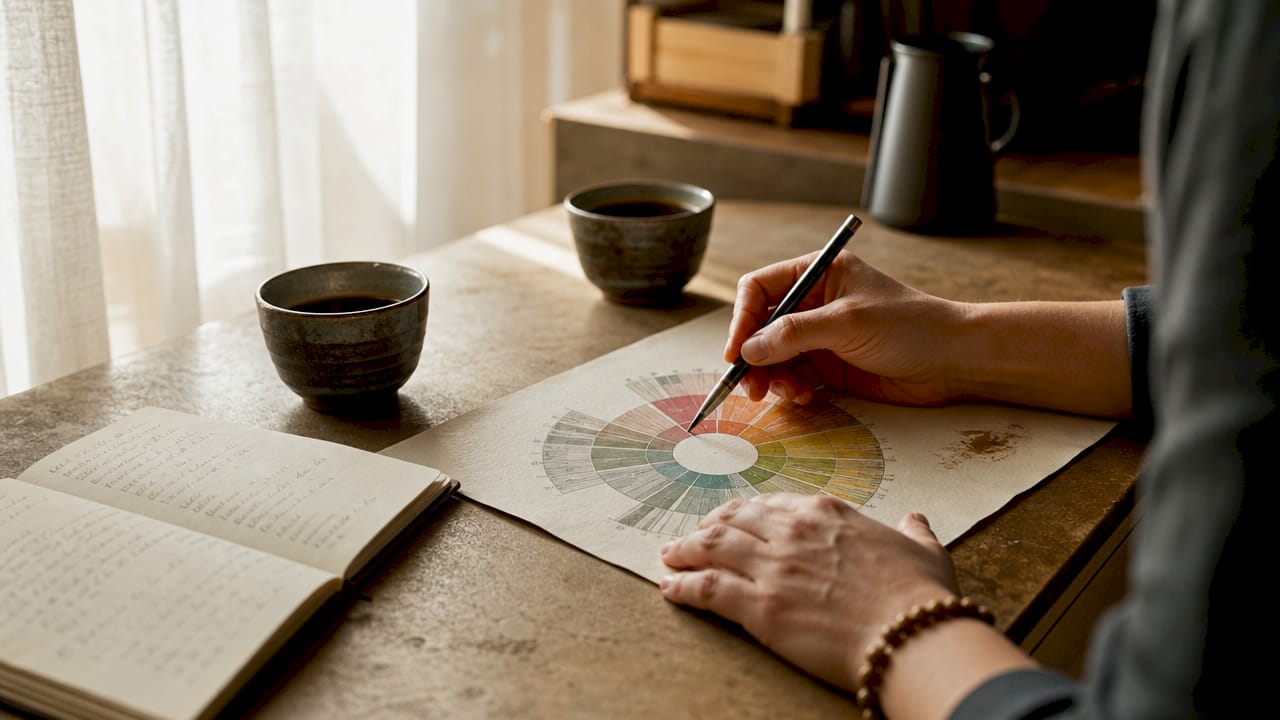
The SCA Coffee Taster’s Flavor Wheel is the industry-standard framework, organizing coffee flavors from broad categories at the center to very specific sensory descriptors on the outer ring. This matters because coffee contains over 800 volatile aromatic compounds, making unstructured tasting notes unreliable and inconsistent across different people and cultures.
Flavor mapping also connects directly to commerce. Specialty roasters use taste profiling to write accurate bag notes, green buyers use it to evaluate lots at origin, and retailers like Zscoffee use it to match customers with coffees that fit their preferences. Without a shared map, “fruity” to one person means berry jam and to another means fermented funk.
The practice also deepens personal appreciation. Once you can locate a flavor on the wheel, you start asking why it’s there, which leads you into origin, processing, and roasting science. That curiosity is what separates a casual coffee drinker from someone who genuinely understands what’s in the cup.
How is the SCA Coffee Taster’s Flavor Wheel structured?
The SCA Flavor Wheel contains 8 core categories at its center, including Fruity, Floral, Roasted, Sweet, Nutty/Cocoa, Spices, Sour/Fermented, and Green/Vegetative. Each category branches outward through middle-tier subcategories and then into highly specific outer-ring descriptors. A taster moves from “Fruity” to “Citrus” to “Lemon” as their perception sharpens.
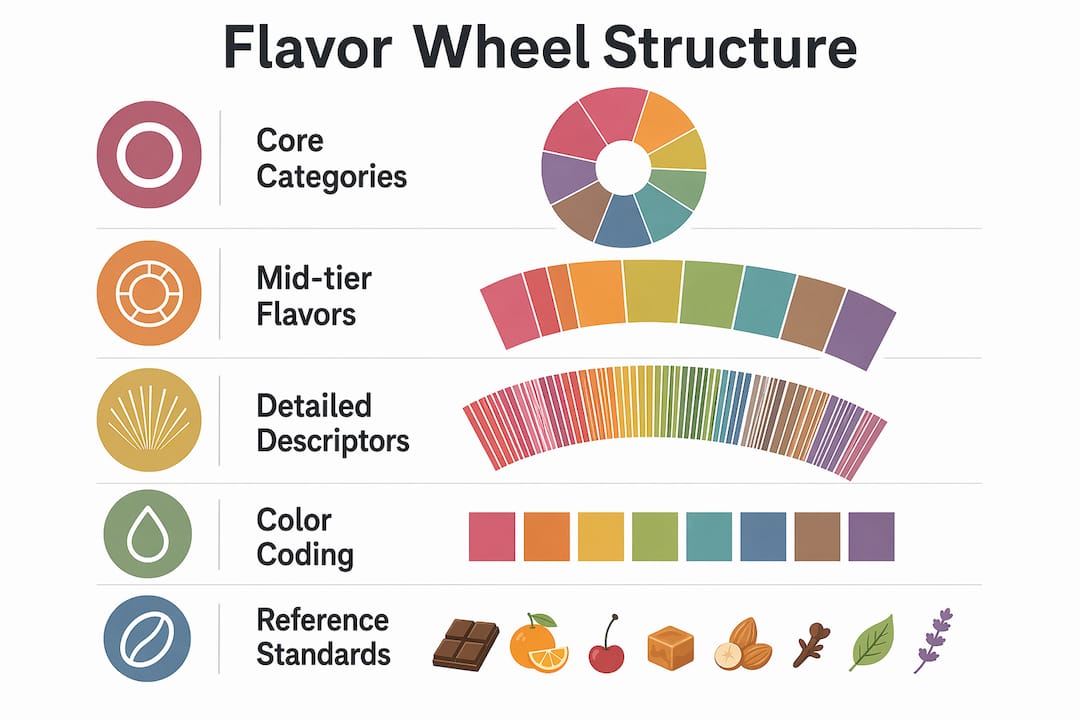
Each descriptor on the wheel is anchored to a physical reference standard defined in the World Coffee Research Sensory Lexicon. For example, the term “Blackberry” is calibrated against the flavor of Smucker’s Blackberry Jam, not a fresh berry or a vague memory. This specificity is what makes the wheel a genuine communication tool rather than a list of poetic suggestions.
The color design of the wheel is intentional and functional. Yellows and oranges signal sour and acidic notes, browns and reds indicate caramel and roasted qualities, and greens represent vegetal or fresh characteristics. This color association taps into synesthetic perception, helping tasters match what they taste with intuitive visual cues before they even read the label.
| Flavor category | Example descriptors | Color zone |
|---|---|---|
| Fruity | Berry, Citrus, Dried Fruit | Yellow/Orange |
| Roasted | Tobacco, Cereal, Burnt | Brown/Dark Red |
| Sweet | Vanilla, Caramel, Honey | Warm Orange |
| Floral | Chamomile, Rose, Jasmine | Light Yellow |
| Nutty/Cocoa | Almond, Dark Chocolate | Tan/Brown |
Pro Tip: Stop at the middle ring if you’re unsure. The SCA explicitly states that staying at mid-tier categories is a successful tasting outcome. Forcing yourself to the outer ring when the perception isn’t clear produces inaccurate notes, not impressive ones.
A separate flavor wheel developed for Coffea canephora (robusta) with 103 descriptors across hierarchical categories confirms that the wheel model scales beyond arabica. That wheel was built from 67 samples and 49 graders across multiple countries, demonstrating that the hierarchical approach works across species and cultures.
How origin, processing, and roasting shape your flavor map
Terroir is not a wine concept borrowed loosely for coffee. It is a measurable reality. Infrared spectroscopy and sensory analysis have differentiated Coffea arabica samples by geographic origin, connecting chemical profiles directly to sensory outcomes. Compounds like chlorogenic acids, lipids, and sugars correlate with perceived acidity, body, and balance, which means where a coffee grows determines where it lands on the flavor map before a single roasting decision is made.
Regional flavor tendencies are consistent enough to predict. Ethiopian naturals tend toward berry and floral notes. Guatemalan washed coffees frequently show chocolate and brown sugar. Kenyan AA lots often present with tomato-like acidity and blackcurrant. These patterns exist because coffee terroir shapes the bean’s chemical composition at the cellular level before harvest.
Processing method is the second major variable. The key distinctions are:
- Washed (wet) processing strips the fruit before drying, producing cleaner, brighter cups where origin character and acidity dominate the flavor map.
- Natural (dry) processing dries the whole cherry, allowing fruit sugars to ferment into the bean, pushing the map toward berry, wine, and fermented notes.
- Honey processing sits between the two, leaving varying amounts of mucilage on the bean to create sweetness and body without full fermentation character.
- Anaerobic fermentation is a newer method that uses sealed tanks to intensify specific flavor compounds, often producing tropical fruit or lactic notes that sit in unusual positions on the wheel.
Roasting development phases map directly onto the wheel’s categories. Light roasts preserve origin character, keeping the map in the Fruity and Floral zones. Medium roasts develop Nutty, Cocoa, and Sweet notes as Maillard reactions build caramel compounds. Dark roasts push the map firmly into Roasted and Smoky territory, often masking origin character entirely. Understanding this progression means you can read a roast level from a flavor map before you taste the coffee. For a deeper look at how coffee origin affects flavor, the relationship between altitude, variety, and processing is worth exploring in detail.
How to use flavor mapping in real tasting situations
Applying the flavor wheel in practice requires a specific sequence. Rushing to the outer ring before establishing broad perceptions produces noise, not signal. The SCA recommends a deliberate progression:
- Smell the dry grounds before brewing. Identify one or two broad categories from the center of the wheel. “Fruity” or “Roasted” is enough at this stage.
- Smell the wet grounds or bloom immediately after hot water contact. Volatile aromatics peak here. Move one ring outward if you can. “Fruity” might become “Berry.”
- Taste at three temperatures. Hot, warm, and cool cups reveal different compounds. Acidity often sharpens as coffee cools. Sweetness becomes more apparent at warm temperatures.
- Locate your perception on the wheel. Start at the center, move outward only when confident. Stop at the middle ring if the outer descriptor feels forced.
- Note the finish. The aftertaste often reveals a different category entirely. A coffee that tastes sweet mid-palate may finish with a roasted or spicy note.
- Cross-reference with the Sensory Lexicon. If you write “blackberry,” confirm that the flavor matches the Lexicon’s reference standard, not your personal memory of blackberries.
Pro Tip: Tasting coffee properly alongside a reference food, like a piece of dark chocolate or a slice of citrus, trains your palate to recognize specific descriptors faster than tasting coffee alone.
One underused technique is tracking flavor evolution across a single cup as it cools. A coffee that opens with floral notes at 160°F and finishes with caramel at 120°F is telling you something specific about its roast development and processing. That evolution is part of the complete flavor map, not a distraction from it.
Flavor mapping also serves communication beyond personal tasting. Baristas use it to write accurate menu descriptions. Green buyers use it to score lots against each other. Retailers use it to build recommendation systems. The coffee flavor profiles of specific origins and roasts become a shared reference point that removes ambiguity from every conversation about coffee.
How AI and sensory science are advancing flavor mapping
AI-driven predictive models can now classify consumer liking of coffee using sensory inputs like just-about-right acidity, flavor intensity, and sweetness. This means flavor mapping is no longer just a tasting tool. It is becoming a product development and personalization engine.
The research reveals that consumers segment into distinct preference groups based on key sensory drivers. Some groups respond strongly to sweetness and chocolate notes. Others prefer high acidity and fruit-forward profiles. AI identifies these segments from sensory data faster and more accurately than traditional survey methods. For roasters and retailers, this means flavor maps can be matched to customer profiles rather than relying on generic descriptors.
One finding from this research reframes how tasters should think about sweetness. Sweetness in black coffee is rarely caused by actual sugar content. It is a cognitive interpretation driven by caramel or fruity aromatics combined with the absence of bitterness and acidity. Understanding this helps tasters calibrate their flavor maps more accurately and communicate sweetness as a sensory construct rather than a chemical measurement.
“AI can segment consumers into distinct preference groups, revealing that coffee flavor mapping must account for diverse sensory expectations.” — npj Science of Food
The limitations of AI in this space are real. Predictive models require large, high-quality sensory datasets to function accurately, and most small roasters do not have access to that infrastructure. The technology also cannot replace the trained human palate for nuanced descriptor work. What it does well is aggregate preference patterns at scale, which makes it a powerful complement to traditional flavor mapping rather than a replacement for it.
Key takeaways
Coffee flavor mapping works because it combines a standardized hierarchical framework with trained sensory perception, connecting chemical reality to communicable language.
| Point | Details |
|---|---|
| Start with the SCA Flavor Wheel | Use the wheel’s center-out structure to move from broad categories to specific descriptors without forcing precision. |
| Origin shapes the map before roasting | Terroir, variety, and processing method determine a coffee’s chemical profile and its position on the flavor wheel. |
| Stop at the middle ring when uncertain | Accurate mid-tier descriptors communicate more than forced outer-ring guesses that don’t match the cup. |
| Sweetness is a cognitive construct | Perceived sweetness in black coffee comes from aroma and low bitterness, not sugar. Calibrate accordingly. |
| AI extends mapping to consumer preference | Machine learning models can match flavor profiles to consumer segments, making mapping a tool for personalization. |
Why flavor mapping changed how I taste coffee
I spent years writing tasting notes that felt accurate in the moment but fell apart the second I tried to explain them to someone else. “It tastes bright” means nothing without a shared reference. The SCA Flavor Wheel forced me to slow down and locate my perception rather than describe it poetically.
The shift that changed everything was learning to stop at the middle ring. Most tasters, including professionals early in their practice, feel pressure to reach the outer descriptors. “Lemon” sounds more impressive than “Citrus.” But when the perception is genuinely “Citrus” and you force it to “Lemon,” you’ve introduced inaccuracy into your map. The wheel is not a performance. It’s a calibration tool.
What I find most rewarding about flavor mapping is how it connects the cup to the entire supply chain. Once you can identify a washed Ethiopian’s floral and bergamot notes on the wheel, you start understanding why altitude, variety, and fermentation time matter. The map becomes a window into decisions made months before the coffee reached your grinder. That connection is what makes this practice genuinely worth developing, not just for professionals but for anyone who drinks coffee with intention.
The community dimension matters too. Cupping with other tasters and comparing maps reveals how much perception varies and how much it converges when people use the same vocabulary. That convergence is the whole point of standardized flavor mapping, and it’s more satisfying than any single tasting note you’ll ever write alone.
— zachary
Explore coffee flavor diversity with Zscoffee
Flavor mapping only sharpens when you taste across a wide range of origins, roasts, and processing methods. Zscoffee’s curated coffee and tea collection is built specifically for enthusiasts who want to taste with intention, featuring coffees selected for their distinct and contrasting flavor profiles.
Whether you’re calibrating your palate against a washed Kenyan or exploring the natural sweetness of a Brazilian natural, the selection gives you the raw material to practice every stage of the flavor wheel. Pair your tasting sessions with a quality travel mug to track how flavor evolves as your coffee cools, one of the most informative and underused mapping techniques available.
FAQ
What is coffee flavor mapping in simple terms?
Coffee flavor mapping is the process of identifying and organizing a coffee’s taste and aroma characteristics using a standardized framework like the SCA Coffee Taster’s Flavor Wheel. It moves from broad sensory categories to specific descriptors to create a precise, communicable profile.
What is the SCA Coffee Taster’s Flavor Wheel?
The SCA Coffee Taster’s Flavor Wheel is the industry-standard tool for coffee taste profiling, organizing flavors from 8 broad center categories outward to highly specific descriptors, each anchored to a physical reference standard in the World Coffee Research Sensory Lexicon.
What affects coffee flavor the most?
Geographic origin, post-harvest processing method, and roast development are the three primary variables that shape a coffee’s flavor map. Chemical compounds like chlorogenic acids and lipids, which vary by terroir, directly correlate with sensory attributes like acidity and body.
How do I start mapping coffee flavors at home?
Start by smelling dry grounds and identifying one broad category from the center of the SCA Flavor Wheel. Taste at three temperatures, hot, warm, and cool, and move outward on the wheel only when your perception is clear. Stopping at the middle ring is a valid and accurate outcome.
Can AI help with coffee flavor analysis?
Yes. AI-driven models can predict consumer liking based on sensory inputs like sweetness, acidity, and flavor intensity, and can segment tasters into distinct preference groups. These tools complement human sensory analysis but require large datasets to function accurately.