TL;DR:
- Flash brewed coffee is hot coffee brewed directly over ice, instantly chilling the beverage while preserving complex flavors. This method, known as Japanese iced coffee, combines the aromatic depth of pour-over with the refreshing temperature of iced drinks, offering a fast and flavor-rich alternative to cold brew. It requires precise concentration, consistent grind size, and a proper ice-to-liquid ratio to produce a bright, nuanced cup that highlights origin characteristics.
Flash brewed coffee is hot coffee brewed directly over ice, chilling the drink instantly while locking in bright, complex flavors that slower cold methods simply cannot replicate. Known in specialty coffee circles as Japanese iced coffee, this technique has been refined in Japanese coffee culture for decades before gaining traction in Western third-wave cafés. The result is a cup that delivers the aromatic depth of a hot pour-over with the refreshing temperature of an iced drink. Callie Petrocine of Oatly describes the method as a precise balance of concentration and dilution, where every variable matters.
What is flash brewed coffee and how does it work?
Flash brewed coffee, also called Japanese iced coffee, is defined by one core mechanic: hot water extracts flavor from coffee grounds at full brewing temperature, and the brewed liquid falls directly onto a bed of ice in the receiving vessel. The flash chill method retains more flavor complexity than any cold-water extraction process because hot water dissolves aromatic compounds, acids, and oils that cold water cannot access in a short time frame.
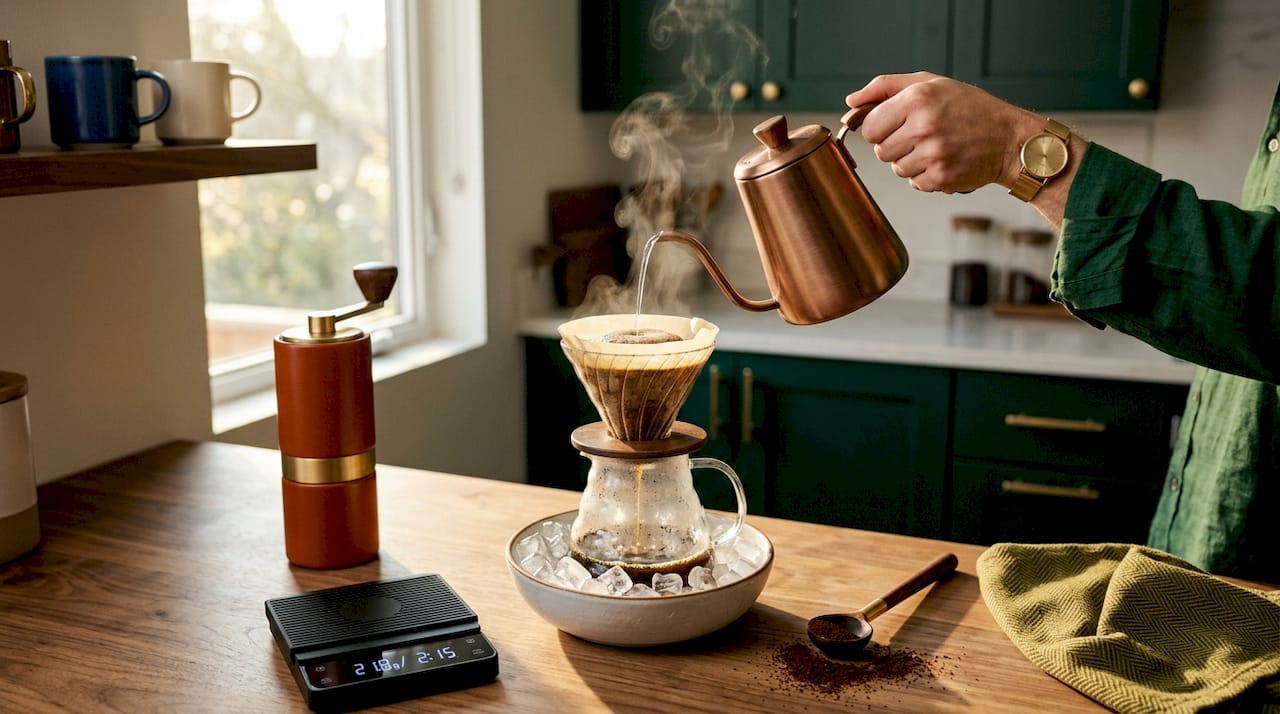
The equipment list is straightforward. A standard home setup includes a pour-over brewer such as a Hario V60 or Chemex, a paper filter, a gooseneck kettle, a digital scale, a burr grinder, and weighed ice placed directly in the carafe or server below the brewer. The ice is not added afterward. It sits in the vessel before the first drop of coffee falls, so chilling begins the moment extraction ends.
The step-by-step brewing process
- Weigh your ice. Place roughly 40% of your total liquid weight as ice into the carafe. If your target yield is 300 grams of finished coffee, use approximately 120 grams of ice.
- Dose your coffee. Use a higher coffee-to-water ratio than you would for a standard hot brew. A 1:13 ratio (coffee to total water) is a reliable starting point.
- Grind fresh. Set your burr grinder to a medium-fine setting, similar to table salt in texture.
- Heat your water. Bring water to 200°F (93°C). Consistent temperature controls extraction rate and flavor balance.
- Brew slowly and evenly. Pour in controlled, circular passes over the grounds. The brewed coffee drips onto the ice below, chilling instantly.
- Serve immediately. Flash brewed coffee is best consumed right away while the aromatics are at their peak.
Pro Tip: A burr grinder and precise scale are the two tools that most directly control your extraction quality. Inconsistent grind size creates uneven extraction, which produces a flat or bitter cup regardless of how good your beans are.
How does flash brew compare to cold brew and iced coffee?
The three most common cold coffee preparations share a goal but take completely different paths to get there. Understanding the differences helps you choose the right method for your taste preferences and available time.
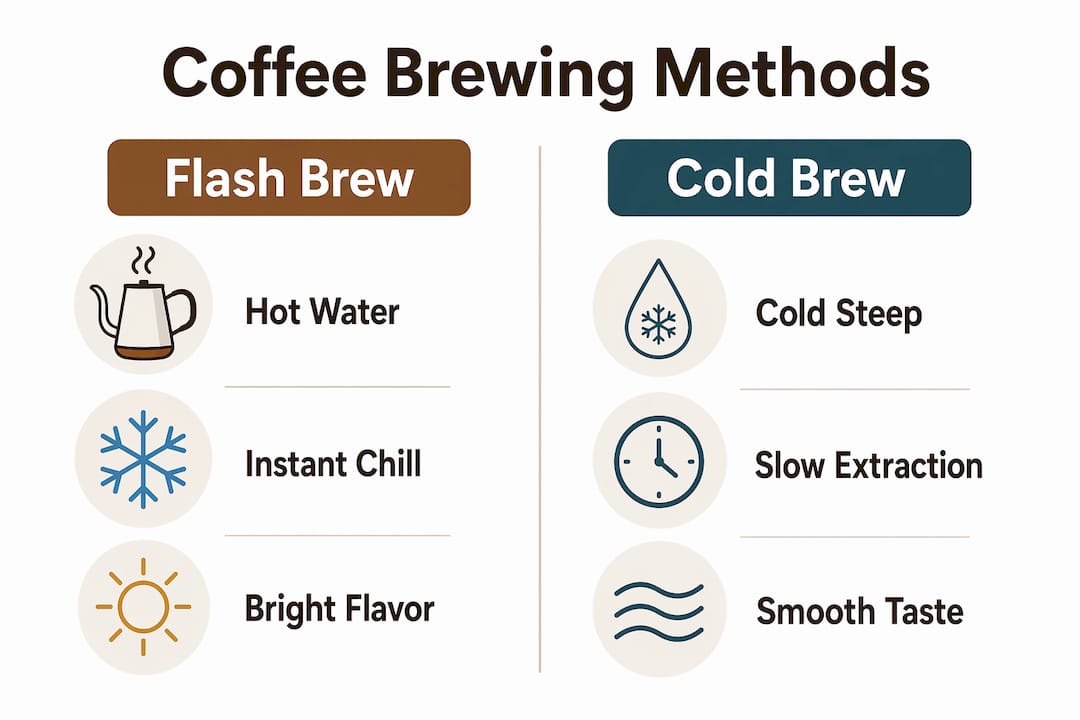
Cold brew coffee involves steeping coarse grounds in cold or room-temperature water for 12 to 24 hours. The long, slow extraction at low temperature produces a smooth, low-acid cup with a heavy, almost syrupy body. The chemical extraction profile differs significantly from hot brewing. Cold water never fully dissolves the volatile aromatic compounds that give coffee its brightness, which is why cold brew tastes mellow and chocolatey rather than floral or citrusy.
Traditional iced coffee, by contrast, brews hot coffee and then cools it by pouring it over ice or refrigerating it. The problem is that the coffee sits hot for a period before chilling, which causes oxidation and flavor degradation. The result is often a flat, slightly stale-tasting cup with dilution from the ice added after the fact.
Flash brewing solves both problems. Hot water extracts the full aromatic spectrum, and the instant chill from the ice bed stops oxidation before it starts.
| Method | Brew temperature | Time required | Flavor profile | Acidity |
|---|---|---|---|---|
| Flash brew | Hot (200°F) | 3 to 5 minutes | Bright, aromatic, complex | High |
| Cold brew | Cold or room temp | 12 to 24 hours | Smooth, mellow, chocolatey | Low |
| Traditional iced coffee | Hot, then cooled | 10 to 15 minutes | Flat, diluted, oxidized | Medium |
The table makes the trade-offs clear. Flash brew wins on flavor complexity and speed. Cold brew wins on smoothness and low acidity. Traditional iced coffee offers convenience but sacrifices quality on both fronts.
What flavor profile does flash brewed coffee deliver?
Flash brewed coffee produces a cup that is bright, clean, and layered with aromatic complexity. The acidity and nuanced aromatics are preserved far better than in cold brew, making it the preferred method for drinkers who want to taste the origin characteristics of a specialty coffee bean. A light-roast Ethiopian Yirgacheffe brewed flash-style will show its blueberry and jasmine notes clearly. The same bean cold-brewed for 18 hours will taste primarily of chocolate and nuts.
The body of a flash brewed cup is lighter than cold brew but more structured than a standard hot pour-over served at room temperature. The rapid chilling tightens the texture slightly, giving the coffee a clean, crisp finish that feels refreshing without being watery. This is why the method pairs so well with single-origin beans that have distinct terroir characteristics.
“Flash brewing is about preserving what the roaster and the farmer worked to create. The ice doesn’t dull the coffee. It locks it in.” This perspective, shared widely among specialty coffee professionals, reflects why the method has become a benchmark for quality iced coffee in competition settings.
Roast level matters more in flash brew than in cold brew. Medium and light roasts express the most complexity because their higher acidity and aromatic compounds are exactly what the hot extraction and instant chill are designed to capture. Dark roasts can work, but the bright qualities that define flash brew are less pronounced when the roast has already driven off the more delicate volatile compounds.
For guidance on selecting beans that perform well with this method, the Zscoffee coffee bean types guide covers origin characteristics and roast profiles in practical detail.
How to flash brew coffee at home for the best results
Getting flash brew right at home comes down to three variables: concentration, grind consistency, and ice weight. Nail those three, and the method is forgiving on everything else.
Concentration is the most common point of failure. Because roughly 40% of your liquid weight is ice, you are brewing a concentrated coffee that dilutes as the ice melts. If you use a standard 1:16 ratio, the final cup will taste thin and watery. Higher brew concentration is the key to preserving flavor through dilution. Start at 1:13 and adjust from there based on your taste preference.
Here are the variables to dial in for a consistently excellent cup:
- Grind size: Medium-fine for V60, slightly coarser for Chemex. A consistent grind from a burr grinder prevents over-extraction in fine particles and under-extraction in coarse ones.
- Water temperature: 195°F to 205°F (90°C to 96°C). Lower temperatures slow extraction and reduce brightness. Higher temperatures risk bitterness.
- Ice weight: Aim for 40% of total liquid weight. Weigh it on your scale before brewing, not by volume.
- Pour speed: Slow, controlled pours give the grounds even saturation. Rushing the pour creates channeling, where water finds the path of least resistance and skips sections of the coffee bed.
- Bean freshness: Use beans roasted within the past two to four weeks. Stale beans produce flat, papery cups regardless of technique.
Pro Tip: Rinse your paper filter with hot water before adding grounds. This removes the papery taste from the filter and preheats the brewer, which stabilizes extraction temperature from the first pour.
For a complete walkthrough of home brewing fundamentals that apply across methods, the Zscoffee home brewing guide covers technique, ratios, and equipment in depth.
Recipe variations worth trying include adding a small amount of citrus zest to the ice bed for a subtle brightness, or using a blend of ice and frozen coffee cubes to eliminate dilution entirely. The frozen coffee cube approach works especially well if you want to serve flash brew over a longer period without the cup weakening.
Key takeaways
Flash brewed coffee delivers the flavor complexity of hot pour-over coffee in an iced format by brewing at full temperature directly onto ice, making it the fastest and most flavor-preserving method for cold coffee.
| Point | Details |
|---|---|
| Core definition | Flash brew is hot coffee brewed directly over ice for instant chilling and flavor preservation. |
| Concentration is critical | Use a 1:13 coffee-to-water ratio to compensate for dilution from the ice bed. |
| Flash brew vs. cold brew | Flash brew is brighter and more acidic; cold brew is smoother and takes 12 to 24 hours. |
| Best beans to use | Light and medium roasts with distinct origin characteristics perform best in flash brew. |
| Equipment essentials | A V60 or Chemex, burr grinder, digital scale, and gooseneck kettle are the core tools needed. |
Why flash brew changed how I think about iced coffee
I spent years defaulting to cold brew because it felt like the “serious” option. It required planning, patience, and a certain ritual that made it feel intentional. Flash brew felt too fast, too simple. I assumed the quality would reflect that.
The first time I brewed a washed Guatemalan single-origin over ice using a V60, I was not prepared for how much flavor survived the process. The cup was brighter than anything I had made with cold brew from the same beans. The stone fruit notes the roaster described on the bag were actually there, not buried under a layer of chocolate and muted acidity.
What I have found through consistent experimentation is that flash brew rewards precision more than any other iced coffee method. Cold brew is forgiving. You can steep for 14 hours or 20 hours and the difference is subtle. Flash brew is not like that. A grind that is too coarse produces a watery cup. Too fine, and you get bitterness that the ice cannot hide. The method teaches you to pay attention, and that attention pays off in the cup.
My honest recommendation: start with a light-roast single-origin from a region known for fruit-forward flavor, such as Ethiopia or Kenya. Brew at 1:13, use 40% ice by weight, and pour slowly. Taste it before you add anything. You may find you do not need milk, sugar, or syrup at all. That clarity is what flash brew does better than anything else.
— zachary
Start your flash brew setup with Zscoffee

Flash brew rewards good equipment and quality beans more than almost any other method. At Zscoffee, you will find everything you need to get started, from specialty coffee beans sourced from high-quality origins to the pour-over brewers, burr grinders, and digital scales that make precision brewing possible at home. Browse the full coffee collection to find light and medium roasts that shine in flash brew, or explore the complete coffee and tea range for brewing accessories and complementary products. Whether you are setting up your first pour-over station or upgrading your current kit, Zscoffee ships globally to coffee enthusiasts who take their cup seriously.
FAQ
What is flash brewed coffee in simple terms?
Flash brewed coffee is hot coffee brewed directly over ice, which chills it instantly and preserves bright, complex flavors. It is also called Japanese iced coffee and takes about three to five minutes to prepare.
How is flash brew different from cold brew?
Cold brew steeps grounds in cold water for 12 to 24 hours, producing a smooth, low-acid cup. Flash brew uses hot water over ice and takes minutes, delivering a brighter, more aromatic result.
What equipment do I need to flash brew at home?
The core tools are a pour-over brewer such as a Hario V60 or Chemex, a burr grinder, a digital scale, a gooseneck kettle, paper filters, and weighed ice placed in the carafe before brewing.
What coffee-to-water ratio works best for flash brew?
A 1:13 ratio of coffee to total water is a reliable starting point. The higher concentration accounts for dilution from the ice, which makes up roughly 40% of the total liquid weight in the final cup.
Can any coffee bean be used for flash brewing?
Light and medium roasts from fruit-forward origins such as Ethiopia or Kenya produce the most complex results. Dark roasts work but express fewer of the bright, aromatic qualities that make flash brew distinct from other iced coffee methods.