Cold brew is one of the most misunderstood drinks in the coffee world. Most people assume it’s just iced coffee, but the two couldn’t be more different in process, chemistry, and taste. Cold brew has surged in popularity among specialty coffee fans because it delivers a smoother, naturally sweeter cup with none of the sharp bitterness you get from hot brewing. In this guide, we’ll break down exactly what cold brew is, how it’s made, what it tastes like, and how you can brew a great batch at home starting today.
Table of Contents
- What is cold brew? The core concept explained
- Cold brew vs iced coffee vs hot brew: Key differences
- How is cold brew made? Step-by-step method and science
- Cold brew flavor profiles: What tastes to expect and how to enhance them
- Cold brew: Expert tips and advanced techniques
- Discover specialty cold brew and coffee essentials
- Frequently asked questions
Key Takeaways
| Point | Details |
|---|---|
| Cold brew basics | Cold brew is made by slowly steeping coarse grounds in cold water to create a smooth, less acidic concentrate. |
| Unique flavor | Expect a sweet, nutty, and chocolatey cup with up to 67% less acid than a typical hot brew. |
| Home-friendly method | Anyone can make cold brew at home using the right grind, ratio, and steep time for their ideal taste. |
| Advanced tips | Adjust grind, steep time, or try cold drip for a personalized cold brew—experimentation delivers pro results. |
What is cold brew? The core concept explained
Cold brew is not iced coffee. That’s the single most important thing to understand before anything else. Iced coffee is brewed hot and then cooled down, which means it carries all the acidity and bitterness of a standard hot brew, just served cold. Cold brew, on the other hand, never touches hot water at all.
The process is simple in concept: coarse coffee grounds steep in cold or room temperature water for an extended period, typically 12 to 18 hours. Time replaces heat as the extraction force. The result is a coffee concentrate that tastes noticeably different from anything you’d get out of a drip machine or espresso maker.
Here’s what defines cold brew at a glance:
- Method: Immersion steeping in cold or room temperature water
- Grind: Coarse, similar to sea salt
- Time: 12 to 18 hours (sometimes up to 24)
- Ratio: Higher coffee-to-water ratio (1:4 to 1:8 by weight), producing a concentrate diluted before serving
- Flavor: Smooth, low bitterness, naturally sweet, chocolatey or nutty
The chemistry behind that smooth taste is real. Cold brew has up to 67% less titratable acidity compared to hot brew, with a pH ranging from about 5.0 to 5.8. Less acid and fewer extracted oils mean less bitterness and a rounder, sweeter flavor. If you want to understand how coffee varietals and brewing methods interact, cold brew is one of the most revealing experiments you can run at home.
“Cold brew’s extended steep time in cold water fundamentally changes which compounds are extracted, producing a cup that’s chemically distinct from any hot-brewed coffee.”
Cold brew vs iced coffee vs hot brew: Key differences
Now that you know what cold brew actually is, let’s put it side by side with its closest relatives. The differences go deeper than temperature.
| Feature | Cold brew | Iced coffee | Hot brew |
|---|---|---|---|
| Brewing method | Cold water steep | Hot brewed, then cooled | Hot water extraction |
| Grind size | Coarse | Medium | Medium to fine |
| Brew time | 12 to 24 hours | Minutes | Minutes |
| Acidity | Very low | High | High |
| Caffeine | Similar (concentrated) | Similar | Similar |
| Typical flavors | Chocolatey, nutty, sweet | Bright, slightly diluted | Fruity, floral, complex |
One of the biggest practical advantages of cold brew is that it avoids dilution. Iced coffee gets watered down as the ice melts, which flattens the flavor. Cold brew concentrate holds its strength. Cold brew avoids dilution and the immersion method is forgiving for beginners, though precise ratios and grind sizes unlock professional-level results.

On the flavor chemistry side, cold brew extracts similar caffeine to hot brew but fewer antioxidants, and the flavor profile leans toward chocolatey and nutty notes rather than the fruity or floral qualities you’d find in a well-made pour-over. That’s not a flaw. It’s a feature that pairs beautifully with milk, cream, or even a splash of vanilla.
Choosing the right beans matters a lot here. Exploring types of coffee beans before you brew can help you predict the flavor direction of your cold brew. And once you’ve nailed your base, coffee flavor pairing opens up a whole new dimension of creativity.
Pro Tip: Start with a 1:8 ratio (coffee to water by weight) for a lighter concentrate, then work your way toward 1:4 for a stronger, more intense base. Small ratio shifts create big flavor differences.
How is cold brew made? Step-by-step method and science
Making cold brew at home is genuinely easy. You don’t need special equipment to get started, just a jar, a filter, and patience.
- Grind your coffee coarsely. Think sea salt texture. A coarse grind prevents over-extraction, cloudiness, and bitterness. Finer grinds increase TDS (total dissolved solids) and caffeine but risk sediment and a muddy cup.
- Measure your ratio. Use 1 part coffee to 4 to 8 parts water by weight. Start at 1:8 if you’re new to this.
- Combine and stir. Add the grounds to your container, pour in cold or room temperature water, and stir gently to make sure all grounds are saturated.
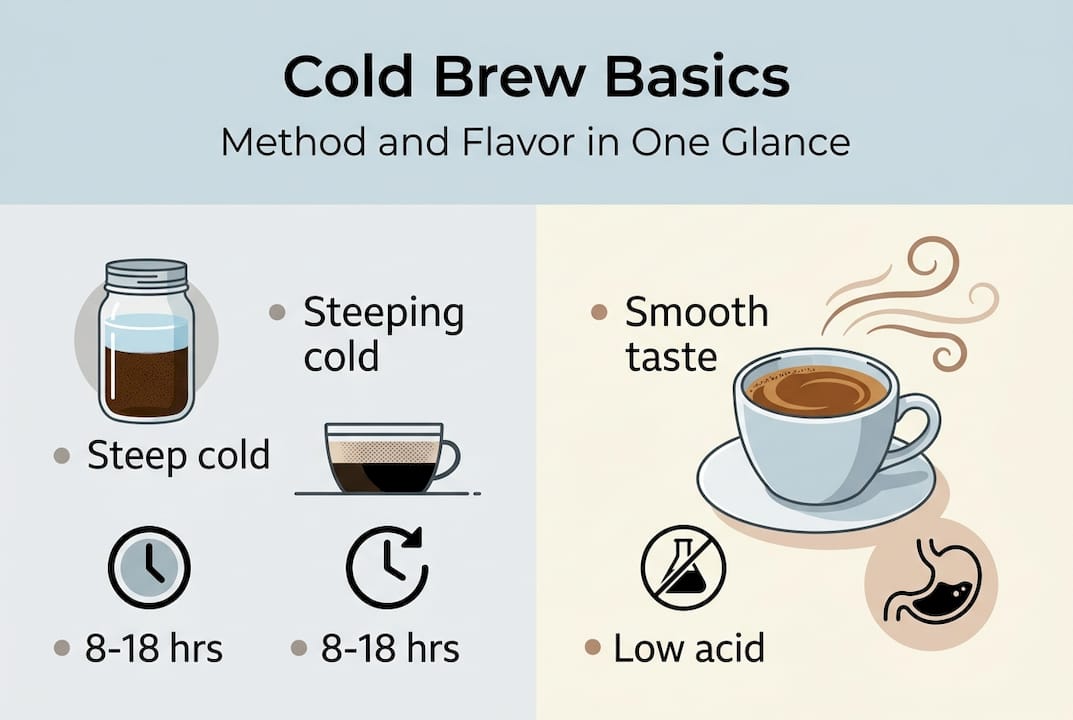
- Steep. Cover and place in the fridge or leave at room temperature. The optimal steep time is 12 to 18 hours. Shorter steeps (around 8 hours) produce a brighter, lighter cup. Longer steeps (up to 24 hours) create a richer, bolder flavor but risk astringency.
- Filter. Pour the mixture through a fine mesh strainer lined with cheesecloth or a paper filter. This step determines clarity.
- Dilute and serve. Mix your concentrate with water, milk, or a milk alternative at roughly a 1:1 ratio. Adjust to taste.
| Steep time | Flavor result |
|---|---|
| 8 hours | Bright, lighter body, mild sweetness |
| 12 to 15 hours | Balanced, smooth, classic cold brew |
| 18 to 24 hours | Rich, bold, deeper chocolate notes |
The science behind steep time is straightforward. Heat speeds up extraction, so without it, time does the work. Going too long doesn’t just make it stronger. It starts pulling out compounds that add astringency, which is that dry, puckering sensation on the back of your tongue.
For choosing coffee beans that work well in cold brew, medium to dark roasts with chocolatey or nutty profiles tend to shine. Light roasts can work too, especially if you want a more delicate, tea-like result. Having the right brewing accessories makes the process cleaner and more consistent. And if you want to go deeper on technique, mastering coffee at home is a great next step.
Pro Tip: Try steeping at room temperature for the first 4 hours, then moving the container to the fridge. Room temperature speeds up early extraction, while the fridge slows it down and reduces the risk of over-extraction. It’s a small trick that adds noticeable smoothness.
Cold brew flavor profiles: What tastes to expect and how to enhance them
Cold brew has a signature flavor identity. Once you know what to look for, you’ll recognize it immediately.
The most common tasting notes in cold brew include:
- Chocolate and cocoa: Especially prominent in medium to dark roasts from Brazil or Colombia
- Nutty and caramel: A natural sweetness that doesn’t need added sugar
- Low bitterness: The absence of sharp edges makes it approachable for people who normally avoid black coffee
- Full body: Cold brew feels heavier and more coating on the palate than iced coffee
The reason for all of this comes back to chemistry. Cold brew has up to 67% less titratable acid than hot brew. Less acid means the sweetness and body come forward instead of being masked by sharpness. It’s the same reason a ripe fruit tastes sweeter than an unripe one. Acidity competes with sweetness.
Flavor-wise, cold brew emphasizes chocolatey and nutty notes over the fruity or floral qualities you’d find in a light roast pour-over. That doesn’t mean cold brew is one-dimensional. Bean origin plays a huge role. An Ethiopian bean steeped cold will still carry some of its natural berry-like character, just softened and rounded.
To enhance your cold brew experience:
- Experiment with single-origin beans to discover how origin shapes flavor
- Adjust your dilution ratio to control strength and sweetness
- Add infusions like cinnamon sticks, vanilla beans, or orange peel during the steep
- Try different roast levels to shift the flavor from bright and delicate to deep and bold
Exploring coffee flavor profiles before you brew helps you set expectations and make smarter bean choices. And if you want to take things further, coffee pairing ideas can turn your cold brew into a full sensory experience.
Cold brew: Expert tips and advanced techniques
Once you’ve mastered the basics, there’s a lot of room to push your cold brew further. These techniques are for enthusiasts who want more control and complexity.
- Try a finer grind with better filtration. A slightly finer grind increases TDS and caffeine extraction, but you’ll need a double-layer filter setup to avoid sediment. Finer grinds boost caffeine and TDS but require better filtration to keep the cup clean.
- Experiment with cold drip. Cold drip (also called Kyoto-style) uses a slow drip of cold water through the grounds rather than full immersion. It’s slower and more complex to set up, but it preserves volatile aromatic compounds that immersion brewing loses.
- Troubleshoot bitterness. If your cold brew tastes bitter, the most likely culprits are grind size (too fine), steep time (too long), or ratio (too concentrated). Start by coarsening your grind.
- Troubleshoot weakness. If it tastes thin or watery, increase your coffee-to-water ratio or extend your steep time by a few hours.
- Troubleshoot muddy texture. Double-filter through cheesecloth and then a paper filter. This two-step process removes fine particles that make the cup feel gritty.
“Cold drip brewing preserves volatile aromatic compounds that are lost in immersion cold brew, producing a more complex, layered cup with floral and fruity notes that survive the cold extraction process.”
Pro Tip: Use a kitchen scale for every brew. Eyeballing ratios is the single biggest reason home cold brew results are inconsistent. Even a small change in ratio shifts the flavor significantly.
For those who want to apply these principles to other brewing methods, expert espresso advice shares a similar mindset around precision and extraction control.
Discover specialty cold brew and coffee essentials
Ready to take your cold brew to the next level? The beans and tools you use make a real difference in the final cup, and having the right setup removes the guesswork entirely.

At Z’s Coffee, you’ll find a curated selection of cold brew coffee options designed for smooth, full-flavored results. If you want to explore something unexpected, the mushroom coffee blend offers a medium roast with an earthy, grounding character that works surprisingly well as a cold brew base. And for those who brew on the go, a quality travel mug with a handle keeps your cold brew cold and your hands comfortable. Browse the full collection at Z’s Coffee to find everything you need for your next batch.
Frequently asked questions
Does cold brew coffee really have less acid than hot coffee?
Yes. Cold brew has up to 67% less titratable acid than hot brew, making it smoother and far less likely to taste bitter or cause stomach discomfort.
Does cold brew have more caffeine than hot brew?
Cold brew extracts similar caffeine to hot brew overall, but because it’s served as a concentrate, the final caffeine level depends heavily on how much you dilute it before drinking.
How long should I steep cold brew for the best flavor?
The sweet spot is 12 to 18 hours. An 8-hour steep produces a brighter cup, while 24 hours creates a richer, bolder result but risks astringency if you go much longer.
What kind of coffee grind is best for cold brew?
A coarse grind like sea salt is the standard recommendation. It prevents over-extraction, keeps the cup clean, and avoids the sediment and bitterness that finer grinds can introduce.