TL;DR:
- Recyclable coffee packaging mainly uses mono-material structures with barrier coatings under 5% of total weight to ensure recyclability. The success of recycling depends on local infrastructure, collection, and sorting facilities, which vary by region. Innovations like EVOH and SiOx coatings significantly improve shelf life while maintaining recyclability.
Recyclable coffee packaging is defined as packaging made from materials engineered to be collected, sorted, and reprocessed into new products within existing recycling systems. Most conventional coffee bags fail this standard because they bond multiple material layers together, making separation impossible at standard recycling facilities. The industry term for the preferred alternative is mono-material packaging, where every layer, including valves and zippers, uses the same polymer family. Switching to mono-material structures reduces carbon footprint by about 50% compared to traditional multi-material laminates. That single figure explains why both regulators and specialty roasters are rethinking what goes around your coffee beans.
What is recyclable coffee packaging made from?
The core challenge in eco-friendly coffee packaging is that coffee needs protection from oxygen, moisture, and light, and most materials that provide that protection are hard to recycle. The solution lies in choosing materials that deliver barrier performance without bonding incompatible polymers together.
Mono-material polyethylene and polypropylene
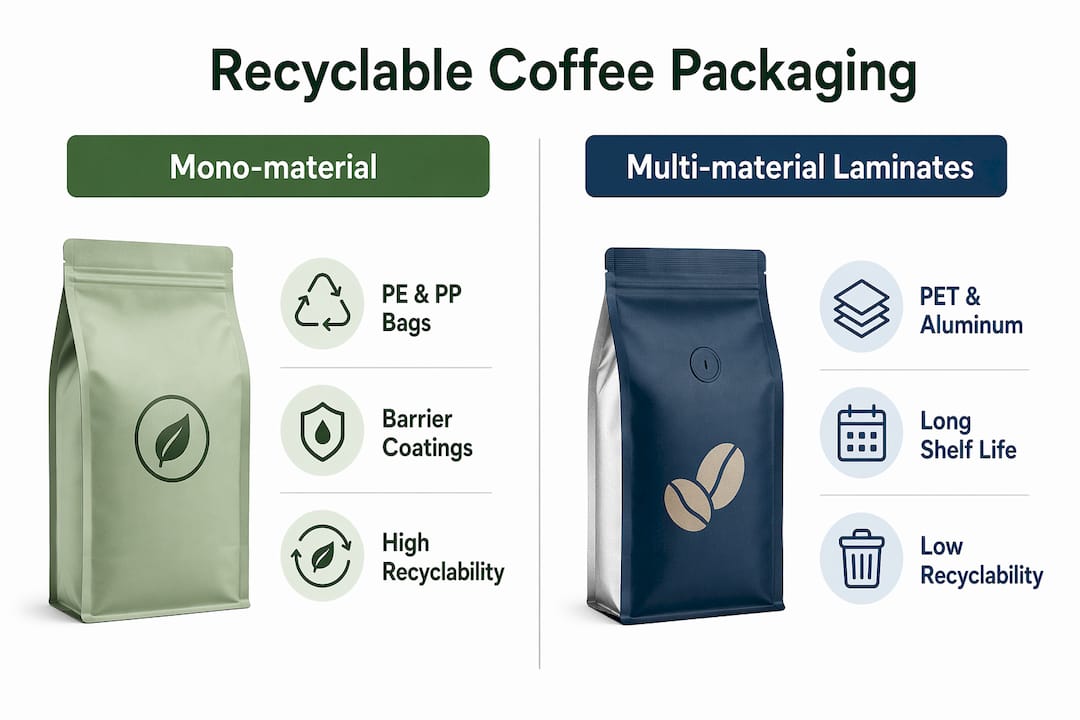
Mono-material polyethylene (PE) and polypropylene (PP) bags are the most widely adopted recyclable packaging for coffee today. Because every component uses the same polymer family, optical sorting equipment at Materials Recovery Facilities can identify and separate them cleanly. PE packaging with EVOH barriers achieves recycling rates up to 60% while preserving an 18-month shelf life. That combination of performance and recyclability makes PE the benchmark material for sustainable coffee packaging options.
EVOH and SiOx barrier coatings
Barrier coatings are what allow mono-material bags to protect coffee without sacrificing recyclability. EVOH (ethylene vinyl alcohol) and SiOx (silicon oxide) coatings block oxygen and moisture at the microscopic level. The key rule is that barrier additives must stay under 5% of total packaging weight to maintain recycling compatibility. Above that threshold, the coating disrupts the polymer stream and the bag effectively becomes non-recyclable.
Paper-based rigid formats
Paper-based options represent the fastest-growing segment of sustainable coffee packaging options in 2026. Formats like GREENCAN® are produced with up to 98% recycled paper content from 100% recycled paperboard, meeting EU PPWR recyclability standards. These rigid canisters suit whole-bean and ground coffee sold in retail environments where shelf presence matters. They also align with growing consumer demand for packaging that avoids fossil-fuel-derived plastics entirely.
Pro Tip: When evaluating any coffee bag labeled “recyclable,” check whether the valve and zipper use the same material as the bag body. Mixed-material closures are the most common reason a bag fails recyclability testing even when the film itself qualifies.
Traditional multi-material laminates bond layers of PET, aluminum foil, and PE together. These bonded laminates contaminate recycling streams and are rejected by standard facilities, sending them directly to landfill. The freshness performance is excellent, but the end-of-life outcome is not.
How does recycling infrastructure affect coffee bag recyclability?
A bag can be technically recyclable in design and still end up in a landfill. Local infrastructure dictates recyclability in practice, because a mono-material PE bag requires specific optical sorting equipment to be processed correctly. This gap between “recyclable” and “curbside recyclable” is the most misunderstood concept in the coffee bag recycling guide conversation.
Recycling success depends on three steps working in sequence:
- Collection. The bag must be accepted by your local curbside program or a designated drop-off location. Many PE film bags are not accepted curbside and must go to store drop-off programs, such as those found at major grocery retailers.
- Sorting. Materials Recovery Facilities use near-infrared optical sorters to identify polymer types. Facilities without this technology cannot distinguish PE film from mixed plastic waste, so the bag gets rejected.
- Processing. Even correctly sorted bags need a processor willing to buy and remanufacture that material. Any failure in this chain means the packaging is effectively not recycled, regardless of what the label says.
The practical implication is that consumers and businesses must verify local acceptance before assuming a recyclable label means anything in their region. A bag certified recyclable under European EN 13430 standards may not be processable in a rural American county with a single-stream facility.
Pro Tip: Search your zip code on How2Recycle’s website or your municipal waste authority’s portal to confirm whether flexible PE film is accepted curbside or only at drop-off locations near you.
Understanding how packaging preserves coffee freshness also helps you evaluate whether a recyclable bag is actually protecting the coffee inside, not just wearing a green label.
What are the trade-offs and innovations in recyclable coffee packaging?
The central tension in sustainable coffee packaging is freshness versus recyclability. Multi-material laminates have historically won on performance because bonded layers of aluminum and plastic block oxygen far more effectively than any single polymer.
Multi-material laminates deliver 18–24 months of shelf life but are essentially non-recyclable. Mono-material alternatives without barrier innovation drop to a 6–12 month shelf life window. That gap has slowed adoption among specialty roasters who sell aged or single-origin beans with long distribution chains.
The table below shows where the trade-offs land across the main packaging types:
| Packaging type | Shelf life | Recyclability | Key limitation |
|---|---|---|---|
| Multi-material laminate (PET/foil/PE) | 18–24 months | Not recyclable | Bonded layers cannot be separated |
| Mono-material PE with EVOH coating | Up to 18 months | Up to 60% recycling rate | Requires film drop-off, not curbside |
| Paper-based rigid (GREENCAN® style) | 12–18 months | High, meets EU PPWR | Less flexible for small-batch roasters |
| Standard paper bag (no barrier) | 2–4 weeks | Curbside recyclable | No oxygen or moisture protection |
Ultra-thin barrier coatings are closing the performance gap. EVOH and SiOx coatings engineered to stay below 5% of total packaging weight now protect coffee against oxygen ingress at levels approaching aluminum foil performance. Vacuum packaging combined with these coatings extends shelf life without adding non-recyclable layers. The lifecycle assessment data confirms that mono-material structures with these coatings cut carbon footprint in half compared to conventional laminates, even accounting for the energy used in coating application.
The EU’s Packaging and Packaging Waste Regulation (PPWR) is accelerating this shift by setting mandatory recyclability thresholds for packaging sold in European markets. Brands selling globally are redesigning packaging to meet PPWR standards, which effectively raises the floor for the entire industry. Understanding why coffee freshness matters for flavor helps put these shelf life trade-offs in practical context.
How can consumers and businesses contribute to effective coffee packaging recycling?
Knowing what recyclable packaging looks like is only half the work. Acting on that knowledge requires a few specific habits, whether you are buying coffee for your home or sourcing packaging for a roastery.
For consumers, the most useful steps are:
- Check the label. Look for How2Recycle labels or equivalent certification marks that specify whether the bag goes in curbside bins or film drop-off locations.
- Run the water-soak test on paper bags. Submerge a small piece of the bag in water for 30 seconds. If a plastic film separates from the paper, the bag contains a hidden moisture barrier and cannot go in paper recycling.
- Use store drop-off programs. Many grocery chains accept clean, dry PE film bags. Rinse the bag, let it dry, and drop it off with other flexible plastics.
- Avoid bags with mixed-material closures. Zippers and valves made from different polymers than the bag body disqualify the entire package from most recycling streams.
For businesses sourcing packaging, the water-soak method is a definitive, low-cost test to verify supplier claims before committing to a packaging run. Request material data sheets and confirm that barrier coatings stay below 5% of total weight. Ask suppliers for third-party recyclability certifications rather than relying on self-declared claims.
Pro Tip: Consumers generally will not separate complex packaging components before recycling. Choosing bags where the valve, zipper, and film all use the same polymer removes that burden entirely and dramatically improves real-world recycling rates.
Brands are increasingly adopting single-serve packaging formats designed with mono-material structures, recognizing that recyclability must be built in at the design stage, not added as an afterthought.
Key Takeaways
Recyclable coffee packaging requires mono-material construction, verified barrier coatings below 5% weight, and confirmed acceptance by local recycling infrastructure to deliver real environmental benefit.
| Point | Details |
|---|---|
| Mono-material design is the standard | PE and PP bags with same-polymer closures are the most recyclable flexible coffee packaging available. |
| Barrier coatings must stay below 5% | EVOH and SiOx coatings under 5% of total weight preserve freshness without breaking recyclability. |
| Local infrastructure determines outcome | A recyclable label means nothing if your local facility lacks optical sorting for flexible film. |
| Paper-based formats are growing fast | GREENCAN-style canisters with up to 98% recycled content meet EU PPWR and suit retail environments. |
| The water-soak test catches hidden plastics | Submerging paper bag samples reveals concealed plastic barriers that disqualify bags from paper recycling. |
The part of this conversation most brands skip
The recyclable packaging debate in coffee tends to focus on materials, and that is the right place to start. But after watching this space for years, the part that gets skipped most often is the infrastructure gap between what a bag is certified to do and what actually happens to it after the consumer finishes the coffee.
I have seen roasters proudly switch to mono-material PE bags, print “recyclable” on the front, and then ship to markets where flexible film is not accepted at curbside or at any nearby drop-off point. The bag is recyclable in theory. In practice, it goes to landfill. The carbon footprint reduction from the material switch is real, but the recycling benefit is not being captured.
The most honest thing a brand can do is publish a clear recycling guide specific to the markets it sells in. Not a generic “please recycle” note, but a region-by-region instruction that tells customers exactly where to take the bag. That kind of transparency builds genuine trust and actually moves the needle on recycling rates.
The technology side is genuinely exciting. Ultra-thin SiOx coatings and vacuum packaging are closing the shelf life gap faster than most people expected. EU PPWR compliance deadlines are forcing global brands to redesign packaging that will eventually raise standards everywhere. The direction is right. The gap between certification and real-world outcome just needs more attention than it currently gets.
— zachary
Sustainable coffee worth drinking and packaging worth recycling
Caring about what wraps your coffee is part of caring about the coffee itself. Zscoffee sources products with that same mindset, selecting offerings where quality and responsibility go together rather than trade off against each other.
Zscoffee’s cold brew coffee is a strong starting point for eco-conscious coffee drinkers who want great flavor without compromise. The full coffee and tea collection at Zscoffee covers a range of roasts and formats, giving you options that fit both your taste and your values. Choosing well-packaged coffee is one of the simplest ways to put sustainable purchasing into practice, one bag at a time.
FAQ
What makes a coffee bag truly recyclable?
A coffee bag is truly recyclable when every component, including the film, valve, and zipper, uses the same polymer family, and when local recycling infrastructure can accept and process that material. Mono-material PE bags with EVOH coatings below 5% of total weight currently meet this standard most reliably.
Are paper coffee bags recyclable?
Paper coffee bags are recyclable only if they contain no hidden plastic moisture barrier. The water-soak test, submerging a bag sample in water for 30 seconds, reveals whether a plastic film is present and disqualifies the bag from paper recycling streams.
What does “curbside recyclable” mean for coffee packaging?
Curbside recyclable means your local municipal collection program accepts the material without requiring a separate drop-off trip. Most flexible PE film coffee bags are not curbside recyclable and must go to store drop-off locations that aggregate film plastics for processing.
How much does switching to recyclable packaging reduce environmental impact?
Transitioning from multi-material laminates to mono-material coffee packaging reduces carbon footprint by about 50%, based on lifecycle assessment data comparing the two structures across production, use, and end-of-life stages.
Does recyclable coffee packaging keep coffee fresh?
Mono-material PE bags with EVOH barrier coatings preserve coffee freshness for up to 18 months, matching the shelf life performance of many conventional multi-material laminates while remaining compatible with flexible film recycling programs.