TL;DR:
- Relationship coffee involves long-term, transparent partnerships between roasters and producers built on mutual trust. It fosters consistent quality, ethical sourcing, and deeper connections that benefit producers, roasters, and consumers alike. Genuine relationship coffee relies on ongoing communication and shared values, not just repeated purchases or marketing claims.
Relationship coffee is defined as a sourcing practice where roasters commit to long-term buying partnerships with the same producers across multiple harvest cycles, built on transparency, shared values, and mutual financial viability. The term was coined by David Griswold in the 1990s and has since become one of the most meaningful concepts in specialty coffee culture. Unlike certifications or one-time purchases, relationship coffee is a living commitment that evolves with every season. Understanding it changes how you read a coffee bag, choose a roaster, and think about the cup in your hand.
What is relationship coffee, and how is it defined?
Relationship coffee is a sourcing model, not a certification. Roasters who practice it return to the same farms or cooperatives year after year, building trust and shared knowledge rather than shopping for the lowest price each season. Counter Culture Coffee describes this as a practice that enables quality consistency and evolving standards with suppliers. That consistency is the foundation everything else is built on.
The industry term most closely associated with this practice is “relationship coffee,” though you will also hear it discussed under the broader umbrella of ethical sourcing and direct trade. What separates it from those adjacent terms is its emphasis on complete supply chain transparency. All parties understand costs, pricing logic, and value distribution. No one is left guessing where the money goes.
The relationship between coffee and people in this model runs deeper than a commercial transaction. Roasters share harvest feedback with producers. Producers share crop challenges with roasters. Both sides adapt. That back-and-forth is what makes relationship coffee a genuine partnership rather than a marketing phrase.
How does relationship coffee differ from direct trade and certifications?
Relationship coffee and direct trade are often used interchangeably, but they are not the same thing. Direct trade describes a sourcing channel where roasters buy directly from farms, bypassing traditional importers. Relationship coffee describes the quality of that connection, not just the channel. You can buy direct without ever building a real relationship.
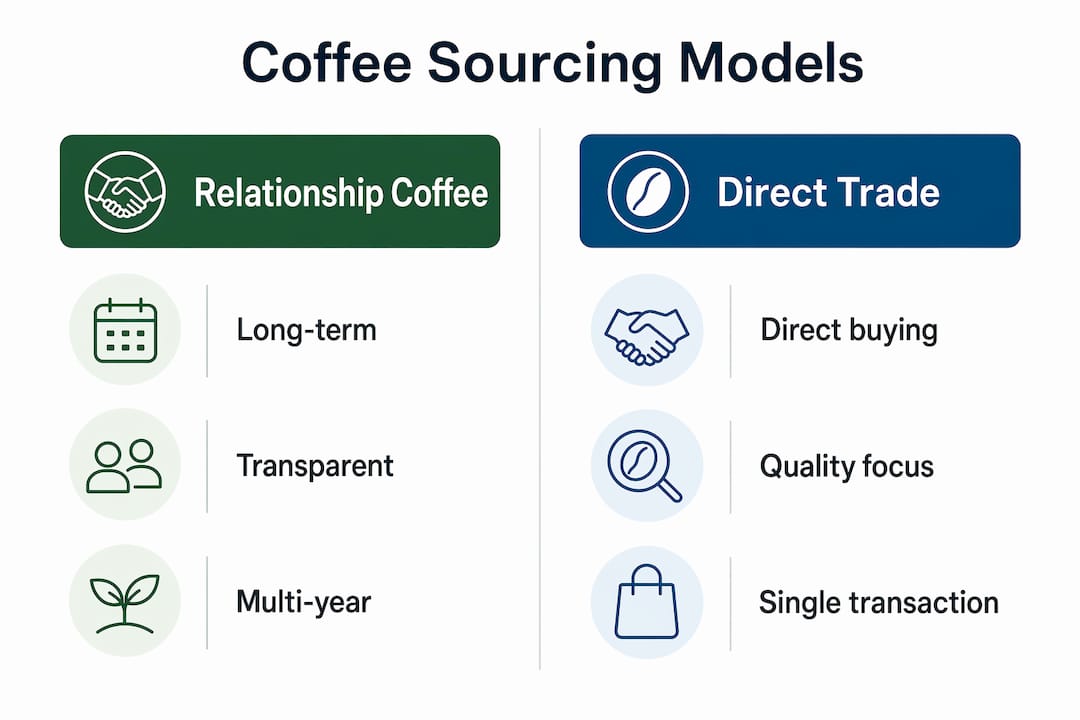
Certifications like Fair Trade or Rainforest Alliance set minimum standards that any participating farm must meet. They provide a useful baseline, but they are fixed rules applied uniformly. Relationship coffee, by contrast, has no fixed rulebook. Geoff Watts, a pioneer in specialty coffee sourcing, explains that it is a dynamic commitment that evolves yearly with changes and challenges. That flexibility is both its strength and the reason it resists easy labeling.
The most common misconception is that repeat purchasing equals relationship coffee. Ashley Rodriguez notes that predictable buying helps forecasting but does not constitute a real relationship without shared values and ethical responsibility. Buying the same coffee every year is a habit. Relationship coffee is a commitment.
Pro Tip: When evaluating a roaster’s sourcing claims, look for specific producer names, farm locations, and multi-year purchase histories. Generic phrases like “we work closely with farmers” without supporting detail are a red flag.
| Sourcing model | Key characteristic |
|---|---|
| Relationship coffee | Long-term, transparent partnership with shared problem-solving |
| Direct trade | Roaster buys directly from farm, bypassing importers |
| Fair Trade certification | Fixed minimum standards applied across all member farms |
| Rainforest Alliance | Environmental and social baseline certification |
| Spot market buying | Single-transaction purchasing based on current price |
How did relationship coffee develop in specialty coffee culture?
The history of relationship coffee starts with David Griswold, who coined the term in the 1990s while working to move specialty coffee beyond transactional commodity buying. His core argument was simple: if roasters and producers understood each other’s costs and constraints, both sides could make better decisions. Transparency was the tool. Long-term commitment was the goal.
Sustainable Harvest, the company Griswold founded, became one of the earliest organizations to put these principles into practice at scale. Counter Culture Coffee followed a similar path, building multi-year sourcing relationships with farms in Ethiopia, Colombia, and beyond. These pioneers showed that long-term partnerships were not just idealistic. They were practical and commercially viable.
The specialty coffee movement of the early 2000s accelerated this shift. As consumers began asking where their coffee came from, roasters who could answer that question with specificity gained a real competitive advantage. Single-origin coffees with named farms and detailed harvest notes became a signal of quality. Relationship coffee was the supply chain practice that made those stories possible.
By the 2010s, the concept had spread far beyond its origins. Roasters across the United States and Europe began using the language of relationship coffee, which also created a problem. The term started appearing on bags without the substance behind it. That gap between marketing and practice is still the central tension in the specialty coffee world today. Understanding the history of direct-from-farm sourcing helps you spot the difference.
Why does relationship coffee matter for producers, roasters, and consumers?
Relationship coffee delivers concrete benefits at every level of the supply chain. For producers, the most immediate gain is financial stability. When a roaster commits to buying from the same farm across multiple seasons, the producer can plan investments, hire staff, and improve processing infrastructure with confidence. That stability is not a minor detail. It is the difference between a farm that can afford to experiment with new varietals and one that cannot.
For roasters, the benefit is quality and craft. Katie Carguilo at Counter Culture Coffee explains that ongoing commitment fosters craft improvement in a competitive market. When a roaster knows a farm’s microclimate, soil conditions, and processing methods across several years, they can dial in roast profiles with far greater precision. The coffee gets better because the knowledge gets deeper.
Consumers benefit in ways that are less visible but equally real:
- Traceability: Relationship coffees typically come with detailed origin information, including farm name, region, altitude, and processing method.
- Ethical sourcing: Transparent pricing and long-term commitments reduce the risk of exploitative practices in the supply chain.
- Flavor consistency: Producers who receive stable income and feedback invest in quality, which shows up in the cup year after year.
- Richer coffee rituals: Coffee as a social drink carries more meaning when the story behind it is real and verifiable.
- Support for communities: Relationship coffee often funds infrastructure improvements in producer communities, from water systems to schools.
Relationship coffee also connects directly to the cultural significance of coffee gatherings. When you know the farm, the farmer, and the harvest season behind your morning cup, the act of brewing becomes something more than routine. That connection is what specialty coffee enthusiasts are really after, and relationship coffee is the sourcing model that makes it authentic.
How is relationship coffee practiced today, and what should consumers look for?
Relationship coffee in 2026 is practiced through constant communication, not contracts. Geoff Watts describes it as a flexible, ongoing commitment relying on renegotiation and shared problem-solving rather than rigid formal agreements. Roasters visit farms. Producers visit roasteries. Both sides share data on cup scores, yield forecasts, and market conditions.
The challenge for consumers is that the term is frequently misused. True relationship coffee is a behind-the-scenes supply chain practice, not a consumer-facing marketing badge. A bag that says “relationship coffee” without supporting evidence is just a label. Here is what genuine relationship coffee actually looks like:
- Named producers or cooperatives with verifiable contact information
- Multi-year purchase histories published by the roaster
- Transparent pricing that shows what the producer received per pound
- Harvest-specific notes that change year to year, reflecting real seasonal variation
- Evidence of roaster visits or producer exchanges, such as photos, trip reports, or interviews
Pro Tip: Check a roaster’s website for a dedicated sourcing or transparency page. Roasters who practice genuine relationship coffee publish the details. Those who do not usually have something to hide.
Single-origin and limited-edition releases are often the most direct expression of relationship coffee principles. When a roaster releases a micro-lot from a specific farm with a named producer and a detailed harvest report, that is relationship coffee made visible. Learning about coffee origin and flavor helps you read those details with more confidence.
Consumers play a real role in this system. When you pay a premium for a traceable, relationship-sourced coffee and ask your roaster where it comes from, you create demand for transparency. That demand is what keeps roasters accountable and keeps producers invested in quality.
Key Takeaways
Relationship coffee is the most ethically grounded sourcing model in specialty coffee because it replaces single transactions with long-term, transparent partnerships that benefit producers, roasters, and consumers alike.
| Point | Details |
|---|---|
| Core definition | Relationship coffee means multi-year sourcing commitments built on transparency and shared values. |
| Not just repeat buying | Predictable purchasing alone does not qualify; shared ethics and genuine communication are required. |
| Historical roots | David Griswold coined the term in the 1990s; Sustainable Harvest and Counter Culture Coffee pioneered the practice. |
| Benefits across the chain | Producers gain stability, roasters gain quality, and consumers gain traceability and richer coffee stories. |
| Consumer role | Asking for sourcing details and paying for transparency creates the demand that sustains relationship coffee. |
Why relationship coffee is the most honest conversation in specialty coffee
I have spent years watching the specialty coffee world wrestle with its own language. Terms like “direct trade,” “ethical sourcing,” and “farm-to-cup” get stretched until they mean almost nothing. Relationship coffee is different, and I think that difference matters more than most people realize.
What strikes me most is that relationship coffee was never designed to be a marketing tool. It was designed to solve a practical problem: how do you build a supply chain that works for everyone in it, not just the buyer? The answer Griswold and others landed on was radical in its simplicity. Talk to each other. Keep talking. Show up when things go wrong, not just when the harvest is good.
The uncomfortable truth is that most coffee labeled “relationship coffee” today does not meet that standard. It takes years to build the kind of trust where a producer will tell a roaster that the harvest failed and the roaster will respond by paying anyway. That kind of loyalty is rare. When you find a roaster who practices it genuinely, support them. The coffee will be better, and so will the industry.
Consumers who care about specialty coffee quality standards are already asking the right questions. The next step is demanding real answers.
— zachary
Relationship coffees at Zscoffee
Zscoffee sources and sells coffees that reflect the principles behind genuine relationship coffee, including traceable single-origin beans and ethically sourced selections with clear producer stories.
Every product in the coffee and tea collection is chosen with sourcing transparency in mind. You will find harvest-specific details, regional context, and the kind of flavor consistency that only comes from long-term producer partnerships. Zscoffee also carries brewing accessories that help you get the most from high-quality beans, so the care that went into sourcing carries through to your cup. Browse the full range at Zscoffee and find coffees worth knowing by name.
FAQ
What is relationship coffee in simple terms?
Relationship coffee is a sourcing practice where roasters buy from the same producers year after year, built on transparency and shared problem-solving rather than one-time transactions.
Is relationship coffee the same as direct trade?
No. Direct trade describes the sourcing channel; relationship coffee describes the quality of the connection. You can buy direct without building a genuine long-term partnership.
Who coined the term “relationship coffee”?
David Griswold coined the term in the 1990s while working to move specialty coffee beyond commodity-style transactional buying toward full supply chain transparency.
How can I tell if a roaster practices real relationship coffee?
Look for named producers, multi-year purchase histories, transparent pricing, and harvest-specific notes that change from year to year. Generic sourcing language without supporting detail is not enough.
Does relationship coffee cost more?
Relationship coffee typically commands a higher price because producers receive stable, above-market payments that reflect true production costs. That premium funds quality improvements and community investment at the farm level.