TL;DR:
- Direct-from-farm coffee, or “direct trade,” connects consumers directly with growers, ensuring fresher beans and higher farmer pay. Authentic relationships involve farm visits, published prices, and named farms, offering better flavor and supply chain transparency. It also helps meet future regulations, like the EU Deforestation Regulation, by guaranteeing farm-level traceability and supporting ethical sourcing.
Direct-from-farm coffee is defined as purchasing coffee beans directly from growers, bypassing importers, exporters, and commodity brokers to deliver fresher beans, higher farmer compensation, and full supply chain transparency. This sourcing model, known in the specialty coffee industry as “direct trade,” is gaining ground fast among coffee lovers and ethical consumers who want more than a good cup. It connects what’s in your mug to the specific farm, elevation, and processing method that shaped it. Understanding why choose direct-from-farm coffee matters more in 2026 than ever before, as new regulations and rising consumer expectations are reshaping how the industry operates.
Why does direct-from-farm sourcing improve coffee flavor and quality?
Direct sourcing cuts the time between harvest and roasting. That gap matters because coffee’s volatile aromatic compounds degrade quickly once the cherry is processed. When a roaster buys through a commodity chain, green beans can sit in warehouses for six to eighteen months before they reach a roaster. Direct trade eliminates most of that lag.
The flavor benefits of farm-fresh coffee go beyond freshness. Direct sourcing delivers fresher green beans that preserve volatile aromatics and unlock unique flavor profiles tied to specific farms. A roaster buying directly from a producer in Ethiopia’s Yirgacheffe region can select a specific micro-lot processed using natural fermentation, a method that produces intensely fruity, wine-like notes impossible to replicate in commodity blends.
Transparency also drives quality upward at the farm level. When a roaster visits a farm and pays a premium tied to cup score, the farmer has a direct financial reason to improve sorting, drying, and fermentation. Farmers reinvest direct trade premiums into better processing, sorting, and drying, which lifts cup scores by 1–4 points on the Specialty Coffee Association’s 100-point scale. A four-point jump can move a coffee from “commercial grade” to “specialty grade,” which is the difference between $2 and $8 per pound at retail.
Pro Tip: When shopping for farm-to-cup coffee, look for roasters who publish the harvest date on the bag. A roast date alone tells you nothing about how long the green bean sat before roasting.
Key quality signals to look for on any bag:
- Named farm or cooperative (not just a country or region)
- Specific processing method (washed, natural, honey)
- Harvest season or crop year
- Elevation in meters above sea level
- Published price paid to the farmer
You can learn more about how these standards connect to specialty coffee quality and what separates commodity from exceptional beans.
What ethical and economic benefits does direct-from-farm coffee provide to growers?
The financial case for direct trade is concrete. Direct trade premiums range from 25% to 400% above commodity benchmarks, which means a farmer earning $1.00 per pound on the commodity market could earn $1.25 to $5.00 per pound through a direct relationship. That range reflects the difference between a roaster paying a modest premium and one deeply committed to long-term farm partnerships.
Fair Trade certification sets a floor price designed to protect farmers from commodity price crashes. Direct trade, at its best, goes well above that floor. The distinction matters because Fair Trade prices are negotiated at the cooperative level, and individual farmers often see only a fraction of the premium after cooperative fees and administrative costs. Direct trade payments go closer to the source.
“Transparency about sourcing details and prices is the hallmark of credible direct trade brands; consumers should demand verifiable claims.” — CoffeeGeek
The challenge is that “direct trade” carries no official certification. Any roaster can print it on a bag. Authentic direct trade commitment looks like this:
- Repeated, documented farm visits by the roaster or sourcing team
- Published prices paid above Fair Trade minimums
- Named farms or cooperatives on the bag and website
- Multi-year purchase agreements that give farmers planning security
- Shared feedback on cup quality that helps farmers improve
When a roaster cannot name specific farms or confirm prices paid exceed Fair Trade by a meaningful margin, direct trade is often marketing, not ethical commitment. That distinction is the most important thing an ethical consumer can understand before buying.
For a deeper look at how certifications like Fair Trade compare to direct sourcing, the Fair Trade coffee breakdown at Zscoffee covers the key differences clearly.
How does direct-from-farm sourcing fit into the 2026 regulatory landscape?
Direct trade is transitioning from a marketing story to a compliance necessity. The EU Deforestation Regulation (EUDR) requires companies selling coffee in European markets to prove their supply chains are deforestation-free, with farm-level traceability as the standard. Coffee is among the regulated commodities requiring farm-level traceability for compliance. Brands that rely on opaque commodity sourcing cannot meet this standard without a major overhaul.

Direct trade sourcing solves this problem by design. When a roaster has a direct relationship with a named farm, they already hold the GPS coordinates, land-use records, and processing documentation that regulators require. Commodity buyers must reconstruct that data retroactively, often at significant cost and with incomplete records.
Pro Tip: If you sell or plan to sell coffee in European markets, ask your supplier for a farm-level sourcing document before 2026 compliance deadlines hit. A named farm relationship is your fastest path to EUDR readiness.
| Sourcing model | Traceability level | EUDR compliance readiness | Farmer premium |
|---|---|---|---|
| Direct trade | Farm-level | High | 25%–400% above commodity |
| Fair Trade certified | Cooperative-level | Moderate | Fixed floor price |
| Commodity/conventional | Country or blend | Low | Market rate only |
Direct trade also helps buyers manage price volatility through predictable allocation and shared planning with producers. That stability benefits roasters who need consistent supply and farmers who need income certainty across growing seasons.
Direct-from-farm vs. Fair Trade vs. commodity coffee: which is better?
The three main sourcing models differ on four dimensions: price to farmer, traceability, flavor consistency, and consumer accountability. Here is how they compare:
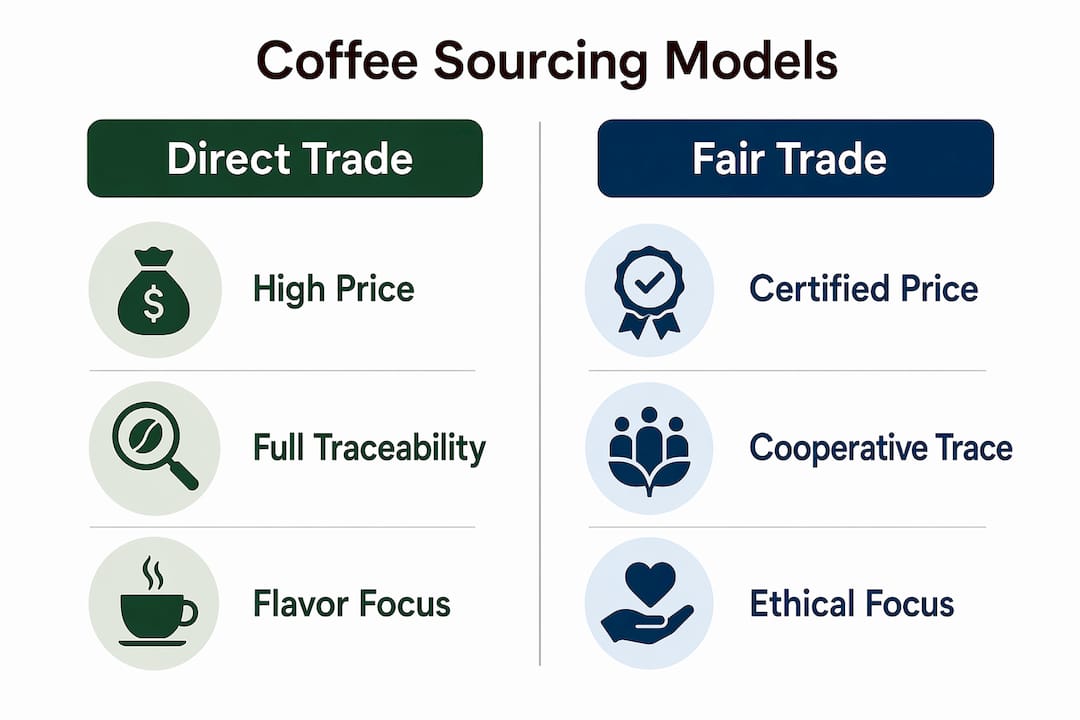
| Factor | Direct trade | Fair Trade | Commodity |
|---|---|---|---|
| Price to farmer | Highest (relationship-based) | Above market floor | Market rate |
| Traceability | Farm-level | Cooperative-level | Minimal |
| Flavor quality | Micro-lot, high scoring | Variable | Blended, inconsistent |
| Certification | None (self-declared) | Third-party certified | None |
| Consumer transparency | High (if authentic) | Moderate | Low |
Fair Trade certification provides a verified floor price and cooperative-level accountability. That matters in regions where cooperatives are well-managed and pass premiums to members. The weakness is that the certification does not guarantee high cup quality or farm-level traceability.
Commodity coffee prioritizes volume and price consistency. It serves mass-market roasters who need millions of pounds of consistent green coffee. Flavor complexity and farmer welfare are secondary concerns in that model.
Direct trade, when practiced authentically, wins on flavor and farmer impact. The tradeoff is that direct sourcing requires more hands-on management and budget for premiums. Not every roaster has the resources to build farm relationships, which is why the label is sometimes applied loosely.
The direct coffee sourcing advantages are clearest when you compare cup scores. Specialty-grade micro-lots sourced directly routinely score 85–92 on the SCA scale. Commodity blends rarely exceed 80. That gap is the flavor argument for direct trade in a single number.
For consumers curious about how experimental processing methods factor into direct trade quality, those techniques are almost exclusively accessible through direct farm relationships.
How to identify genuine direct-from-farm coffee when you buy
Spotting authentic direct trade requires reading past the label. Here is a practical checklist:
- Find the farm name. A bag that says “Ethiopia” is not direct trade. A bag that says “Dumerso washing station, Gedeo Zone, Ethiopia” is a start.
- Check the price paid. Credible roasters publish what they paid per pound. If that number is not available, ask. Silence is a red flag.
- Look for roaster transparency. Does the roaster’s website describe farm visits, relationships, or sourcing trips? Vague language like “carefully selected” means nothing.
- Expect to pay more. True direct trade pricing supports farmer reinvestment and processing risks. A $9 bag claiming direct trade from a high-altitude Ethiopian farm is almost certainly not what it claims.
- Embrace seasonal variation. Micro-lot coffees change year to year based on rainfall, processing decisions, and harvest timing. That variation is a feature, not a flaw.
Pro Tip: Single-origin micro-lots are the clearest expression of direct trade quality. If you want to taste the difference, start with a micro-lot coffee from a roaster who names the producer and the price.
Supporting local roasters who practice direct trade multiplies the impact. A local roaster buying directly from a Guatemalan farm creates a supply chain with three parties instead of seven. Every link you remove from that chain means more money stays with the farmer.
Key takeaways
Direct-from-farm coffee delivers superior flavor, higher farmer income, and supply chain transparency that commodity and Fair Trade models cannot match at the farm level.
| Point | Details |
|---|---|
| Flavor starts at the source | Direct sourcing preserves volatile aromatics and unlocks micro-lot flavor profiles unavailable in commodity blends. |
| Farmer premiums drive quality | Premiums of 25%–400% above commodity rates incentivize better processing and lift cup scores by 1–4 points. |
| Regulations make traceability mandatory | The EU Deforestation Regulation requires farm-level sourcing data, making direct trade a compliance tool in 2026. |
| “Direct trade” has no official standard | Authentic commitment requires named farms, published prices, and documented farm visits, not just a label. |
| Price reflects real cost | Unusually low prices on “direct trade” bags signal marketing, not genuine ethical sourcing. |
Why I think direct trade is the most honest cup you can buy
I have tasted a lot of coffee described as “ethically sourced” that tasted like it came from the bottom of a warehouse bin. The label and the cup told two different stories. Direct trade, when it is real, closes that gap. The flavor difference between a commodity blend and a named-farm micro-lot is not subtle. It is the difference between a flat, forgettable cup and one that makes you stop and actually think about what you are tasting.
The challenge I see most often is consumer skepticism born from exactly the kind of label abuse I described above. People have been burned by vague claims, and they stop trusting the category entirely. That is the wrong response. The right response is to demand specifics. Ask where the farm is. Ask what the roaster paid. If the answer is a shrug, walk away.
Direct trade also asks something of you as a buyer. You pay more. You accept that the flavor profile will shift from season to season. You give up the false consistency of a commodity blend. In return, you get a cup that is traceable, fresher, and connected to a real place and a real person who was paid fairly for their work. That trade is worth it every time.
— zachary
Explore Zscoffee’s direct-sourced coffee selection
Zscoffee sources coffee with the same transparency standards described in this guide. Every selection in the Zscoffee catalog prioritizes named-farm relationships, published sourcing details, and flavor quality that commodity blends cannot deliver.
If you want to experience the benefits of farm-fresh coffee without the research burden, Zscoffee has done the sourcing work for you. The cold brew coffee lineup is built on direct-sourced beans chosen for their clean, complex flavor at every brew temperature. For a broader look at what direct trade tastes like across origins and roast profiles, browse the full coffee and tea collection and filter by single origin to find your next favorite farm.
FAQ
What is direct-from-farm coffee?
Direct-from-farm coffee means purchasing beans directly from growers, bypassing commodity brokers and importers. The industry term is “direct trade,” and it prioritizes farm-level traceability, higher farmer compensation, and fresher green beans.
Is direct-from-farm coffee actually better tasting?
Yes, in most cases. Direct sourcing preserves volatile aromatics and gives roasters access to micro-lots with distinct flavor profiles. Specialty-grade direct trade coffees routinely score 85–92 on the SCA scale, well above commodity averages.
How much more do farmers earn from direct trade?
Direct trade premiums range from 25% to 400% above commodity benchmarks. The exact amount depends on the roaster’s commitment and the quality of the lot purchased.
How do I know if a “direct trade” label is genuine?
Look for named farms, published prices paid above Fair Trade minimums, and documented roaster farm visits. Vague direct trade claims without these specifics are usually marketing, not verified ethical sourcing.
Does direct-from-farm coffee cost more?
Yes, and that price reflects real costs including farmer premiums, processing quality, and supply chain transparency. A higher price on a direct trade bag is a signal of authenticity, not a markup for branding.