TL;DR:
- Milk interacts with coffee’s proteins and polyphenols, reducing bitterness and increasing sweetness.
- The type of milk affects foam stability, creaminess, and flavor modulation in coffee drinks.
- Proper steaming technique and milk choice are essential for elevating home coffee quality.
Grab any coffee, pour in some milk, and you assume you’re just adding a splash of white. But milk is doing something far more complex than softening your brew. The protein structure, fat content, and even the temperature of your milk are silently rewriting the flavor profile in your cup. Whether you reach for whole dairy, oat, or soy, tasting coffee flavor changes dramatically based on what you pour and when you pour it. This guide breaks down exactly why milk matters and how to use it better.
Table of Contents
- Why milk matters in coffee: More than just creaminess
- Dairy vs. plant-based: Comparing milks for coffee
- How milk transforms flavor and texture: The sensory science
- Optimizing your coffee: Milk selection, technique, and pouring order
- What baristas wish more coffee drinkers understood about milk
- Elevate your coffee experience with Z’s
- Frequently asked questions
Key Takeaways
| Point | Details |
|---|---|
| Milk chemistry changes everything | Milk reshapes coffee’s taste and texture by reducing bitterness and enhancing smoothness. |
| Foamability depends on type | Whole milk creates superior foam, while plant milks need special blends to compete. |
| Technique is critical | Pouring order, temperature, and milk choice drastically impact your coffee drinking experience. |
| Choose milk by drink style | Select the right milk for lattes, cold brew, or cappuccinos to optimize flavor and mouthfeel. |
Why milk matters in coffee: More than just creaminess
Most coffee lovers treat milk as a background player. It softens bitterness, adds a bit of body, and makes the drink look beautiful with latte art. But what’s actually happening at a molecular level is far more interesting than that.
When milk meets coffee, proteins and polyphenols get to work immediately. Polyphenols (the compounds in coffee responsible for antioxidant activity and some of that dry, gripping sensation on your palate) interact directly with milk proteins like beta-casein. Milk proteins and coffee polyphenols bind non-covalently, which means they form connections without permanently altering either compound. This interaction reduces astringency, improves antioxidant stability, and modulates how flavor compounds release over time on your palate.
Fat content adds another layer. Higher fat milk coats your palate more completely, smoothing out sharp or sour notes. Lower fat milks do less work in this department, which is why a skim milk flat white can taste noticeably thinner and even slightly more acidic than one made with whole milk.
Here is what you actually gain in the cup when milk is added correctly:
- Reduced bitterness and astringency from protein-polyphenol binding
- Enhanced sweetness perception because fat softens sharp contrasts
- Creamier mouthfeel driven by fat globules and protein networks
- Better aroma retention as fat traps volatile aromatic compounds
- Improved antioxidant bioaccessibility, meaning your body absorbs more from each sip
Research confirms that milk proteins interact non-covalently with coffee polyphenols, enhancing antioxidant stability and modulating flavor release in ways that improve the overall sensory experience of the beverage.
None of this happens with just any milk poured haphazardly. The right choice, temperature, and ratio shift everything.
Dairy vs. plant-based: Comparing milks for coffee
Now that we understand milk’s role, how do the many choices stack up for your ideal cup?
Not all milks behave the same in coffee. This becomes most obvious when you try to steam or foam them. The structure of foam depends on proteins trapping air bubbles and fat stabilizing those bubbles over time. Without the right balance of both, foam either never develops properly or collapses within seconds.

The science of protein stability in milk foaming shows that whole milk wins for foam because it has a balanced ratio of protein to fat. Skim milk can generate a large foam volume, but without fat for stability, it becomes watery and collapses fast. Plant milks face an even bigger challenge because their naturally lower protein levels lead to poor foam unless the product is specifically engineered as a barista techniques with milk edition.
| Milk type | Protein | Fat | Foamability | Stability | Best for |
|---|---|---|---|---|---|
| Whole dairy | High | High | Excellent | Excellent | Lattes, cappuccinos, latte art |
| Skim dairy | High | Very low | High volume | Poor | Low-cal beverages, lighter drinks |
| Oat (barista) | Medium | Medium | Good | Good | Oat lattes, everyday milk coffee |
| Soy (barista) | High | Low-medium | Good | Fair-good | Flat whites, lattes |
| Almond (regular) | Very low | Low | Poor | Poor | Iced drinks, not steamed |
| Coconut | Very low | High | Poor | Poor | Flavored or iced drinks |
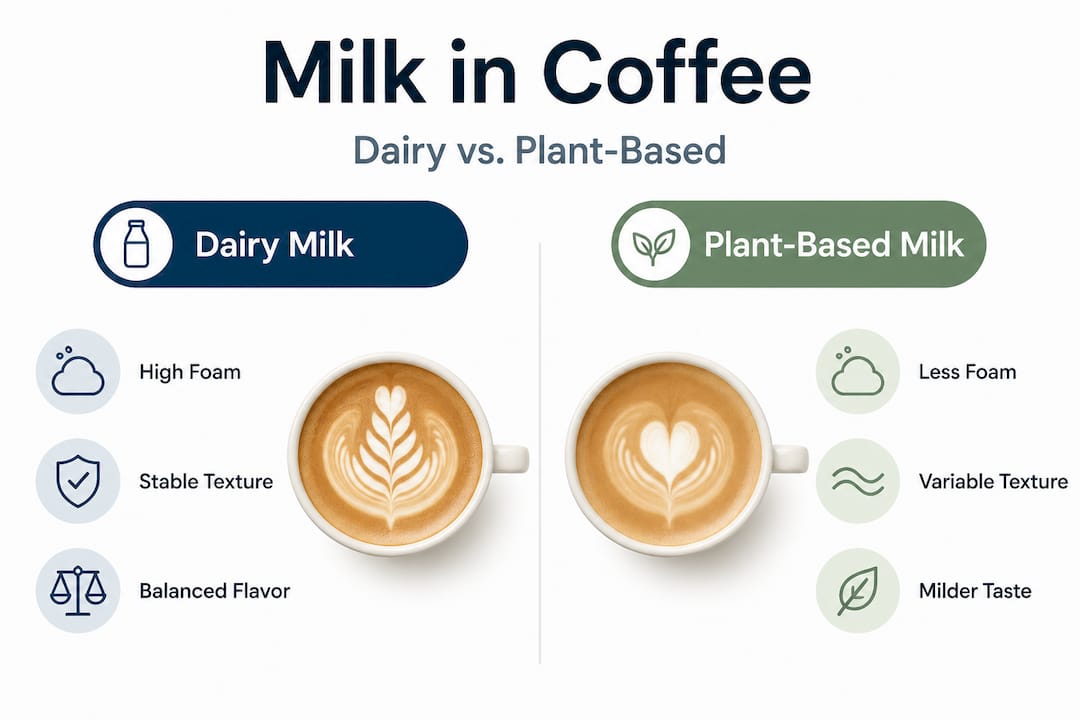
The trade-offs here matter depending on your priorities. If you’re watching calories, health perspectives on milk in coffee show that skim dairy has fewer calories and less saturated fat, but you lose texture and foam stability in the process. If you’re lactose intolerant or plant-based, barista-edition oat or soy milk is genuinely your best bet because they contain added stabilizers and emulsifiers that allow them to behave closer to dairy in steam pitchers.
Regular plant milks? They tend to separate in hot coffee, curdle with acidic single-origin beans, and produce almost no usable foam. Save them for iced drinks where texture matters less.
Pro Tip: When using plant-based milks for steaming, look specifically for the words “barista blend” or “barista edition” on the label. These versions are formulated with higher protein concentrations and added stabilizers to actually hold foam. Standard grocery store oat milk will leave you with a flat, watery disappointment regardless of your technique. Meeting specialty coffee standards at home starts with selecting milk as seriously as you select your beans.
How milk transforms flavor and texture: The sensory science
With a sense of the big-picture differences, let’s see how milk changes the actual coffee drinking experience.
Foam texture is one of the most immediate sensory signals in a milk coffee. Baristas call ideal foam “microfoam” because the bubbles are so small they feel like silk on the palate rather than a layer of stiff peaks. Achieving microfoam comes down to protein denaturation during steaming. When milk is heated between 140°F and 155°F (60°C to 68°C), proteins unfold and reorganize around air bubbles. Fat then locks those bubbles in place, creating a velvety, integrated texture.
Here’s how different protein and fat combinations play out:
| Milk type | Protein (per 100ml) | Fat (per 100ml) | Foam texture | Foam longevity |
|---|---|---|---|---|
| Whole dairy | 3.2g | 3.5g | Silky microfoam | 3 to 5 minutes |
| Skim dairy | 3.5g | 0.1g | Airy, large bubbles | Under 1 minute |
| Oat barista | 1.0g | 1.5g | Moderate, smooth | 2 to 3 minutes |
| Soy barista | 3.3g | 1.8g | Good microfoam | 2 to 4 minutes |
| Almond regular | 0.4g | 1.1g | Very poor | Seconds |
The practical impacts on flavor go beyond just texture. Here is what happens to your coffee experience when you add milk in the right quantity and form:
- Bitterness drops significantly. The milk proteins and coffee polyphenols interaction reduces the grippy, sharp sensation that darker roasts often produce.
- Sweetness becomes more apparent. Fat coats taste receptors and softens the contrast between bitter and sweet compounds, letting natural coffee sweetness surface without adding sugar.
- Aroma becomes richer and longer lasting. Fat molecules trap volatile aromatic compounds, releasing them more slowly and consistently as you drink.
- Antioxidant absorption improves. Milk proteins improve the bioaccessibility of coffee flavor clarity compounds, meaning your body absorbs more of the beneficial polyphenols with each cup.
- Mouthfeel thickens noticeably. High-fat milk creates a coating sensation that makes each sip feel complete rather than thin and watery.
Roast level matters here too. Dark roasts have more bitter compounds, so they respond more dramatically to milk’s smoothing effect. Light roasts, which tend toward fruity and acidic notes, benefit differently. A small amount of whole milk can round out brightness without smothering the delicate floral notes that make a washed Ethiopian or coffee bean types so distinct and enjoyable. Too much milk on a light roast and you erase what you’re paying for.
Understanding enhancing coffee flavor through milk means knowing when to add more and when to hold back based on what the bean itself is expressing.
Optimizing your coffee: Milk selection, technique, and pouring order
Having explored the “why” and “what” of milk in coffee, here’s how to put the science into action in your daily brew.
This is where most coffee lovers leave value on the table. They source great beans, use a quality grinder, dial in their espresso, then reach for cold milk straight from the fridge and pour it in without a second thought. Everything that came before gets undermined by that last step.
Follow this process to get the most from your milk:
- Select milk based on your drink. For lattes, cappuccinos, and flat whites, use whole dairy or barista oat. For iced drinks or lighter preparations, skim or regular plant milk is acceptable.
- Check your milk temperature before steaming. Start with milk between 35°F and 40°F (2°C to 4°C). Cold milk gives you more time to incorporate air and develop microfoam before you hit the target serving temperature.
- Steam to the right temperature. Target between 140°F and 150°F (60°C to 65°C) for the best foam texture. Going beyond 160°F (71°C) breaks down the protein structure, produces large bubbles, and creates a scalded, slightly sweet-cooked flavor.
- Use the right ratio. A standard latte uses about one part espresso to three or four parts milk. A cappuccino keeps it one to one to two with a thicker foam cap. Adjust based on how much of the coffee character you want to come through.
- Follow the right pouring order. Guide to adding milk to coffee shows that for hot drinks, you should pour coffee first and then add milk. This creates a gentler temperature rise and allows the milk to integrate without shocking the espresso. For iced drinks, add milk first, then pour coffee over it for the best texture and temperature control.
- Swirl your steamed milk before pouring. Give the pitcher a gentle swirl on the counter to pop any large bubbles and keep the microfoam consistent before it hits your cup.
Pro Tip: Steam temperature and wand position make or break foam quality. Keep the steam wand tip just below the milk surface at about a 30 to 45 degree angle to create a vortex. This spins the milk continuously, incorporating air evenly and breaking up large bubbles as they form. Dropping the wand too deep stops air incorporation. Keeping it too high produces large, frothy bubbles that sit on top rather than integrating into the milk.
For iced drinks, making cold brew at home is actually one of the best coffee formats for experimenting with milk ratios because the gentler extraction makes the milk’s impact on flavor even more noticeable and easy to control.
What baristas wish more coffee drinkers understood about milk
Here’s something most coffee professionals don’t say out loud but absolutely believe: the milk is at least half the drink.
Walk into any specialty coffee bar and watch where a skilled barista focuses most of their energy. They’ll pull the espresso shot in about 27 to 32 seconds, barely looking at it. Then they’ll spend twice as long positioning the steam wand, watching the pitcher surface, checking the temperature by hand, and swirling the milk before the pour. The shot is a foundation. The milk is the architecture.
Most home coffee drinkers spend months obsessing over grind size, extraction ratios, and bean origin, which are all genuinely important. But then they pour whatever milk is in the fridge at whatever temperature and wonder why their home espresso never tastes like the café version. This is the gap.
The contrarian truth is that using a lower-quality barista blend plant milk or skimping on steaming technique can completely undo even the finest barista insights about bean sourcing and shot pulling. A perfectly extracted single-origin espresso combined with improperly textured milk tastes flat, disconnected, and harsh. Meanwhile, a well-pulled espresso paired with properly steamed whole milk becomes something genuinely greater than the sum of its parts.
Good foam is both an art and a science, regardless of which milk you use. The science tells you the protein and fat ratios you need. The art is learning how those behave differently under steam, how a pitcher of oat milk feels different from dairy in your hand as temperature rises, and how to read the surface of the milk to know when to stop. These are things you develop through repetition, not through reading alone.
The takeaway here is this: treat milk with the same seriousness you treat your beans. Taste your milk cold. Taste it steamed. Notice how it changes the coffee. That shift in attention is what separates average home coffee from genuinely extraordinary results.
Elevate your coffee experience with Z’s
Ready to put these insights to use? Discovering the right coffee is the first step toward understanding how milk truly transforms your cup.

At Z’s Coffee, we’ve curated specialty blends that pair beautifully with milk-based preparations. Our mushroom dark roast is a bold, complex option that holds its character beautifully under steamed whole milk, making it a natural choice for lattes and cappuccinos. If you prefer something smoother and more refreshing, our cold brew coffee is a ready-made base that lets you experiment with different milk ratios and temperatures without any brewing equipment. Browse our full range of specialty coffees and brewing accessories, and start building the home coffee ritual your milk deserves.
Frequently asked questions
Is whole milk or skim milk better for latte art?
Whole milk is better for latte art because its balanced fat and protein create stable microfoam, making designs far easier to execute. Whole milk best for foam due to its balanced protein and fat ratio.
Do plant-based milks work well in coffee?
Barista versions of oat or soy milks can foam reasonably well for coffee, but regular plant milks typically fail to form stable, usable foam. Plant milks need additives for stability because their naturally lower protein levels lead to poor foam structure.
Does milk reduce the bitter taste of coffee?
Yes, milk proteins bind with polyphenols and reduce bitterness for a smoother, less astringent flavor. Coffee polyphenols interact non-covalently with milk proteins, directly reducing astringency and improving the overall flavor profile.
What is the best order for adding milk to coffee?
For hot drinks, pour coffee first and then add milk for the best integration and a gentler temperature rise. For iced drinks, milk first for iced drinks gives you better texture and temperature control as you pour.