TL;DR:
- A coffee lot is a traceable batch of green coffee characterized by origin, processing method, and quality standards essential for trade and pricing. Proper lot management preserves identity, enables premium pricing, and ensures quality consistency throughout the supply chain. Microlots and single origin coffees differ in size and traceability, with preservation of lot identity crucial for value in specialty markets.
A coffee lot is a defined, traceable batch of green coffee beans consolidated by shared characteristics including origin, variety, processing method, and quality specifications, serving as the primary unit in export contracts and specialty trade. If you grow, source, or buy coffee, understanding the coffee lot definition is the difference between commanding a premium and selling into the commodity pool. Every bag that moves through the global supply chain belongs to a lot, and that lot tells buyers exactly what they are getting before the first bean is roasted.
What is a coffee lot and what defines it?
A coffee lot consolidates commercial descriptors including origin, variety, crop season, processing method, moisture, defects, and grading specifications into a single tradeable unit. This means a buyer in Copenhagen or Chicago can evaluate a lot on paper before requesting a physical sample. The lot is not just a quantity of coffee. It is a documented identity.

Documented lot files are a standard in the green coffee supply chain, containing commercial terms, physical specifications, processing details, crop information, and origin data. Without this documentation, a buyer has no objective basis for pricing or contract terms. With it, the lot becomes a product with a verifiable story.
The coffee origin is the first anchor of lot identity. Two batches from the same farm but from different harvest blocks, processed differently, or dried to different moisture levels are treated as separate lots. This granularity is what separates specialty coffee from bulk commodity trading.
What are the key characteristics and grading standards of a coffee lot?
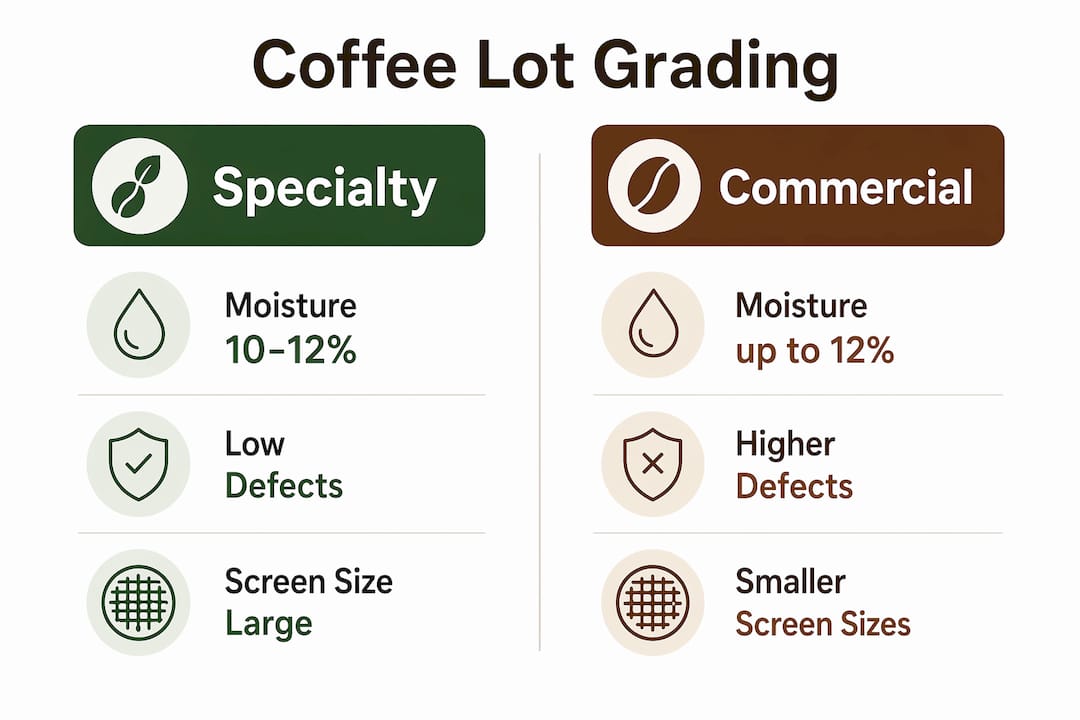
Grading is the process that translates physical reality into tradeable specifications, and it operates on three primary dimensions.
Physical specifications that define a lot:
- Moisture content: Specialty green coffee targets 10 to 12 percent moisture. Lots outside this range face rejection or price deductions.
- Defect levels: Counted per 300 gram sample, defects include full defects (black beans, sour beans, stones) and partial defects (broken beans, shells). Specialty grade allows zero category one defects.
- Screen size: Beans are sorted by screen size measured in 64ths of an inch. Screen 15 and above is typical for specialty Arabica export lots.
Physical specifications such as screen size, moisture content, and defect levels are standardized criteria used to grade coffee lots, directly affecting quality and pricing. A lot graded at screen 18 with 10.5 percent moisture and zero defects commands a fundamentally different contract price than a screen 14 lot with visible defects.
National grading systems add another layer. Ethiopia uses the ECX grading scale from Grade 1 to Grade 5. Colombia’s FNC system grades by excelso and supremo screen sizes. The Specialty Coffee Association (SCA) applies its own cupping protocol, requiring a score of 80 or above on a 100 point scale for specialty classification.
| Grading factor | Specialty standard | Commercial standard |
|---|---|---|
| Moisture content | 10 to 12% | Up to 13% |
| Category 1 defects | 0 per 300g sample | Up to 5 per 300g |
| SCA cupping score | 80 or above | Below 80 |
| Screen size (Arabica) | Screen 15 and above | Screen 13 and above |
The coffee processing method is also embedded in lot identity. A washed lot from the same farm as a natural processed lot will cup differently, carry different moisture profiles, and attract different buyers. Processing is not a footnote. It is a defining lot characteristic.
Pro Tip: Request the full lot file from your exporter or mill before signing any purchase agreement. If moisture, defect count, and screen size are missing, the lot is not properly documented and your contract has no objective anchor.
How is coffee lot size measured?
Coffee lot size varies dramatically depending on where in the supply chain you are standing.
At the farm level, a lot can be as small as a single day’s harvest from one picking block, sometimes just 20 to 50 kilograms of green coffee. These are the building blocks of what the specialty industry calls nanolots. A nanolot is typically under 100 kilograms and represents the most granular level of traceability possible, often tied to a single tree row or fermentation tank.
Micro-lot coffee refers to small, carefully selected batches segregated from the main harvest to preserve unique flavor and quality, often receiving extra attention at every processing stage. Microlots typically range from 100 kilograms to around 1,000 kilograms of green coffee. They are the specialty market’s workhorse, large enough to supply multiple roasters but small enough to maintain traceability and flavor consistency.
At the commercial export level, lots are measured in bags. The standard export bag is 60 kilograms for Arabica and 69 kilograms for Robusta. A commercial export lot typically runs from 50 bags (3,000 kg) to 320 bags (approximately 19,200 kg) depending on the origin and buyer requirements.
In futures trading, the scale shifts again. Coffee futures contracts (ICE ‘C’ contract) are standardized as 37,500 pounds, roughly equating to approximately 250 bags of 60 kilograms each. This standardization creates a common market mechanism for pricing, hedging, and speculation. Farm lots and futures lots operate in entirely different size registers, which is why a producer selling 50 bags is not directly trading on the ICE exchange but is still affected by the price signals it generates.
Lot size comparison by market segment:
- Nanolot: Under 100 kg, single block or tank origin, maximum traceability
- Microlot: 100 kg to 1,000 kg, farm or cooperative level, specialty market focus
- Commercial export lot: 50 to 320 bags (3,000 to 19,200 kg), standard trade unit
- Futures contract lot: 37,500 pounds (approximately 250 bags), exchange standardized
Why does lot identity preservation matter?
Lot identity preservation is the practice of keeping a specific batch physically and documentarily separate from other coffee throughout processing, storage, and shipping. Without segregation and labeling, micro lots can lose their traceability and pricing premium, collapsing into bulk commodity pricing regardless of their actual quality.
The risk is real and common. A cooperative that processes 50 small farmer lots together in one fermentation tank has destroyed the individual lot identities of every contributing farmer. The resulting coffee may still be good, but no single farmer can claim traceability, and no roaster can tell a specific story about it.
Systems that support traceability include ISO 22005, the international standard for traceability in the food and feed chain, and GS1 GTS (Global Traceability Standard), which provides a framework for consistent lot labeling across supply chains. Producers who implement these systems can document every step from cherry picking to export container loading.
“Specialty coffee premiums depend on the traceability and segregation of micro lots throughout the supply chain, as mixing with bulk coffee erodes the unique lot story and value.” Source
The commercial upside of preserved lot identity is significant. A traceable microlot from a named farm in Yirgacheffe, Ethiopia, processed as natural and scored at 87 points SCA, can sell for three to five times the commodity price. The same coffee, mixed into a generic “Ethiopia natural” lot, sells at a fraction of that value.
Pro Tip: Label every bag with a unique lot code at the point of harvest, not at the mill. Retroactive labeling is unreliable. A simple handwritten tag with date, block, and picker group is enough to start a traceability chain.
Microlot vs. single origin vs. blend: what’s the difference?
These three terms describe different approaches to lot sourcing, and confusing them costs producers and buyers real money.
A microlot is defined by its segregation and size. It comes from a specific, small batch with documented characteristics, often from a single farm block, fermentation tank, or drying bed. The value proposition is uniqueness and traceability.
Single origin coffee refers to coffee sourced from one country, region, or farm, but it does not specify lot size. A single origin Ethiopia can be a 10,000 bag commercial lot blended from dozens of cooperative members, or it can be a 200 bag microlot from one farmer. The term describes geographic provenance, not batch granularity.
A blend is intentionally constructed from multiple lots, often from different origins, to achieve a consistent flavor profile across seasons. Blends depend on the availability of multiple defined lots and the skill of the blender to maintain consistency when individual lots change.
| Category | Lot source | Typical size | Market use |
|---|---|---|---|
| Microlot | Single block, tank, or bed | 100 to 1,000 kg | Specialty, direct trade |
| Single origin | One country or farm | Varies widely | Specialty and commercial |
| Blend | Multiple lots, often multi-origin | Commercial scale | Espresso, retail consistency |
Coffee quality standards apply differently across these categories. Microlots are evaluated by SCA cupping protocols. Commercial single origin lots follow national grading systems. Blends are evaluated against proprietary roaster specifications.
Key takeaways
A coffee lot is the foundational unit of quality, traceability, and pricing in both specialty and commercial coffee trade.
| Point | Details |
|---|---|
| Coffee lot definition | A lot is a traceable batch defined by origin, processing, moisture, defects, and screen size. |
| Grading drives pricing | Screen size, defect count, and moisture content determine whether a lot qualifies as specialty or commercial grade. |
| Lot size varies by context | Farm nanolots start under 100 kg; ICE futures contracts standardize at 37,500 pounds per lot. |
| Identity preservation is critical | Mixing lots without segregation destroys traceability and eliminates specialty pricing premiums. |
| Microlot vs. single origin | Microlot describes batch size and segregation; single origin describes geographic provenance only. |
Why lot management is the most underrated skill in coffee production
I have seen producers with genuinely exceptional coffee sell at commodity prices because their lot management was nonexistent. The coffee was there. The story was not. And without a documented lot identity, no roaster in Berlin or Brooklyn could justify paying a premium for it.
The producers I have watched build real market value share one habit: they treat every lot as a product from the moment of harvest, not from the moment of export. That means tagging bags at the drying bed, keeping fermentation tanks dedicated to single batches, and refusing to mix even when it would be operationally easier.
Lean Startup principles applied to coffee micro-lots focus on starting small with segregated mini-batches, measuring impact, and scaling with validated processes. This is exactly right. A producer who runs three distinct 150 kg lots through different fermentation times, cups them separately, and identifies which performs best has real data. That data becomes the foundation for scaling the winning process, not guessing at it.
The uncomfortable truth is that most quality problems in coffee are actually lot management problems. A bag of coffee that cups inconsistently usually contains beans from multiple untracked sources. Consistency starts at segregation, not at the roaster.
— zachary
Explore specialty lots at Zscoffee
Zscoffee sources coffee with lot identity at the center of every selection. If you want to taste the difference that proper lot segregation and grading make, the specialty coffee collection at Zscoffee is the place to start. Each product reflects the sourcing principles covered in this article: defined origin, documented processing, and verified quality. Browse the full range at Zscoffee and find coffee that tells a real story from farm to cup.
FAQ
What is the standard definition of a coffee lot?
A coffee lot is a batch of green coffee beans grouped by shared characteristics including origin, variety, processing method, moisture content, and grading specifications, used as the primary unit in export contracts and specialty trade.
How is a coffee lot size measured?
Coffee lot size is measured in kilograms or bags at the farm and export level, with standard export bags weighing 60 kilograms for Arabica. In futures trading, the ICE ‘C’ contract standardizes lots at 37,500 pounds, approximately 250 bags.
What does coffee lot grading involve?
Coffee lot grading evaluates moisture content, defect levels per 300 gram sample, and screen size against national or SCA standards. Specialty grade requires a cupping score of 80 or above and zero category one defects.
What is the difference between a microlot and a single origin lot?
A microlot is a small, segregated batch of 100 to 1,000 kilograms defined by specific processing and traceability. Single origin describes geographic provenance and does not specify lot size or segregation level.
Why does lot identity preservation matter for pricing?
Preserved lot identity allows producers to document traceability and unique quality attributes, which specialty roasters pay premiums for. Mixing a traceable microlot into bulk coffee destroys that documentation and collapses its price to commodity level.