TL;DR:
- Coffee density measures a bean’s mass relative to its volume and influences roasting and brewing. It can be estimated at home using a scale and graduated cylinder, helping roasters make better profile adjustments. Density varies with altitude, cultivation, and processing, but it guides handling rather than quality assessment.
Coffee density is defined as the mass of a green coffee bean divided by its volume, expressed in grams per liter (g/L). This single measurement shapes how a bean absorbs heat, how a roaster builds a profile, and ultimately what ends up in your cup. Specialty coffee lots commonly fall in the 680–780 g/L range. That range is not arbitrary. It tells a roaster whether a bean needs aggressive early heat or a gentler, longer curve to develop cleanly.
What is coffee density and how is it measured?
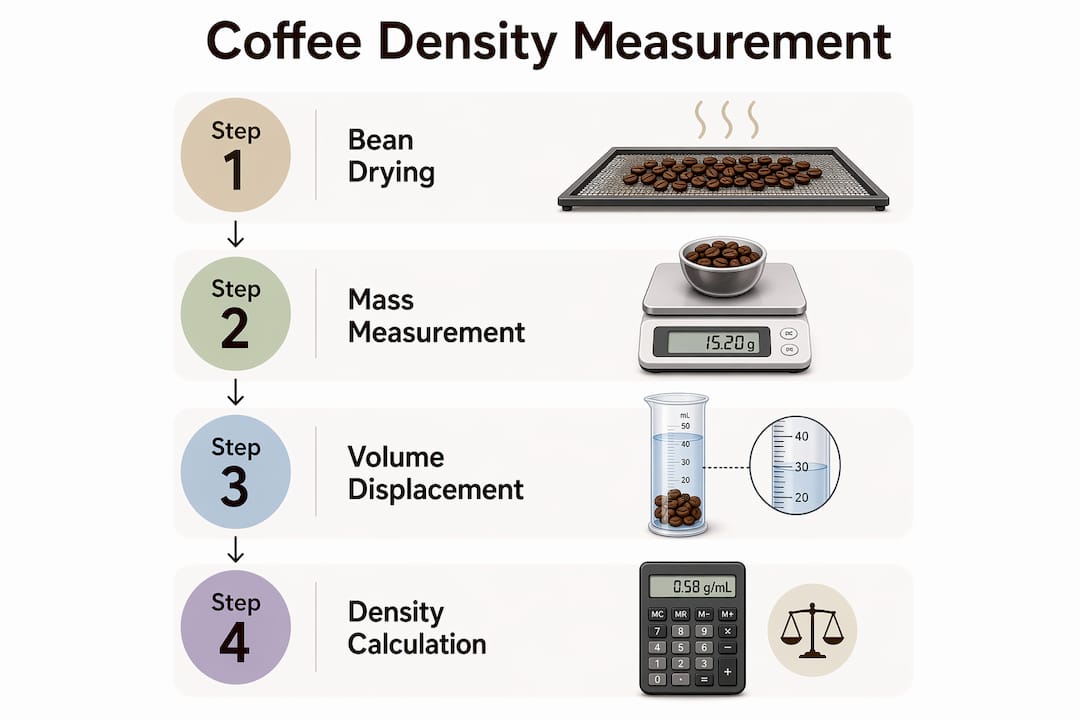
Coffee density is the ratio of a bean’s mass to its volume, calculated using a scale and a graduated cylinder. You weigh a sample of green beans, measure the volume they displace, and divide mass by volume. Professionals use displacement-based meters in lab settings for greater accuracy, but the basic method works well at home with common tools.
Step-by-step home measurement
- Weigh 100 grams of dry green coffee beans on a kitchen scale.
- Fill a graduated cylinder with a known volume of water, around 200 milliliters.
- Submerge the beans fully and record the new water level.
- Subtract the original volume from the new volume to get the beans’ displaced volume in milliliters.
- Divide 100 grams by the displaced volume in liters to get your density in g/L.
This method gives you a working estimate. It is not lab-grade, but it is accurate enough to inform roasting decisions at home.
Pro Tip: Dry your beans completely before measuring. Any surface moisture adds false weight and skews your density reading upward.
A quicker but less reliable method is visual inspection. Beans with narrow, curved center cuts tend to be higher density, while wide, straight cuts suggest lower density. This heuristic gives you a rough direction, not a number. Varietal differences and processing methods can make the same cut shape appear on beans with very different densities. Use visual cues as a starting point, not a conclusion.
What factors influence coffee bean density?
Several biological and environmental variables determine how dense a coffee bean becomes before it reaches your roaster.
- Altitude. Higher altitude coffees grow more slowly, and that slower cherry maturation produces a compact cellular structure. The bean has more time to accumulate sugars and organic compounds, packing more mass into the same volume.
- Microclimate and growing conditions. Temperature swings, rainfall patterns, and soil composition all affect how the coffee plant allocates energy. A plant under mild stress in a cool, high-altitude microclimate tends to produce denser seeds than one growing in warm, low-altitude conditions.
- Processing method. Washed coffees often measure slightly denser than natural-processed coffees from the same farm. The wet fermentation and drying process affects how tightly the bean’s cellular structure sets during drying.
- Varietals. Bourbon, Typica, and Gesha varietals each carry different baseline density tendencies. A Gesha grown at 1,800 meters will behave differently under heat than a Catimor grown at 1,200 meters, even if both look similar in the bag.
- Drying practices. Rapid mechanical drying can lock in a looser cellular structure compared to slow raised-bed drying. Two beans from the same harvest can end up with meaningfully different densities based on post-harvest handling alone.
Understanding these factors helps you predict density before you measure it. When you know a coffee comes from a high-altitude Ethiopian farm using washed processing, you can reasonably expect it to sit toward the upper end of the specialty range.
Why does coffee density matter for roasting and flavor?
Density is a thermophysical property. It determines how a bean conducts heat and how much energy a roaster must deliver to reach the same internal temperature. Denser beans have higher thermal inertia, meaning they resist temperature change and require more momentum early in the roast.
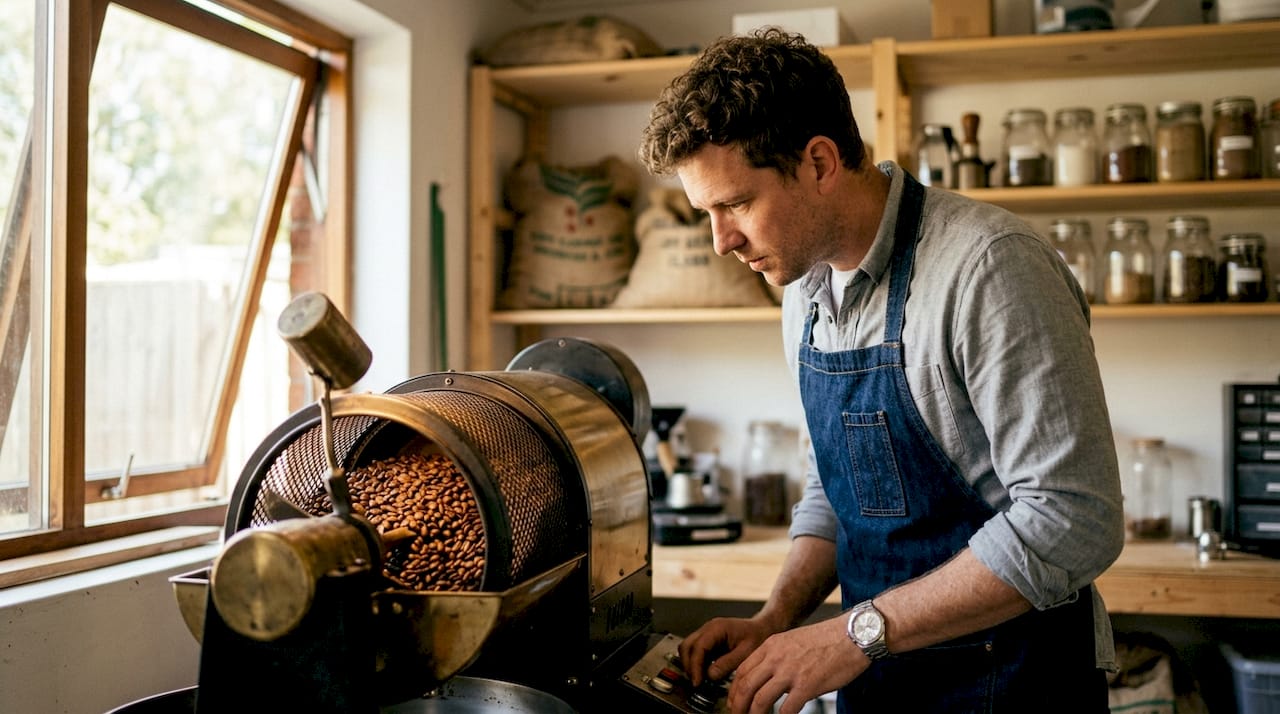
A roaster who ignores density and applies the same profile to every coffee will get inconsistent results. A high-density bean roasted with a low-energy profile will stall before first crack, producing underdeveloped, grassy flavors. A low-density bean hit with a high-energy profile will scorch on the outside before the center develops, producing harsh, ashy notes.
Practical roasting adjustments by density
| Bean density | Charge temperature | Development approach |
|---|---|---|
| High (730–780 g/L) | Higher charge temp | Build energy early; maintain momentum through first crack |
| Medium (700–730 g/L) | Moderate charge temp | Steady rate of rise; standard development time |
| Low (680–700 g/L) | Lower charge temp | Reduce early energy; watch for rapid color change |
Denser beans need more energy input for uniform roasting, and roasters adjust charge temperature and airflow accordingly. The goal is even heat penetration from the outside of the bean to its core.
Pro Tip: When roasting high-density beans, build energy momentum in the first two minutes rather than extending total roast time. A longer roast at low energy bakes the bean instead of developing it.
Density does not work alone. Moisture content, water activity, and density function as a connected system. A dense bean with high residual moisture behaves differently than a dense bean that has been stored dry for six months. Roasters who track all three variables dial in profiles faster and avoid the off-flavors that come from misreading heat dynamics. Density is a critical roasting parameter, not a quality score. A high-density bean from a poorly managed farm will still cup poorly. Density guides the roast; it does not guarantee the outcome.
How does coffee density affect grinding and brewing?
Bean density carries through to the grind. Ground coffee density increases with finer grinds because finer particles pack together with fewer air gaps between them. That tighter packing increases resistance to water flow, which directly affects extraction.
- Espresso. A high-density bean ground fine creates a puck with significant resistance. Water must push through at pressure, and extraction happens quickly. If the original bean density is high and the grind is fine, you may need to adjust dose or grind size to avoid over-extraction and bitter flavors.
- Drip and pour-over. Lower puck resistance means water flows through faster. With a low-density bean ground at the same setting as a high-density bean, you risk under-extraction and a thin, sour cup. Coarsening the grind slightly for low-density beans slows the flow and improves contact time.
- Perceived strength. Enthusiasts often describe high-density coffees as tasting “cleaner” or “more defined.” That clarity comes partly from the bean’s compact structure, which tends to produce more uniform extraction when the grind is dialed in correctly.
- Dose adjustments. Because denser beans pack more mass into the same volume, a volumetric scoop of high-density beans weighs more than the same scoop of low-density beans. Weighing your dose rather than scooping by volume removes this variable entirely.
Understanding how bean density affects brewing gives you a real diagnostic tool. When a brew tastes off, density is one of the first variables worth checking alongside grind size and water temperature.
Key takeaways
Coffee density is the single most underused variable in home roasting and brewing. Measuring it once per new lot changes how you approach every step that follows.
| Point | Details |
|---|---|
| Density defined | Coffee density is mass divided by volume, expressed in g/L, typically 680–780 g/L for specialty lots. |
| Measurement method | Use a scale and graduated cylinder at home; displacement meters give lab-grade accuracy. |
| Altitude drives density | Slower cherry maturation at high altitude produces compact cellular structures and higher density values. |
| Roasting impact | Denser beans need higher early energy input to avoid stalling before first crack. |
| Grinding and brewing | Finer grinds increase ground density and puck resistance, affecting extraction in espresso and drip methods. |
Density is a tool, not a trophy
Coffee density is one of those concepts that sounds technical until you realize it just describes a physical reality you already experience every time you roast or brew. I have seen enthusiasts obsess over sourcing high-density Ethiopian lots as if density alone guarantees a great cup. It does not. I have cupped stunning naturals from lower-altitude farms that outperformed dense washed lots from the same region. Density tells you how to handle a bean, not whether it is worth handling.
What changed my approach was treating density as part of a trio alongside moisture content and processing method. A dense, dry, washed bean is a very different roasting challenge than a dense, moist, natural. Roasters who build roast profiles around all three variables consistently produce cleaner cups than those who rely on density alone.
The visual heuristics are worth knowing, but they are shortcuts, not substitutes. A narrow, curved center cut gives you a hypothesis. A scale and graduated cylinder give you a fact. Start with the heuristic when you are sorting through a new shipment, then verify with measurement before you commit to a roast profile.
My practical advice: measure density on every new green lot you buy, record it alongside moisture and origin data, and build a personal reference log. After twenty or thirty lots, patterns emerge. You will start recognizing how a 750 g/L Ethiopian washed behaves versus a 695 g/L Colombian natural before you even load the drum.
— zachary
Specialty coffees worth exploring at Zscoffee
Zscoffee selects lots with attention to origin, processing, and the physical characteristics that shape roasting behavior. Bean density is part of that picture, and you can taste the difference it makes in the final cup.

Cold brew is one of the clearest ways to experience how bean density affects flavor clarity. Zscoffee’s cold brew coffee is crafted from lots chosen for their flavor development under extended extraction. If you want to explore a wider range of density profiles across origins and roast styles, the full coffee and tea collection at Zscoffee gives you plenty to work with. Each product reflects the kind of sourcing decisions that density data helps inform.
FAQ
What is the standard density range for specialty coffee?
Specialty coffee lots typically fall between 680 and 780 g/L. Beans above 730 g/L are generally considered high density and require more energy during roasting.
Does higher coffee density mean better quality?
No. Density is a roasting parameter, not a quality indicator. A high-density bean from a poorly managed farm will still produce a poor cup if the growing or processing conditions were substandard.
How does altitude affect coffee bean density?
Higher altitude slows cherry maturation, giving the bean more time to develop a compact cellular structure. This slower growth consistently produces denser beans with tighter cell walls compared to low-altitude lots.
Why does grind size affect ground coffee density?
Finer grinding reduces the air gaps between particles. Ground coffee density increases as grind size decreases, which raises puck resistance and slows water flow during extraction.
Can I measure coffee density at home without lab equipment?
Yes. A kitchen scale and a graduated cylinder are enough to get a working estimate. Weigh 100 grams of dry green beans, measure their displaced water volume, and divide mass by volume to get g/L.