TL;DR:
- Altitude influences coffee flavor by affecting acidity, aromatic compounds, and ripening times.
- Higher altitude does not always mean better; medium elevations can produce more balanced, nuanced cups.
- Factors like variety, processing, and terroir interact with altitude to shape the final coffee taste.
Most coffee enthusiasts operate on a simple assumption: the higher the farm, the better the cup. It’s a seductive idea, and the specialty coffee world has done little to discourage it. But altitude is not a quality dial you can simply turn up. It’s one variable in a dense web of chemistry, genetics, climate, and craft. Higher-altitude beans do carry measurable chemical differences that can translate to extraordinary flavor, but the relationship is far more nuanced than a number on a bag ever lets on. This guide pulls back the curtain on what altitude actually does, where the myths break down, and how you can use this knowledge to make smarter, more satisfying choices.
Table of Contents
- Understanding altitude’s effect on coffee chemistry
- Why higher doesn’t always mean better: Nuances and edge cases
- Altitude’s interaction with variety, processing, and terroir
- How to taste and choose altitude-driven coffees
- Why the easy shortcut—just chasing high elevation—misses the true art of flavor
- Explore altitude-distinctive coffees at Z’s Coffee
- Frequently asked questions
Key Takeaways
| Point | Details |
|---|---|
| Altitude shapes flavor | The height where coffee grows changes acids, aromatics, and complexity in the cup. |
| Optimal isn’t always higher | Medium altitudes can yield uniquely rich or balanced flavors depending on climate and variety. |
| Context is key | Variety, processing, and terroir interact with altitude—never rely on altitude alone. |
| Taste test for yourself | Explore coffees from a range of altitudes to find the profiles you enjoy most. |
Understanding altitude’s effect on coffee chemistry
At its core, altitude changes the speed of life for a coffee cherry. Cooler temperatures at higher elevations slow the ripening process, sometimes dramatically. That extended maturation window allows the bean to accumulate a richer mix of acids, aromatic compounds, and complex molecules that define specialty coffee flavor.
Specifically, citric and malic acids increase with elevation, giving high-grown beans their signature brightness. Fatty acids, which are the building blocks of aromatic volatiles, also concentrate more fully in a slowly ripened bean. Chlorogenic acids and polyphenols, which contribute to both complexity and body, tend to be higher as well. Caffeine, interestingly, often decreases as elevation rises. Understanding the coffee aroma science behind these compounds helps explain why high-altitude cups so often feel layered and alive.
Here is a simplified look at how altitude influences key compounds:
| Altitude range | Citric/malic acids | Chlorogenic acids | Caffeine | Fatty acids |
|---|---|---|---|---|
| Low (below 900m) | Low | Low | Higher | Low |
| Medium (900m to 1500m) | Moderate | Moderate to high | Moderate | Moderate |
| High (above 1500m) | High | High | Lower | High |
The flavor signals that come with these chemical shifts are real and recognizable:
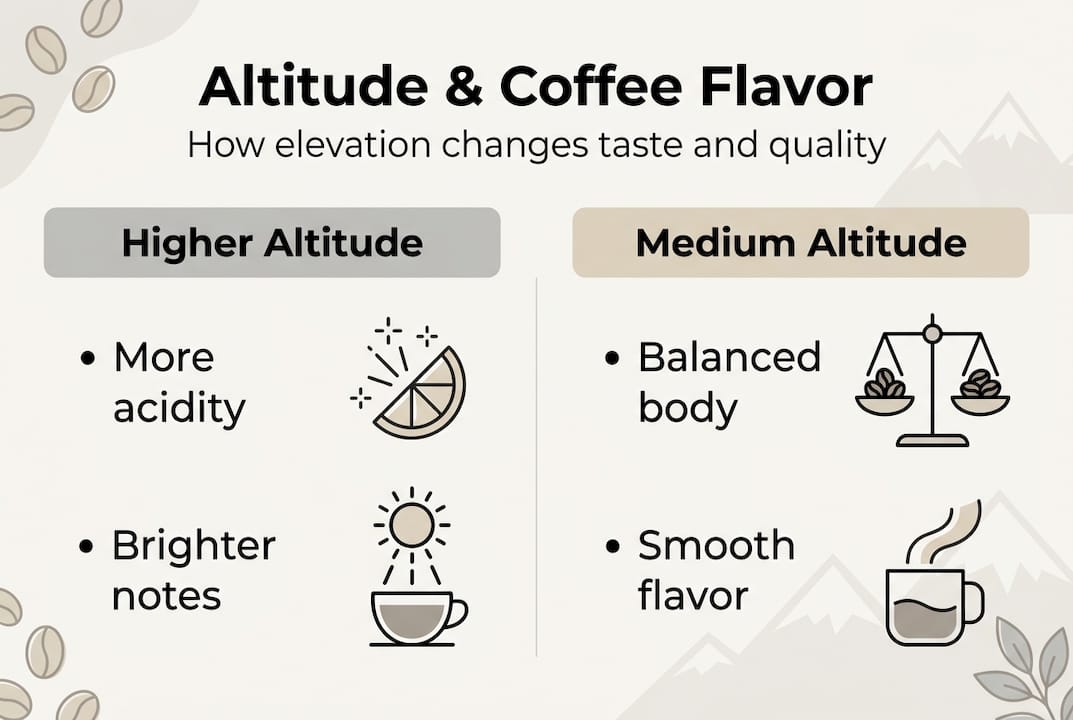
- Low altitude: Mild, soft, sometimes bland or earthy
- Medium altitude: Balanced, sweet, chocolatey or nutty with emerging complexity
- High altitude: Bright, fruity, floral, and complex with pronounced acidity
Ethiopian beans grown at around 2,065 meters consistently show some of the highest recorded phenolic concentrations and aromatic intensity of any origin, making them a benchmark for altitude-driven flavor.
But here is the catch. More complexity is not always more enjoyable. Pushed too far, elevated acidity can tip into sharpness, and certain stress compounds can create harsh, green, or astringent notes. Altitude creates opportunity, not a guarantee.

Why higher doesn’t always mean better: Nuances and edge cases
With the chemistry explained, it’s important to recognize that altitude’s effects aren’t linear. The idea that you should always seek the highest-grown coffee possible is a shortcut that regularly misleads even experienced buyers.
Research into climatic factors and coffee flavor shows that extreme altitudes above 2,000 meters can actually stress the plant to the point of producing unbalanced or harsh flavors. Meanwhile, medium-altitude farms around 1,400 meters in regions like Pu’er, China, show peak concentrations of phenolics and flavonoids, yielding cups that are remarkably nuanced without the aggressive acidity of ultra-high-grown beans.
Here is how flavor traits compare across altitude bands:
| Altitude | Typical flavor traits | Common risks |
|---|---|---|
| Below 900m | Mild, nutty, low complexity | Flat or forgettable |
| 900m to 1500m | Balanced, sweet, floral notes | Few risks when well-processed |
| Above 1500m | Bright, fruity, complex | Excessive acidity or harshness |
Some edge cases worth knowing:
- Pu’er, China (around 1,400m): Produces phenolic-rich, layered cups that rival high-altitude Ethiopian lots
- Some Yemeni farms (above 2,000m): Can veer toward astringent or intensely tannic without skilled processing
- Hawaiian Kona (around 600m to 900m): Consistently praised despite its modest elevation, owing to volcanic soil and microclimate
- Colombian mid-altitude farms: Often deliver the sweet spot between brightness and balance that many palates prefer
The “higher is always better” myth persists partly because high-altitude origin stories make great marketing. Numbers are simple. Context is hard. Checking full coffee flavor profiles alongside elevation data is far more revealing than elevation alone. And using coffee quality standards as a cross-reference gives you an even sharper lens.
Pro Tip: Before buying based on elevation, ask your roaster or retailer for the specific taste notes and processing method. Those details tell you far more than the altitude number alone.
Altitude’s interaction with variety, processing, and terroir
Once you see that high altitude isn’t everything, it’s time to look at the bigger picture. Altitude is one voice in a choir. The final sound depends on who else is singing.
Here is how the key factors stack in sequence:
- Variety: The coffee plant’s genetics set the ceiling. Some Arabica cultivars are built for high-altitude clarity. Others express their best at moderate elevations. And in some cases, caffeine content rises with altitude in specific Robusta and Arabica variants, which flips the conventional assumption entirely.
- Altitude: Temperature, UV exposure, and rainfall patterns at elevation interact with the variety to determine the pace of ripening and the accumulation of flavor compounds.
- Processing method: A washed Ethiopian at 2,000 meters will taste completely different from a natural-processed lot from the same farm. Processing methods and flavor are deeply intertwined, sometimes overpowering altitude’s influence entirely.
- Terroir: Soil composition, shade canopy, wind exposure, and even proximity to water all modify what altitude does to the bean. Two farms at identical elevations, ten miles apart, can produce wildly different cups.
Consider shade-grown coffee as a concrete example. Two farms sitting at 1,600 meters: one in full sun, one under a native forest canopy. The shaded farm’s cherries ripen even more slowly, boosting complexity in a way that pushes the altitude effect further. Varietal differences between the plants on those farms add yet another layer.
The coffee origins and terroir picture that emerges is always a product of all these forces together, never of one in isolation.
Pro Tip: When evaluating a coffee, look for bags or roaster notes that mention both altitude AND variety. If you only have one, you are working with half the story.
How to taste and choose altitude-driven coffees
Knowing that flavor is a sum of interacting factors, here’s how you can taste and select coffees empowered by altitude awareness.
Start by mapping the altitude band to your flavor preferences:
- Low altitude (below 900m): Expect mild, soft, nutty, or gently earthy flavors. Lower acidity. A good match if you prefer smooth, undemanding cups.
- Medium altitude (900m to 1,500m): Floral hints, chocolate, caramel, and balanced sweetness. The brightest sweet spot for most palates, as acids and complexity increase without overwhelming.
- High altitude (above 1,500m): Bright citrus, stone fruit, berries, jasmine, and layered complexity. Best for those who love an expressive, lively cup.
When tasting with altitude in mind, try these steps:
- Brew two coffees from different altitude bands side by side using the same method
- Taste black first, focusing on acidity, sweetness, and finish length
- Notice where the brightness starts to feel pleasant versus sharp
- Add a small amount of water to soften acidity and see if the fruity notes emerge more clearly
A well-designed coffee tasting guide walks you through the formal cupping language, which makes these comparisons far sharper over time. There are also practical techniques to enhance coffee flavor through grind size and water temperature that interact powerfully with altitude-driven acidity.
On packaging, altitude claims are worth reading but not worshiping. A farm listed at 1,800 meters with no processing or variety detail gives you little to work with. Prioritize roasters who contextualize altitude rather than just advertise it.
Pro Tip: If you have access to a local cupping event or coffee club focused on origin comparisons, attend one specifically designed around altitude variation. Tasting the difference in a controlled setting rewires your palate faster than any amount of reading.
Why the easy shortcut—just chasing high elevation—misses the true art of flavor
To close, let’s step back and consider what focusing only on elevation misses.
The specialty coffee industry sometimes packages complexity into a single number because it’s easy to market. “Grown at 2,200 meters” sounds impressive. It moves product. But after years of cupping coffees from around the world, we have found that some of the most memorable, satisfying cups come from farms nobody talks about—mid-altitude plots in unexpected regions where a thoughtful farmer, a well-matched cultivar, and careful processing aligned perfectly.
Obsessing over elevation can actually work against you. It narrows your curiosity at the exact moment you should be widening it. Cultivar selection, microclimate conditions, and processing choices can trump altitude in terms of final cup quality. Origin and quality are stories told by many chapters, not one variable.
The best approach is also the most rewarding one: stay curious, ask questions, and trust your palate over any single data point on a bag. The connoisseur who drinks with context beats the one chasing numbers every time.
Explore altitude-distinctive coffees at Z’s Coffee
Ready to taste the difference altitude makes in your cup? Putting this knowledge into practice is where it gets genuinely exciting.

At Z’s Coffee, you can explore coffees sourced from a range of origins and elevations, each with clear provenance details so you can experiment with intention. Whether you’re drawn to a high-altitude Ethiopian with electric citrus brightness or a balanced mid-altitude blend with chocolate and caramel depth, the range lets you compare and discover firsthand. For convenience without compromise, try the instant coffee blends made from quality beans that bring real origin character into every cup. Altitude awareness starts with having great coffee to taste.
Frequently asked questions
Why does high altitude coffee taste brighter?
Higher altitudes slow bean ripening, which allows citric and malic acids to accumulate more fully, producing the characteristic brightness and complexity specialty drinkers prize.
Is medium altitude ever preferable to high altitude for coffee?
Absolutely. Research shows that phenolics and flavonoids can peak at medium elevations around 1,400 meters in certain regions, creating balanced, layered cups without aggressive acidity.
How should I factor altitude when choosing coffee?
Use altitude as a starting point, but always pair it with variety and processing details. As studies confirm, flavor outcomes vary significantly depending on how these factors interact together.
Does altitude always affect caffeine content?
Not always. While caffeine generally decreases as elevation rises, some Arabica and Robusta variants show the opposite trend, making variety just as important as elevation when predicting caffeine levels.
Recommended
- Why coffee origin matters for flavor and quality in 2026 – Z’s Coffee
- How coffee varietals shape flavor and brewing methods – Z’s Coffee
- How to taste coffee properly: a guide to richer flavor – Z’s Coffee
- How to enhance coffee flavor: brew, beans & tips – Z’s Coffee
- How Coffee Farms Define Flavor: Practices That Impact Quality – Adira Coffee US