TL;DR:
- Manual brewing involves preparing coffee by hand without automation, offering full control over variables like water temperature, grind size, and contact time. It emphasizes understanding extraction through methods such as immersion and percolation, with beginner-friendly techniques like French press and AeroPress providing forgiving entry points. Starting simply with a grinder, a chosen method, and precise measurements enhances the sensory awareness and appreciation of coffee flavors.
Manual brewing is one of those things people assume is complicated before they ever try it. The reality is the opposite: manual brewing means preparing coffee by hand, without electricity or automatic machines, giving you direct control over every variable that shapes what ends up in your cup. No black box. No pre-programmed settings. Just you, water, coffee, and the technique you choose. For anyone serious about understanding why their coffee tastes the way it does, manual brewing is the most direct path to real answers.
Table of Contents
- Key Takeaways
- What is manual brewing, and why it matters
- Popular manual brewing techniques and devices
- Manual vs. automatic brewing
- How to get started with manual brewing at home
- My honest take on manual brewing
- Explore Zscoffee for your manual brewing journey
- FAQ
Key Takeaways
| Point | Details |
|---|---|
| Manual brewing defined | Preparing coffee by hand using devices like pour-over, French press, or AeroPress without automatic machines. |
| Control is the core benefit | You adjust water temperature, grind size, brew ratio, and contact time to dial in your exact flavor. |
| Two extraction types | Immersion and percolation methods produce noticeably different textures, clarity, and taste profiles. |
| Beginner-friendly starting point | Immersion methods like French press are more forgiving, making them ideal for new manual brewers. |
| Tracking beats guessing | Recording variables each brew is the fastest way to identify what works and repeat it. |
What is manual brewing, and why it matters
Manual brewing is both science and art. It requires patience and attention to detail, but the payoff is a cup you understand at every level. To brew manually, you control the five variables that determine extraction quality: water temperature, grind size, brew ratio, contact time, and agitation.
Here is what each one actually does:
- Water temperature: Hotter water extracts faster and pulls more bitter compounds. Most hot-brew methods land between 92°C and 96°C for a reason.
- Grind size: Finer grinds expose more surface area, speeding up extraction. Coarser grinds slow it down. Every method has a sweet spot.
- Brew ratio: The weight of coffee to water determines strength. A ratio around 1:15 to 1:18 by weight covers most manual methods.
- Contact time: How long water and coffee stay together. French press runs 10 to 15 minutes. AeroPress can be done in 30 seconds to 2 minutes.
- Agitation: Stirring or swirling changes how evenly water contacts the grounds, affecting consistency and strength.
Understanding these variables is what separates manual brewing from simply pouring hot water on coffee. You are not guessing. You are making deliberate choices.
Immersion vs. percolation
The two foundational extraction methods behind all manual brewing are immersion and percolation. Knowing the difference changes how you read every brewing recipe you encounter.
Immersion brewing submerges coffee grounds in water for a set period before separating them. French press and AeroPress are immersion methods. Because the grounds are fully saturated throughout the steep, extraction tends to be more even and forgiving. Immersion also has a natural self-limiting quality: as extraction slows due to the concentration gradient, over-extraction becomes harder to trigger accidentally.
Percolation brewing sends fresh water through a bed of grounds continuously. Pour-over methods fall into this category. Because the water is always fresh, extraction keeps moving until the pour stops. That makes percolation more sensitive to grind size and flow rate but capable of producing cleaner, brighter cups.
Pro Tip: If you are new to manual brewing, start with an immersion method. The self-limiting extraction makes it significantly harder to ruin a cup while you are still learning.
Popular manual brewing techniques and devices
Every manual brewing method has a distinct personality. Learning what each one does well helps you choose the right tool for the flavor you are chasing.
Pour-over
Pour-over is percolation brewing at its most deliberate. You pour hot water over grounds in a filter-lined dripper, controlling the flow rate by adjusting your pour speed and pattern. Devices like the Hario V60 and Chemex are the most recognized names in this category.
Pour-over methods demand careful grind calibration and a controlled pour for best extraction. The reward is clarity. The filter removes oils and fine particles, producing a clean, nuanced cup that highlights origin character and delicate flavor notes. If you are brewing a single-origin bean with floral or fruit notes, pour-over is often the method that lets those qualities speak loudest.
French press
French press is the entry point for millions of manual brewers. You steep coarsely ground coffee in hot water for around four minutes, then push the metal plunger down to separate the grounds. No paper filter means the coffee oils stay in the cup, producing the thick, full-bodied texture that immersion brewing is known for.
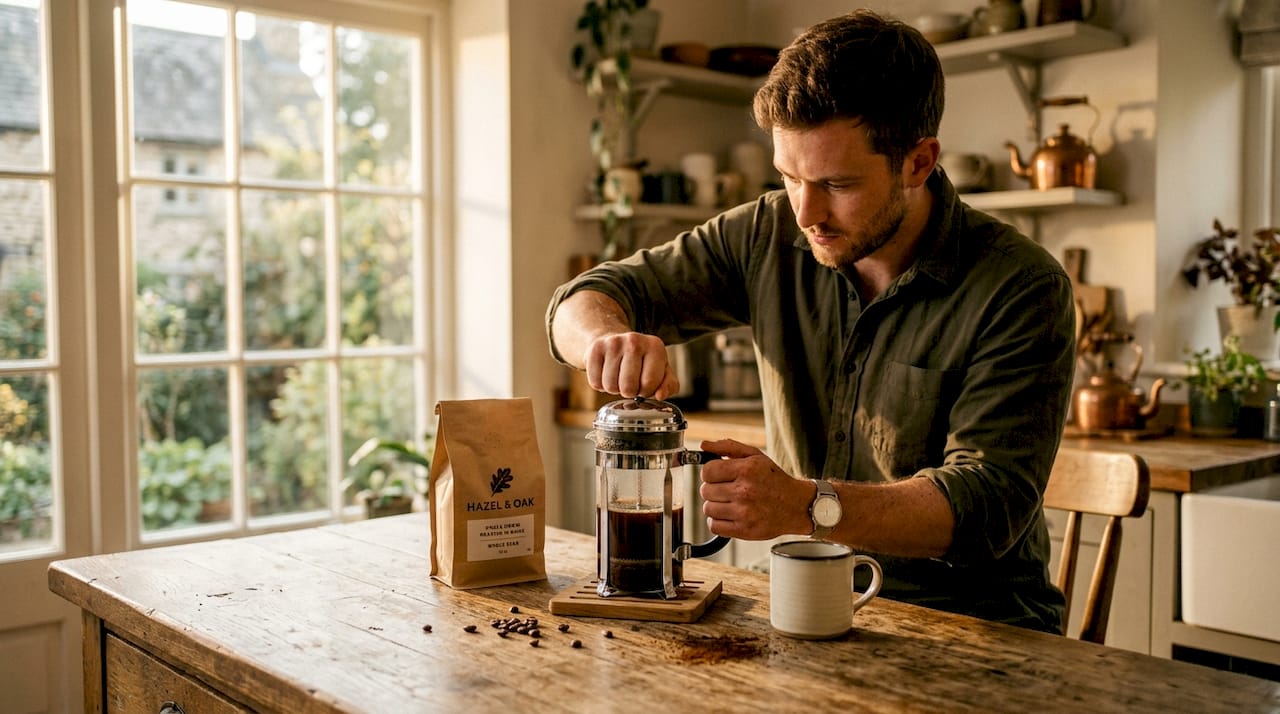
The trade-off is clarity. French press cups have sediment, and the body is heavier than filtered methods. That is not a flaw. For drinkers who want a rich, textured cup from a dark or medium roast, French press delivers every time.
AeroPress
AeroPress is the most flexible device in manual brewing. It combines immersion steeping with a short pressure push through a filter. That dual action produces a concentrated, smooth cup with low acidity. Brew time ranges from 30 seconds to 2 minutes depending on your recipe. You can brew it like an espresso-style concentrate, or dilute it for a longer drink.
The AeroPress inverted method, where you flip the device upside down during steeping, gives you even more control over contact time. It is a small, lightweight device that travels well, which makes it a genuine daily-use tool rather than just a kitchen novelty.
Cold brew
Cold brew is immersion taken to its extreme. You steep very coarsely ground coffee in cold water for 12 to 24 hours, then filter the concentrate. The result is smooth, low-acid coffee with a rich, rounded sweetness. For a full guide to the process, cold brew at home covers the technique in detail.
Other methods worth knowing
Siphon brewing uses vapor pressure to pull water through grounds, producing a theatrical brew with a clean, tea-like body. Cowboy coffee, the simplest method of all, involves boiling grounds directly in water and letting them settle. Both demonstrate the range that manual brewing covers.
Manual vs. automatic brewing
This is not a debate about which is better. It is a question of what you want from your daily cup.
| Factor | Manual brewing | Automatic brewing |
|---|---|---|
| Control | Full control over all variables | Pre-set or limited adjustment |
| Repeatability | Depends on skill and consistency | High, once programmed correctly |
| Flavor range | Broad, customizable | Narrower, consistent within setting |
| Learning curve | Moderate to high | Low |
| Equipment cost | Low to moderate | Moderate to high |
| Convenience | Lower, requires active attention | High, push-button operation |
Manual brewing introduces variability through human input, which is both its strength and its challenge. You can tune every brew in real time. You can also have an off morning and produce an uneven cup. Automatic machines trade flexibility for consistency. They perform the same way every time, which is exactly what busy mornings or high-volume settings demand.
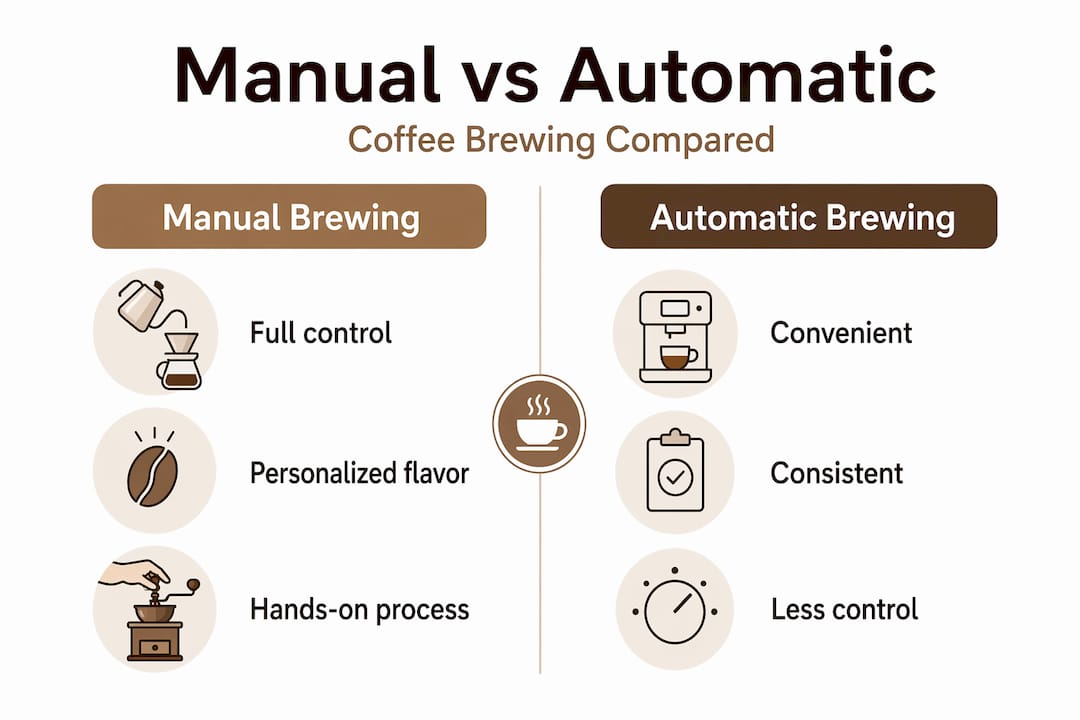
Where manual brewing clearly wins is in flavor exploration and understanding. When you change one variable and taste the difference, you learn something that no machine can teach you. For enthusiasts who want to understand coffee extraction at a deeper level, manual methods are the classroom.
Pro Tip: Do not try to replicate automatic coffee with manual methods. They are different tools. Use automatic when consistency matters most, and manual when you want to explore or dial in a specific flavor.
How to get started with manual brewing at home
The barrier to entry is lower than most people expect. You do not need a full setup on day one. You need a method, a grinder, and basic measuring tools.
- Choose one method and own it. Pick a French press or AeroPress to start. Learn it thoroughly before adding other devices. Chasing multiple methods at once fragments your learning.
- Get a burr grinder. Grind consistency affects extraction more than almost any other variable. A decent burr grinder will improve your cups immediately.
- Weigh your coffee and water. Eyeballing leads to inconsistency. A simple kitchen scale removes one variable from the equation and makes every brew reproducible.
- Use filtered water at the right temperature. Tap water chemistry affects flavor. Aim for around 93°C to 95°C for most hot brew methods. An electric kettle with temperature control makes this easy.
- Time your brew. Use your phone timer. Contact time is a variable you control, so track it.
- Change one thing at a time. If you adjust grind size and brew ratio simultaneously, you will not know which change made the difference. Isolate your variables.
- Write it down. A simple note with grind setting, ratio, temperature, and time lets you build on what works instead of starting over each session.
For a broader walkthrough of home brewing fundamentals, the step-by-step home brewing guide at Zscoffee covers the process from start to finish.
The most common beginner mistakes are using pre-ground coffee, skipping measurement, and changing too many variables at once. Avoid those three and your learning curve shortens dramatically.
My honest take on manual brewing
I will be direct: I think most people underestimate how much manual brewing changes your relationship with coffee. Not because it makes better coffee automatically, but because it forces you to pay attention. After years of experimenting with different methods, the biggest shift was not in my cups. It was in how I tasted them.
When you know you adjusted the grind finer this morning, you taste for the difference. When you extended the steep by 30 seconds, you notice what changed. That feedback loop builds a kind of sensory fluency that passive drinking never develops.
My advice is to resist the urge to perfect your technique too early. The messy middle period, where your pours are uneven and your timing is inconsistent, teaches you more than any recipe. I spent three months convinced my Hario V60 was broken before I realized the problem was my pour speed. That frustration was the lesson.
And I would push back on the idea that manual brewing is for slow mornings only. I brew manually on weekday mornings in under eight minutes. Once the variables are dialed in, speed comes naturally. The ritual does not have to be slow to be intentional.
— zachary
Explore Zscoffee for your manual brewing journey

Whether you are pulling your first pour-over or refining a cold brew recipe you have been tweaking for months, having the right beans matters as much as the technique. At Zscoffee, the coffee and tea collection includes options suited to every manual brewing method, from light roasts built for pour-over clarity to fuller-bodied options that shine in a French press. If you brew on the go, the travel mug with handle keeps your manual-brewed cup at the right temperature wherever your morning takes you. Great brewing starts with great coffee. Find yours at Zscoffee.
FAQ
What is manual brewing in coffee?
Manual brewing means preparing coffee by hand using devices like pour-over drippers, French press, or AeroPress, without relying on automatic machines or electricity. It gives the brewer direct control over water temperature, grind size, contact time, and brew ratio.
Why choose manual brewing over a coffee machine?
Manual brewing offers far more control over extraction variables, allowing you to customize flavor, body, and strength to your preference. Automatic machines prioritize repeatability and convenience but limit how much you can adjust.
What is the easiest manual brewing method for beginners?
Immersion methods like French press or AeroPress are the most beginner-friendly because their self-limiting extraction makes over-extraction harder to trigger by accident.
How long does manual brewing take?
Brew time varies widely by method. AeroPress takes 30 seconds to 2 minutes, pour-over typically runs 3 to 4 minutes, French press takes around 4 minutes of steeping, and cold brew requires 12 to 24 hours.
Do I need expensive equipment to start manual brewing?
No. A French press and a decent burr grinder are enough to start, and both are available at modest price points. A kitchen scale and a temperature-controlled kettle are the next useful additions, but neither is required on day one.