TL;DR:
- Artisan coffee’s flavor depends on factors like terroir, varietal, processing, roasting, and freshness, which shape each cup uniquely. Unlike commercial coffee, artisan beans emphasize traceability, small batches, tailored roast profiles, and quick shipping to preserve delicate aromas. Recognizing these elements and tasting side by side helps consumers select high-quality, transparent beans that reveal their true character.
Artisan coffee beans taste different because of six compounding factors: where they were grown (terroir and altitude), which varietal was planted, how the farm processed the cherry, how carefully the lot was sorted and dried, how the roaster adapted the heat curve to that specific batch, and how fresh the beans are when you brew them. Each driver shapes the cup independently, and they multiply each other’s effects.
Here is what each driver changes:
- Terroir and altitude determine the bean’s base flavor potential — higher elevations typically produce denser beans with brighter acidity and more complex sugars.
- Varietal sets the genetic flavor ceiling — SL28 tends toward blackcurrant and citrus; Bourbon leans to red fruit and caramel; Typica often shows delicate florals.
- Farm processing (washed, natural, honey) controls how much fruit contact and fermentation the bean undergoes, directly shaping sweetness, body, and aromatic character.
- Post-harvest handling (sorting, drying method, defect removal) preserves or destroys the delicate flavor precursors a roaster later tries to highlight.
- Roast philosophy decides whether those precursors become bright fruit notes or get burned into generic bitterness.
- Freshness determines whether the volatile aromatics that survived roasting are still in the bag when you open it.
The sections below walk through each driver in detail, then give you a practical protocol for tasting and buying.
Table of Contents
- What “artisan” actually means in coffee
- 1. How origin and varietal set the flavor ceiling
- 2. How farm processing shapes what ends up in your cup
- 3. Why artisan roasting techniques produce different results
- 4. Why freshness matters more for artisan beans
- 5. What artisan beans actually taste like compared to commercial ones
- 6. How to taste and evaluate artisan beans at home
- 7. What to look for when buying artisan beans
- 8. Why traceability and direct trade actually change what’s in your cup
- Key Takeaways
- The case for paying attention to the whole chain
- Zscoffee sources the details so you do not have to guess
- Useful sources and further reading
What “artisan” actually means in coffee
The word gets slapped on everything from gas-station blends to $40 single-origin lots, so a working definition matters. Artisan coffee is not primarily about price or exclusivity. It is about intentionality: every decision from farm selection to roast profile exists to highlight what a specific bean can taste like, not to hit a cost target or guarantee a uniform product across millions of bags.
Commercial coffee operates on the opposite logic. The goal is consistency at scale: a blend that tastes the same whether the beans came from Brazil, Vietnam, or Colombia, roasted fast enough to move volume. Darker roast profiles mask lot-to-lot variability, which is genuinely useful when you are sourcing from dozens of origins simultaneously. Artisan roasters, by contrast, treat variability as information. A denser lot from a high-altitude farm in Ethiopia is not a problem to be corrected; it is a starting point for a different roast curve.
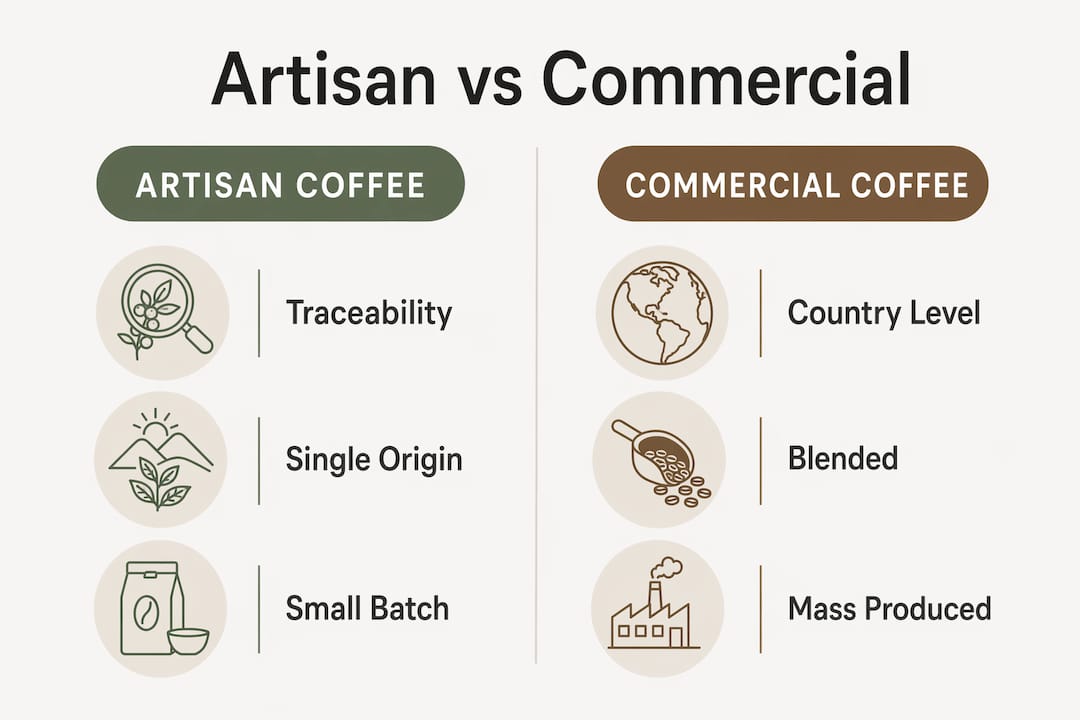
| Dimension | Artisan coffee | Commercial coffee |
|---|---|---|
| Traceability | Farm or cooperative level | Country or blend level |
| Batch size | Small (often under 25 lbs) | Large (hundreds to thousands of lbs) |
| Roast philosophy | Tailored to lot’s density and origin | Standardized curve for uniformity |
| Freshness expectation | Days to a few weeks post-roast | Weeks to months on shelf |
| Sourcing transparency | Named farm, process, harvest season | Generic origin or blend description |
The core artisan principles, stripped to their essentials: single-origin or single-lot focus, small-batch roasting, roast profiles designed to reveal origin character rather than mask it, and sourcing transparent enough that you can trace the coffee back to a cooperative or farm.
1. How origin and varietal set the flavor ceiling
Terroir is the starting point for why artisan beans differ from one another, even before a roaster touches them. Soil mineral content, altitude, microclimate, and harvest timing all shape the sugars, organic acids, and aromatic precursors that develop inside the cherry as it ripens. A coffee’s terroir creates the raw flavor matrix that roasting either preserves or overrides.
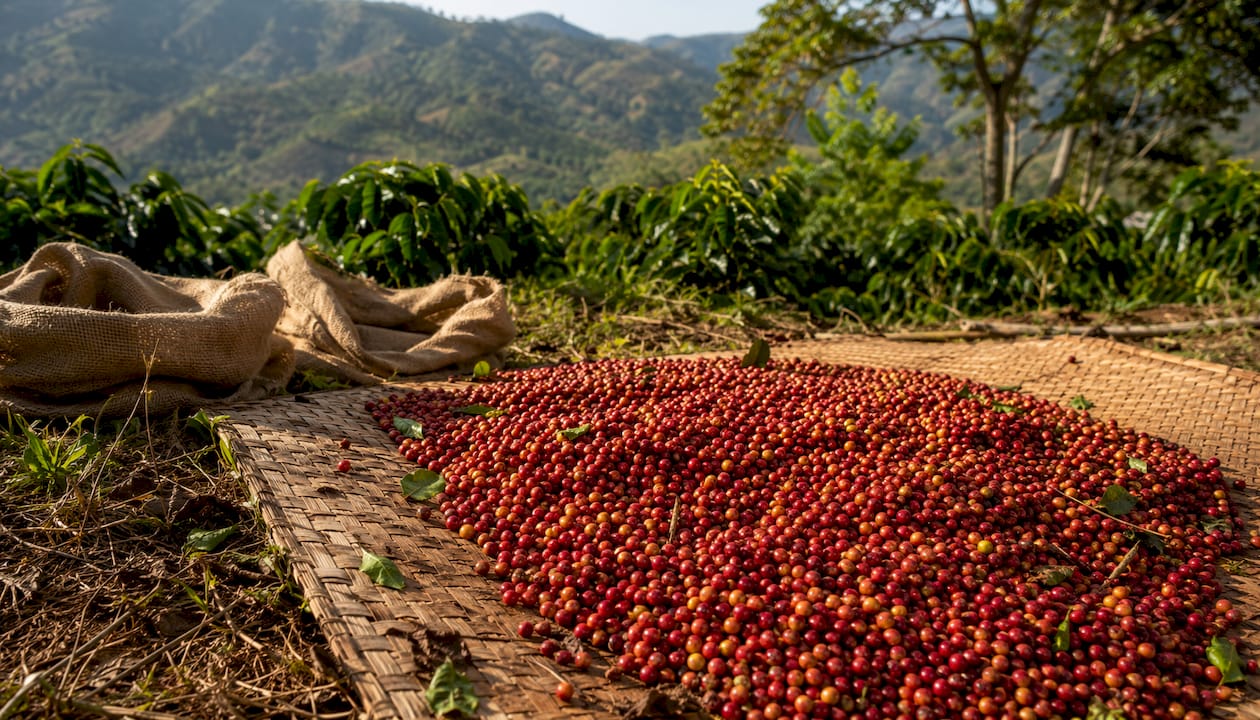
Altitude is the most reliable single predictor of cup character. Higher elevations mean cooler temperatures, slower cherry development, and denser beans packed with more complex sugars and malic and citric acids. Farms above 1,800 meters in Ethiopia’s Yirgacheffe region or Kenya’s Central Province consistently produce beans with a brightness and aromatic complexity that lower-altitude lots from the same country rarely match. The density difference is physical: a denser bean requires more heat energy to develop, which is one reason roasters must adjust their curves lot by lot.
Varietal genetics layer on top of terroir. SL28, developed in Kenya, tends toward blackcurrant and citrus even when grown outside Kenya. Bourbon, one of the oldest Arabica mutations, leans to red fruit and caramel sweetness. Typica, the genetic ancestor of many modern varietals, often shows delicate florals and a clean, tea-like finish. Caturra, a natural Bourbon mutation, is more compact and tends to produce a brighter, lighter-bodied cup. None of these are guarantees — a poorly processed Bourbon from a low-altitude farm will not taste like a well-processed one from 1,900 meters — but varietal sets the genetic ceiling for what the bean can express.
Pro Tip: When you receive a new lot, hold a few beans up to light and compare them for size and color uniformity. Significant variation in size within a single bag often signals mixed-lot sourcing or inconsistent sorting, both of which make it harder to dial in a consistent grind and extraction.
2. How farm processing shapes what ends up in your cup
Processing is where the farm’s decisions become flavor. Every processing method changes how long the bean stays in contact with the coffee cherry’s fruit, how much fermentation occurs, and how the bean dries — all of which alter the sugars, acids, and aromatic compounds that survive into the roasted bean.
The sensory mapping is fairly predictable:
- Washed (wet-processed): The cherry skin and fruit are removed before drying. Result: cleaner cup, brighter acidity, and more transparent origin character. The bean’s intrinsic flavors dominate.
- Natural (dry-processed): The whole cherry dries around the bean for weeks. Result: heavier body, pronounced fruit esters (blueberry, strawberry, tropical notes), and sometimes a wine-like ferment quality.
- Honey-processed: Skin removed, but varying amounts of fruit mucilage left on the bean during drying. Result: a middle path — more sweetness and body than washed, cleaner than natural, with a syrupy mouthfeel.
- Controlled fermentation: Extended or anaerobic fermentation tanks introduce novel esters and lactic or acetic acids. Result: complex, sometimes polarizing flavors — passionfruit, cinnamon, kombucha-like notes — that are highly lot-specific.
Beyond the processing method itself, post-harvest handling matters enormously. Small-lot attention to sorting, raised drying beds versus patio drying, and rigorous defect removal preserves the delicate flavor precursors that a roaster later tries to highlight. A natural-processed lot dried on raised African beds with daily turning will taste cleaner and more complex than one dried on concrete patios with minimal attention, even if both carry the same “natural” label.
When you read a bag description, look for this kind of detail: “Washed, raised-bed dried, 72-hour fermentation, harvested January–February.” That specificity tells you the farm tracked what it was doing. Vague lot notes (“natural process, Africa”) tell you almost nothing.
3. Why artisan roasting techniques produce different results
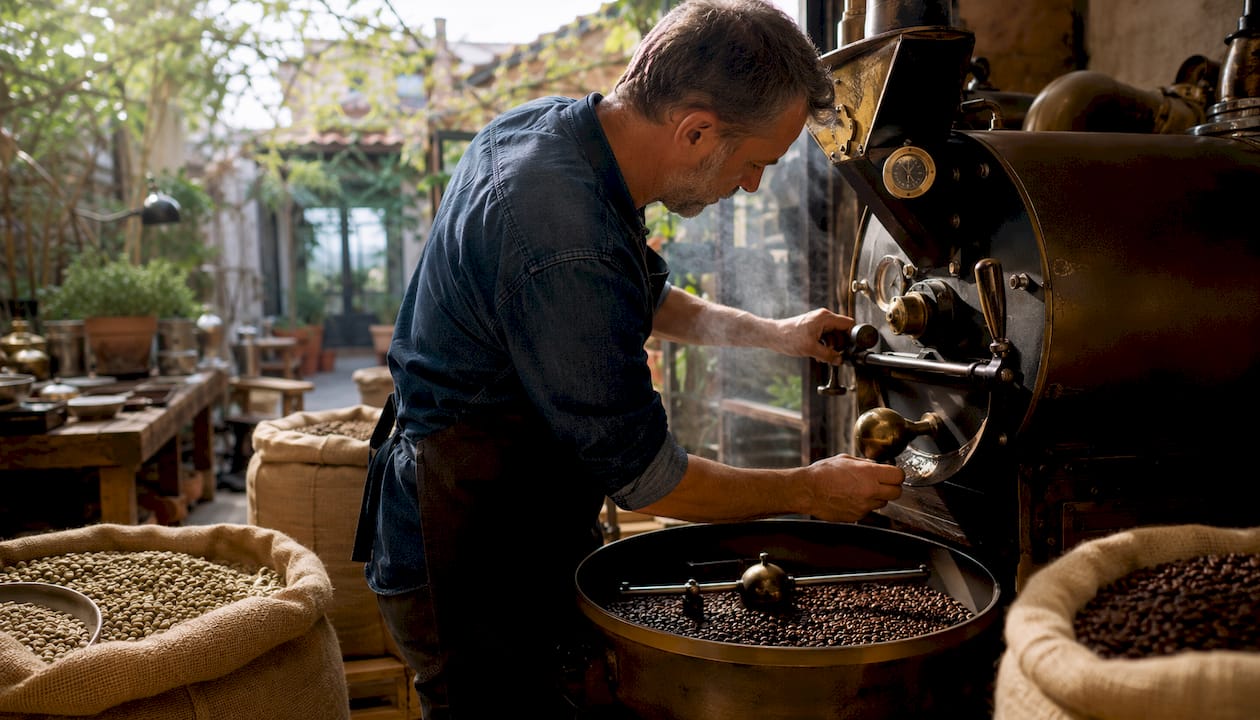
Artisan roasting is reactive. Roasters adjust temperature, airflow, and drum speed in real time based on how a specific batch is behaving — its density, moisture content, and origin characteristics. Industrial roasting runs predefined curves for uniformity. Those two philosophies lead to fundamentally different sensory endpoints.
The chemistry is worth understanding at a basic level. During roasting, beans pass through several thermal stages. The Maillard reaction (roughly 150–200°C) generates hundreds of flavor and aroma compounds — the caramel, nutty, and toasty notes that form the base of most roasted coffee flavor. First crack, the audible pop when steam pressure ruptures the bean’s cell walls, marks the beginning of the development phase. What happens after first crack is where artisan and industrial roasting diverge most sharply.
Development time ratio (D%) is the percentage of total roast time that falls after first crack. A higher D% generally pushes toward more roasty, bitter, and uniform flavor. A lower D% preserves more of the origin-specific acids and aromatic compounds. Artisan roasters targeting a light or medium roast for a high-quality Ethiopian lot might aim for a D% in the 20–25% range, carefully managing heat to avoid scorching while allowing enough development for sweetness. Artisanal roasts typically run 10.5–15 minutes, compared to roughly 7 minutes for commercial roasts — that extra time at lower temperatures is what allows more nuanced flavor development without burning off the volatile aromatics.
Batch size compounds everything. A small 10-pound batch behaves differently from a 100-pound batch in the same drum: heat capacity changes, airflow dynamics shift, and the roaster’s ability to make fine adjustments matters more. Small batches give artisan roasters the control to respond to a denser-than-expected lot without the momentum of a massive charge working against them.
Pro Tip: If a roaster publishes their roast curve data or development time percentage, that transparency is a strong signal of intentional practice. A roaster who tracks D% and shares it is one who has thought carefully about what the bean needs, not just what the timer says.
Roast time as a quality signal: Artisan roasting generally runs longer than commercial roasting. The slower ramp rate preserves volatile aromatic compounds that faster, hotter roasts destroy before they can reach your cup.
4. Why freshness matters more for artisan beans
Artisan beans perform best in a narrower freshness window than most people expect. Artisan roasters frequently ship coffee within days of the roast date specifically to capture peak aromatic volatile compounds — the same compounds that make a light-roasted Ethiopian smell like bergamot and jasmine. Those volatiles degrade over weeks, not months.
The freshness timeline looks like this:
- Day 0–2 post-roast: Beans are actively degassing CO₂. Brewing too early produces uneven extraction and a grassy, underdeveloped cup.
- Day 3–10: The sweet spot for most light and medium roasts. CO₂ has largely escaped, volatiles are at peak concentration, and the cup shows maximum clarity and aroma.
- Day 11–21: Still good, especially for medium-dark roasts. Lighter roasts begin to lose their brightest high notes.
- Day 21+: Oxidation accelerates. Oils go stale, acidity flattens, and the cup loses the complexity that made the lot worth buying.
For storage at home:
- Use an airtight container with a one-way CO₂ valve, stored at room temperature away from light and heat.
- Buy in quantities you can finish within two to three weeks of opening.
- Avoid the freezer unless you are storing an unopened, vacuum-sealed bag for more than a month — repeated freeze-thaw cycles introduce moisture.
- Never store beans in a clear container on a counter near a window or stove.
The red flag to watch for at retail: a vacuum-sealed tin with no roast date. Vacuum sealing extends shelf life, which is useful, but it also lets roasters hide how old the beans are. A dated bag that shows a roast date within the past two weeks is a better sign than an undated tin with impressive packaging. Most grocery-store beans were roasted weeks or months before you pick them up.
5. What artisan beans actually taste like compared to commercial ones
Artisan beans, when sourced and roasted well, show clearer origin notes, more nuanced sweetness, and layered aromas that shift as the cup cools. That is not marketing language; it is a direct result of the lower-D%, slower-ramp roasting that preserves volatile aromatics and the careful processing that built them in the first place.
Acidity in artisan coffee is not sourness. A well-roasted Ethiopian Yirgacheffe might show a bright, almost citrus-like acidity that feels clean and refreshing, similar to biting into a ripe nectarine. A commercial dark roast from the same origin would likely show almost no acidity — the organic acids have been driven off — and instead lead with bitterness and a flat, roasty body. Sweetness in artisan beans tends to be more specific: caramel in a Bourbon, brown sugar in a honey-processed Colombian, dried cherry in a natural Ethiopian. Commercial blends often taste generically sweet or not sweet at all.
Body and aftertaste are where processing shows up most clearly. A natural-processed lot will coat the palate differently than a washed one from the same farm. The aftertaste of a quality artisan roast lingers with something identifiable — fruit, chocolate, florals — rather than just fading into generic bitterness.
Quick home cupping checklist:
- Aroma (dry): What do you smell before adding water? Fruit, florals, nuts, chocolate?
- Aroma (wet): After pouring hot water, does the aroma intensify or shift?
- Acidity: Is there a brightness? Where does it sit — front of the palate, sides?
- Sweetness: Does it arrive without sugar? Is it caramel, fruit, or brown sugar?
- Body: How does the liquid feel — thin and tea-like, or full and syrupy?
- Aftertaste: What lingers after you swallow, and for how long?
6. How to taste and evaluate artisan beans at home
The goal of a home cupping session is to isolate the bean’s identity rather than your brewing skill. Controlling variables tightly is what makes the comparison meaningful.
- Dose: Use 10 grams of coffee per 170 ml of water (roughly a 1:17 ratio). Keep this constant across every lot you compare.
- Grind: Medium-coarse, consistent with a burr grinder. Blade grinders introduce too much size variation to produce reliable results.
- Water temperature: 200°F (93°C). Water that is too hot over-extracts; too cool under-extracts. Both obscure origin character.
- Bloom: Pour twice the weight of the coffee in water (20 ml for a 10-gram dose) and wait 30 seconds. This releases CO₂ and primes even extraction.
- Pour: Add remaining water in a slow, steady spiral. Total brew time for a pour-over should land between 3:00 and 3:30 minutes.
- Rest: Let the cup cool for 2–3 minutes before tasting. Many volatile aromatics are more perceptible at 140–160°F than at scalding temperatures.
- Taste and record: Use the checklist from the previous section. Write down your observations immediately — flavor memory fades fast.
Tasting scorecard (1–5 scale):
Pro Tip: Run two lots side by side using identical parameters. The contrast between a washed Kenyan and a natural Ethiopian, brewed back-to-back at the same dose and temperature, makes the processing differences unmistakable in a way that tasting each in isolation never does.
7. What to look for when buying artisan beans
A bag label is a quality signal before you ever open it. Here is what to check:
Green flags:
- Roast date printed on the bag (not a “best by” date)
- Named farm or cooperative, not just a country
- Processing method listed (washed, natural, honey, anaerobic)
- Varietal named (Bourbon, SL28, Typica, Gesha, etc.)
- Cupping notes that are specific (bergamot, red apple, brown sugar) rather than generic (“smooth,” “rich”)
- Roast level described in terms of development, not just “dark” or “light”
Red flags:
- No roast date anywhere on the packaging
- Origin listed only as a country or continent
- “Blend” with no component origins named
- Tasting notes that could describe any coffee (“bold,” “smooth,” “full-bodied”)
- Vacuum-sealed with no date — freshness is being hidden, not guaranteed
On price: higher cost in artisan coffee usually pays for smaller-lot sourcing, direct-trade premiums that reach farmers, more labor-intensive processing, and the roaster’s time spent dialing in a profile for a single lot rather than a standardized blend. That is not always worth it for every cup, but understanding what you are paying for helps you evaluate whether a specific roaster’s premium is justified. The transparency signals on a bag — farm name, process, harvest date, roast date — are the clearest indicators that the premium reflects real supply-chain decisions rather than just premium packaging.
Artisan coffee is not merely exclusivity or price; it emphasizes intentionality so consumers can trace coffee back to a cooperative or farm. That traceability is the practical test of whether a “artisan” label means anything.
8. Why traceability and direct trade actually change what’s in your cup
Traceability is not just an ethical talking point. It changes the flavor in your cup through a direct mechanism: when a roaster has a named relationship with a specific farm or cooperative, that farm has an incentive to sort more carefully, dry more consistently, and communicate about processing decisions. Small-lot attention to sorting and drying reduces defects and preserves the delicate flavor precursors that roasting later highlights.
The practical difference shows up in cup clarity. A lot sourced through a commodity broker might contain beans from dozens of farms across a region, processed inconsistently, with defects that survived sorting. A direct-trade lot from a single cooperative, where the roaster visited the farm and communicated specific quality requirements, tends to arrive with fewer defects and more consistent density. That consistency means the roaster can dial in a profile that works across the whole bag rather than averaging across a wide range of bean behaviors.
Intentional transparency — naming cooperatives, farms, processing days, and roast dates — signals a roaster oriented toward quality and repeatable sourcing rather than commodity blending. That is the connection between the ethical and the sensory: better relationships produce better information, and better information produces better roasting decisions.
The exclusivity myth applies here too, across craft beverage categories: limited-release or small-lot products are not inherently better because they are rare. They are better when the scarcity reflects genuine quality constraints — a small harvest from a high-altitude farm, a varietal that does not scale, a processing method that requires intensive labor. Rarity without traceability is just marketing.
Pro Tip: Ask your roaster — or check their website — for three specific pieces of information: the farm or cooperative name, the harvest season, and the processing method. A roaster who can answer all three without hesitation has a real supply-chain relationship. One who can only tell you the country of origin is sourcing from a broker.
Key Takeaways
Artisan beans differ because of compounding decisions made at every stage from farm to cup — terroir and varietal set the potential, processing and handling shape the precursors, roasting either preserves or destroys them, and freshness determines what survives to your brew.
| Point | Details |
|---|---|
| Origin and varietal are the foundation | Altitude, soil, and genetics set the flavor ceiling before any roasting decision is made. |
| Processing method predicts sensory character | Washed = clarity and acidity; natural = fruit and body; honey = balanced sweetness. |
| Artisan roasts run longer for a reason | Roast times of 10.5–15 minutes versus roughly 7 minutes for commercial roasts preserve volatile aromatics. |
| Freshness window is narrow | Most artisan beans peak between days 3 and 10 post-roast; store airtight and buy in small quantities. |
| Zscoffee curates small-lot artisan beans | Zscoffee publishes roast dates and origin information so you can apply the buyer checklist directly at checkout. |
The case for paying attention to the whole chain
Most coffee writing focuses on roasting or brewing as the primary quality lever. That framing undersells what happens before the beans reach a roaster. A mediocre lot, however skillfully roasted, will not produce a great cup. The roaster’s job is to reveal what is already there — and if what is there is a commodity blend with inconsistent density, mixed varietals, and poor post-harvest handling, no heat curve fixes that.
The more useful mental model is to think of artisan coffee as a chain where every link has to hold. Terroir and varietal set the potential. Processing and drying either preserve or squander it. Roasting either highlights or masks what survived. Freshness determines whether the volatile compounds that made it through roasting are still present when you brew. And your brewing parameters determine whether you extract those compounds efficiently or leave them in the grounds.
What this means practically: the buyer checklist in this article is not pedantry. Checking for a roast date, a named farm, and a specific processing method is how you verify that the chain held at every link before you paid for it. A bag that cannot tell you where the coffee came from or when it was roasted is asking you to trust a chain you cannot inspect.
The home cupping protocol is the other half of that. Tasting two lots side by side, with controlled variables, is how you build the sensory vocabulary to recognize when a chain held and when it did not. That skill compounds over time in a way that reading about coffee never quite replicates.
Zscoffee sources the details so you do not have to guess
Knowing why artisan beans differ is one thing. Finding beans where every link in that chain is actually documented is another.
Zscoffee curates small-lot artisan coffee with roast dates and origin information published at the product level, so you can apply the buyer checklist from this article before you add anything to your cart. No hunting for a harvest season buried in fine print. If you want a ready-to-drink option that skips the brewing variables entirely, the cold brew is sourced with the same transparency standards. For home brewers who want to work through the tasting protocol above, browse the full selection at zscoffee.shop and filter by origin and process. The roast date is on every bag.
Useful sources and further reading
The claims in this article draw on the following sources. Each is worth reading in full if you want to go deeper on a specific driver.
-
What Is Artisan Coffee and Why Does It Matter? — Tempest Artisan Coffee Bar: Covers the working definition of artisan coffee, the freshness-window argument, and the traceability-as-quality-signal framework. Useful starting point for the definition and freshness sections.
-
Artisan and Industrial Coffee, What Are the Differences? — Caffè Ernani: Explains reactive roasting practice, batch-level density adjustments, and why industrial curves prioritize uniformity over origin expression. The source for the roasting deep-dive.
-
The Chemical and Attitudinal Differences Between Commercial and Artisanal Products — npj Science of Food: Peer-reviewed analysis of pre-production, production, and post-production differences between artisanal and commercial food products. The source for the 10.5–15 minute versus 7-minute roast time comparison.
-
Artisan Coffee Defined: What Makes Coffee Truly Artisan? — The Dough and Bean: Focuses on farm-level traceability, small-lot sourcing, and how post-harvest sorting affects cup quality. Supports the processing and EEAT sections.
-
Single-Origin Coffee: Taste, Quality, and Story — Zscoffee: Zscoffee’s own deep dive into how single-origin sourcing shapes flavor and why lot-level traceability matters for home brewers.
-
Coffee Terroir: How Environment Shapes Every Cup — Zscoffee: Detailed look at soil, altitude, and microclimate effects on flavor development. Pairs directly with the origin and varietal section above.
-
Coffee Processing Methods for Better Flavor Clarity — Zscoffee: Practical descriptions of washed, natural, and honey processes with sensory notes. The companion read for the processing section.
-
Why Transparency Matters in Coffee: A Consumer Guide — Zscoffee: Covers the labeling signals buyers should look for and how to evaluate a roaster’s sourcing claims. Directly supports the buyer checklist.
-
How to Choose Coffee Beans for the Best Home Brew — Zscoffee: Buyer-focused guidance that expands on the checklist and helps readers match bean characteristics to their preferred brew method.